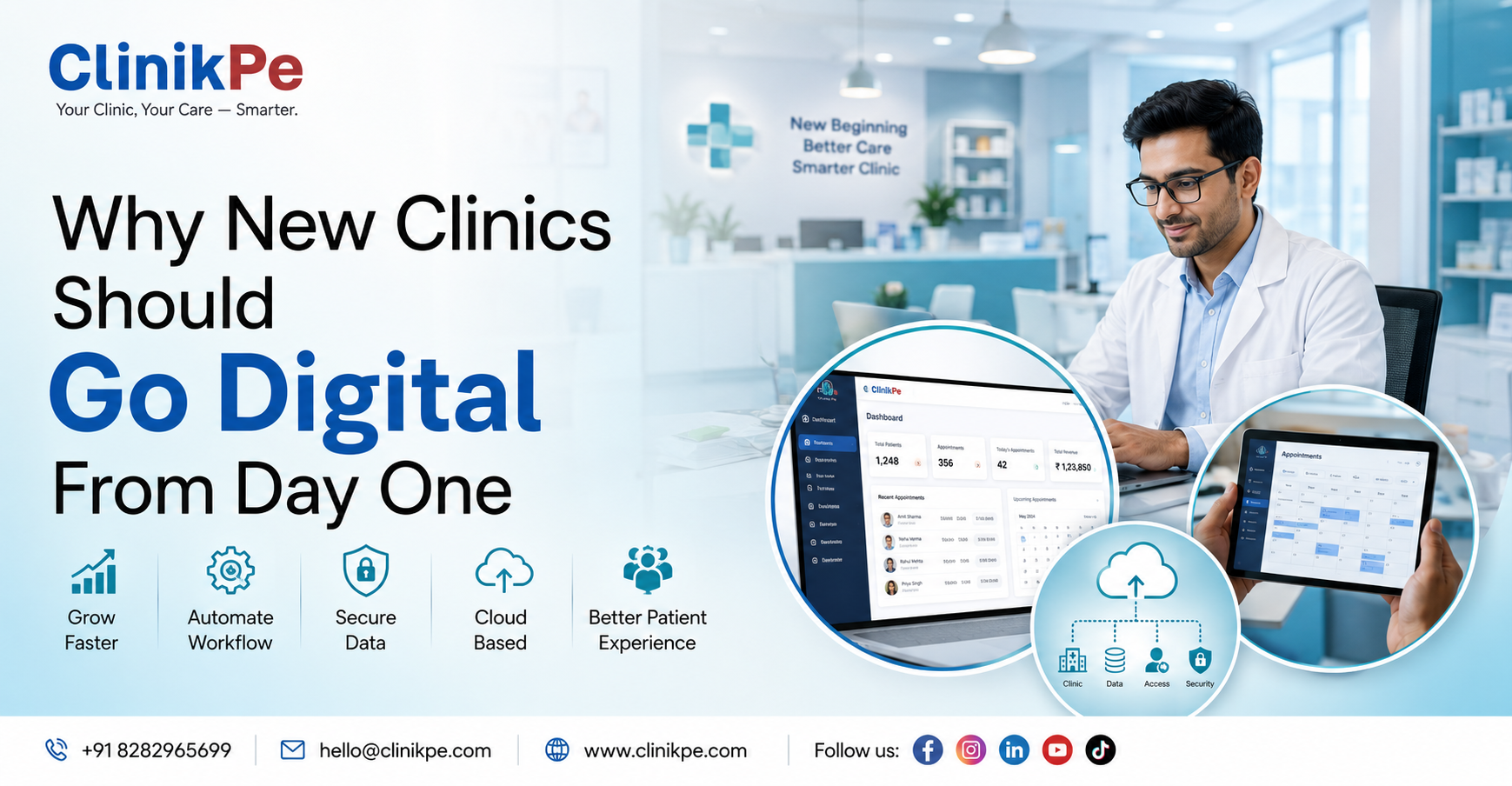
Starting a new clinic involves managing several operational tasks, including patient registration, appointment scheduling, prescriptions, billing, and record keeping. Many new clinics in India initially manage these processes using manual registers and paper-based systems because they appear simple and inexpensive.
However, as patient volumes grow, manual processes can quickly become difficult to manage. Maintaining patient records, tracking appointments, and handling billing manually often creates administrative workload and operational inefficiencies. Clinics that adopt digital clinic management systems from the beginning are better positioned to manage patient data, streamline workflows, and scale their operations smoothly.
Digital systems allow clinics to centralize patient records, automate appointment scheduling, generate prescriptions, and maintain organized documentation. By implementing digital tools early, clinics can avoid operational challenges that often arise when transitioning from manual systems later.
In this article, we explore why adopting digital clinic management systems from day one can help new clinics operate more efficiently and prepare for long-term growth.
The Problem Explained:
Many clinics begin with manual systems because they seem easier to implement during the early stages of operations.
Typical manual workflows include:-
- Patient registration in paper registers
- Appointment booking through phone calls or notebooks
- Handwritten prescriptions
- Manual billing records
- Physical storage of patient files
While these systems may work initially, they often become inefficient as patient numbers increase.
Common operational problems include:-
- Difficulty retrieving patient records
- Appointment scheduling conflicts
- Billing errors
- Longer patient waiting times
- Difficulty maintaining patient history
When clinics eventually decide to adopt digital systems, migrating from paper records can become time-consuming.
Why This Happens in Indian Labs/Clinics:
Several factors lead new clinics to start with manual systems.
Lower initial cost perception
Many clinic owners assume that digital systems require significant upfront investment.
Familiarity with traditional workflows
Doctors and clinic staff may be accustomed to paper-based processes.
Uncertainty about future patient volumes
Some clinics initially expect lower patient numbers and delay adopting digital systems.
Limited awareness of digital clinic tools
Many clinic owners are not fully aware of the operational benefits of clinic management software.
However, as clinics grow, manual systems often become difficult to scale.
Practical Solutions:
New clinics can improve operational efficiency by adopting digital workflows from the beginning.
1. Implement digital patient registration
Digital registration systems allow clinics to store patient records in a centralized database.
2. Use appointment scheduling systems
Digital appointment systems help clinics manage patient visits efficiently.
3. Maintain digital prescriptions
Electronic prescriptions help maintain an organized patient medical history.
4. Automate billing processes
Digital billing systems reduce manual errors and simplify payment tracking.
5. Maintain centralized clinic data
Centralized systems allow clinic owners to monitor operations and patient volume more easily.
Technology’s Role:
Digital clinic management systems help clinics streamline administrative workflows and maintain organized patient records.
A Clinic Management System typically includes features such as:
- Patient registration and records
- Appointment scheduling
- Digital prescriptions
- Billing management
- Patient visit history
- Operational analytics
These systems help clinics improve efficiency while maintaining consistent documentation. Digital platforms also allow clinic owners to access patient data quickly and monitor clinic performance.
You can [Explore our Clinic Management System] to see how digital systems support clinic operations. You may also want to read [Manual vs Digital Clinic Management] to understand the operational differences between manual and digital workflows.
Implementation Tips:
New clinics can implement digital systems smoothly by following a structured approach.
Implementation Checklist
✔ Implement digital patient registration from the beginning
✔ Use appointment scheduling systems for consultations
✔ Maintain digital prescriptions and patient history
✔ Integrate billing with patient management systems
✔ Train staff on digital workflows
✔ Maintain secure patient data storage
✔ Use scalable clinic management software
These steps help clinics establish efficient workflows from the start. If you’re evaluating clinic management tools, you can also [View Clinic Software Pricing].
Final Takeaway
Adopting digital systems from day one can significantly improve operational efficiency for new clinics. Manual systems may appear simple initially, but they often create challenges as patient volumes grow.
By implementing digital clinic management systems early, clinics can streamline administrative workflows, maintain organized patient records, and scale operations more easily. As healthcare services continue to digitize across India, clinics that adopt digital infrastructure early are better positioned for long-term growth.
Explore our Clinic Management System
FAQ Section
Digital systems help clinics manage patient records, appointments, and billing more efficiently from the start.
Many modern clinic management systems operate on affordable subscription models suitable for small clinics.
Yes. Digital systems help small clinics organize workflows and manage patient data more efficiently.
Typical features include patient registration, appointment scheduling, digital prescriptions, and billing management.
Most modern systems are designed for easy setup and can be implemented with minimal training.