Quick answer
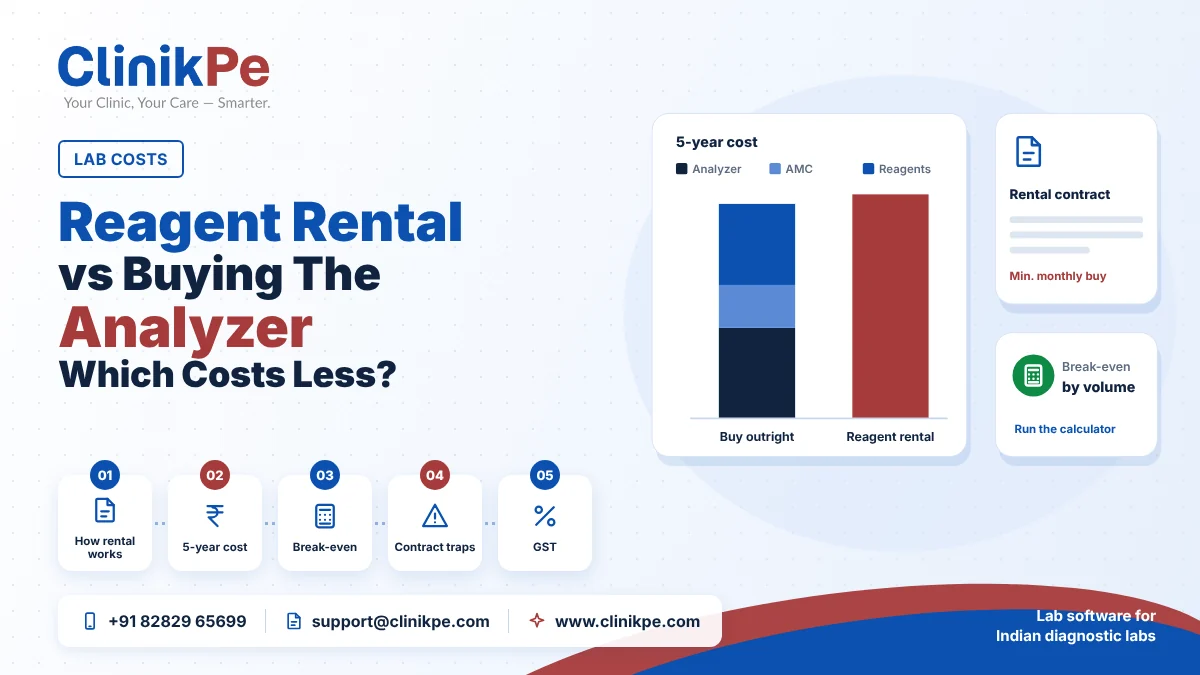
Under reagent rental, a supplier places an analyzer in your lab and you commit to buying its reagents, usually at a higher price per test, for 3 to 5 years. You save the upfront cost but pay more per test, and minimum purchase clauses can charge you for reagent you don’t use. At higher volumes buying usually costs less over five years. Run both quotes through the calculator.
Key takeaways
- Rental trades upfront cost for a higher reagent price and a 3–5 year lock-in.
- Minimum purchase clauses can charge you for reagent you don’t use.
- Government tenders show the terms to ask for: fixed prices, uptime penalties, no minimum.
- At higher volumes, buying usually costs less over five years.
- Reagents and analyzers are at 5% GST; rulings differ on GST for placed machines.
How reagent rental works
Under reagent rental (also called reagent placement or a cost-per-reportable-test deal), a supplier installs an analyzer in your lab without you buying it. In return you buy the supplier’s reagents, usually at a higher price per test, for a fixed period, often 3 to 5 years. The supplier keeps ownership, and usually maintains the analyzer.
Two versions are common:
- Reagent rental: you commit to a minimum reagent purchase each month or year. If you buy less, the supplier can charge for the shortfall.
- Cost per reportable test (CPRT): you pay a fixed price for each reported test, covering reagents, calibrators, controls, repeats and service. Government tenders often use this.
What good contracts look like: lessons from government tenders
Government hospitals have strong buying power, and their tenders show what to ask for:
| Term | What tenders specify | Source |
|---|---|---|
| Ownership | Analyzer remains the supplier’s property | AIIMS Bhubaneswar, 2025 |
| Uptime | 95% uptime, with a penalty for each extra day down | AIIMS Bhubaneswar, AIIMS Raipur |
| Breakdowns | Supplier pays for tests sent to an outside lab while the analyzer is down | AIIMS Raipur |
| Price | Fixed for the contract period | AIIMS Bhubaneswar, RIMS Ranchi |
| Minimum volume | No guaranteed minimum quantity | AIIMS Bhubaneswar, AIIMS Raipur |
| What’s included | Controls, calibrators and repeats in the per-test price; free reagents for failed runs | AIIMS Bhubaneswar, AIIMS Raipur |
Private labs usually see tougher terms: a minimum purchase commitment, shortfall charges, sometimes a non-refundable deposit, and the analyzer going back at the end. Negotiate towards the government-style terms above.
Run your numbers
5-year cost: buy vs reagent rental
Example values are illustrative for a compact fully automatic chemistry analyzer. Use the quotes you’ve been given.
If you buy
If you rent
Buy: total
₹40.3 lakh
Rental: total
₹46.8 lakh
Difference
Buying saves ₹6.5 lakh
Buying starts to win above roughly 3,300 tests a month.
With the example values, buying costs about ₹40 lakh over five years against about ₹47 lakh on rental. At 6,000 tests a month the rental premium on each test adds up. At lower volumes rental can win, especially if you’d struggle to find ₹6 lakh up front, but watch the minimum purchase: below it you pay for reagent you don’t use.
Pros and cons
| Buy outright | Reagent rental | |
|---|---|---|
| Upfront cash | High (analyzer price) | Little or none |
| Cost per test | Lower; you can shop for reagents if the system is open | Higher; locked to one supplier |
| Service | AMC after warranty, at your cost | Usually included |
| Flexibility | Yours to keep, sell or replace | Locked in for 3–5 years |
| Volume risk | None | Shortfall charges if you buy less than the minimum |
| Upgrades | Your decision and cost | Sometimes negotiable at renewal |
GST and tax points
- Rates now: diagnostic reagents (HSN 3822) and analyzers (HSN 9027) attract 5% GST from 22 September 2025, down from 12% and 18%.
- Is the “free” analyzer taxed? Rulings differ by state. A Karnataka advance ruling (Randox, 2019) found no GST on the placed machine where there was no deposit, but GST on the machine where a non-refundable deposit was paid. A Kerala appellate ruling (Abbott, 2022) held that a “free” placement is still a supply, with the purchase commitment as consideration. Advance rulings bind only the applicant.
- Shortfall charges were treated as a separate taxable service in the Randox ruling.
- Because patient tests are GST-exempt, your lab can’t claim back GST paid on reagents or equipment; see our guide to GST on pathology labs.
Checklist before you sign a rental contract
- Is the price per test fixed for the full term, and what’s included (controls, calibrators, repeats)?
- What is the minimum purchase, and what happens if you fall short?
- Is there a deposit, and is it refundable?
- What uptime is guaranteed, and what’s the penalty or backup if the analyzer is down?
- Who pays for service, parts and engineer visits?
- Can you exit early, and on what terms?
- What happens at the end of the term: return, buy-out or renewal?
- Will the analyzer connect to your lab software?
Frequently asked questions
Reagent rental is an arrangement where a supplier installs an analyzer in your lab without you buying it, and you commit to buying their reagents, usually at a higher per-test price, for a fixed term of 3 to 5 years. The supplier keeps ownership and usually services the analyzer.
It depends on volume. Rental saves the upfront cost, but the higher reagent price per test adds up. At high volumes buying usually costs less over five years; at low volumes rental can be cheaper, unless a minimum purchase commitment makes you pay for reagent you don’t use.
CPRT is a contract where the lab pays a fixed price for each reported test, covering reagents, calibrators, controls, repeats and the analyzer’s service. Government tenders such as AIIMS Raipur use CPRT with uptime guarantees and penalties.
Check the fixed price and what it includes, the minimum purchase and shortfall charges, any deposit, uptime guarantees and penalties, who pays for service, early exit terms, what happens at the end of the term, and whether the analyzer can be interfaced with your software.
Rulings differ. A Karnataka advance ruling (Randox, 2019) found no GST on the machine without a deposit but GST where a non-refundable deposit was paid, while a Kerala appellate ruling (Abbott, 2022) treated free placement as a taxable supply. Reagents and analyzers are now at 5% GST.
The supplier. The lab uses it for the contract term and normally returns it at the end, unless a buy-out is agreed.
Know your real test volumes before you sign
See monthly test counts by analyzer in ClinikPe, so you can negotiate rental terms on real numbers.
No setup, migration or training fees · Free trial on cloud plans
Sources
- AIIMS Bhubaneswar reagent rental tender (2025)
- AIIMS Raipur CPRT tender (2023)
- RIMS Ranchi reagent rental memo (2024)
- Karnataka AAR: Randox Laboratories (2019)
- Kerala AAAR: Abbott Healthcare (2022)
- GST rate cuts on diagnostics, September 2025
- Reagent rental pros and cons (Clinical Lab Products)
Written by the ClinikPe lab operations team in Kolkata. General information, not legal, tax or medical advice; check the sources and your state rules before acting.