Quick answer
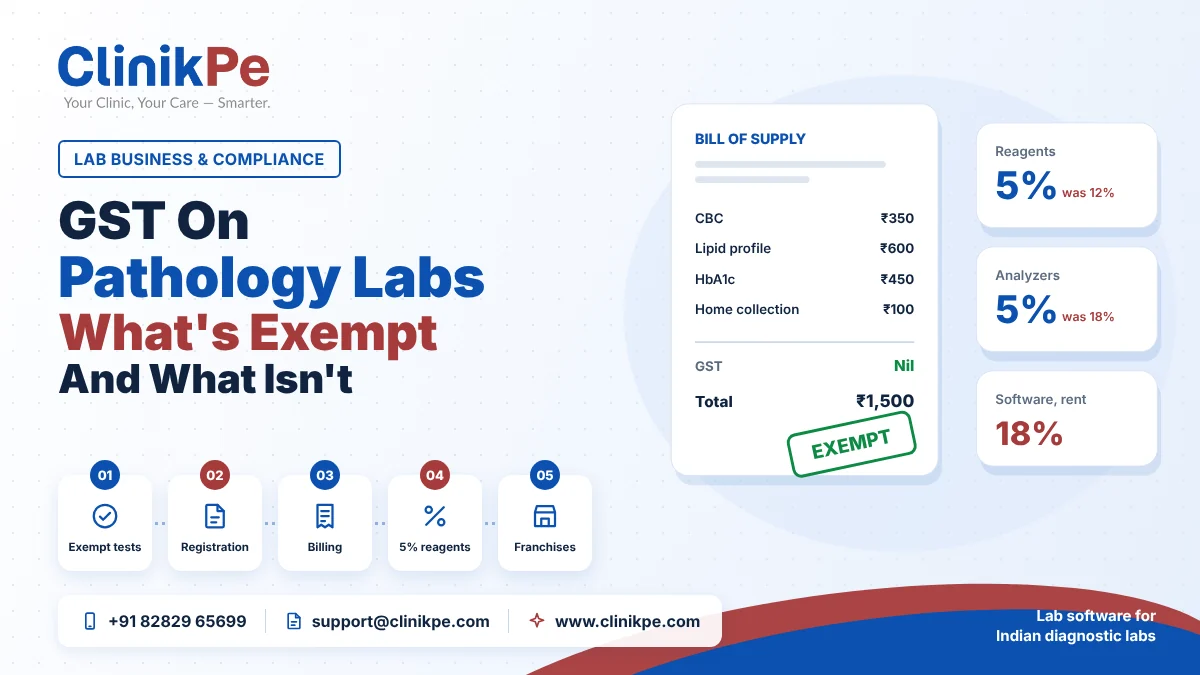
Diagnostic tests for patients are exempt from GST as health care services by a clinical establishment (entry 74, Notification 12/2017). A lab with only exempt income doesn’t need GST registration. Side income, such as reagent sales, rent, collection commission and franchise fees, is taxable. Since September 2025, reagents and analyzers attract 5% GST, but labs can’t claim that back.
Key takeaways
- Patient diagnostic tests are GST-exempt, including tests outsourced by hospitals and corporate check-ups.
- A lab earning only exempt income doesn’t need GST registration.
- Any taxable income, such as rent, reagent sales or commission, can trigger registration above ₹20 lakh aggregate turnover.
- Reagents and analyzers dropped to 5% GST from 22 September 2025.
- Exempt labs can’t claim input tax credit, so GST on purchases is a cost.
Are pathology lab tests exempt from GST?
Yes. Diagnostic tests for patients are exempt. Entry 74 of Notification 12/2017-Central Tax (Rate) exempts “health care services by a clinical establishment, an authorised medical practitioner or para-medics”. Two definitions in that notification decide whether a lab qualifies:
- Clinical establishment includes any place set up “to carry out diagnostic or investigative services of diseases”. A standalone pathology lab or collection-and-processing lab fits this.
- Health care services means “any service by way of diagnosis or treatment or care for illness, injury, deformity, abnormality or pregnancy” in a recognised system of medicine. Cosmetic procedures are excluded.
Advance rulings in Kerala (Medivision Scan & Diagnostic Research Centre, 2019) and Karnataka (Matrix Imaging Solutions, 2019) applied this to pathology, biochemistry, microbiology and radiology tests.
The September 2025 GST rate changes (“GST 2.0”) didn’t touch this exemption. They cut the GST on goods labs buy, covered below.
What’s exempt and what isn’t: quick checker
Most of a lab’s income is exempt. The exceptions are income that isn’t diagnosis of a patient. Pick a situation:
Exempt
Health care services by a clinical establishment, which includes a diagnostic lab, are exempt under entry 74 of Notification 12/2017-Central Tax (Rate). Kerala and Karnataka advance rulings confirm pathology and radiology tests are covered.
General guidance as of October 2026, not tax advice. Advance rulings bind only the business that asked for them.
| Income | GST |
|---|---|
| Diagnostic tests for patients (walk-in or referred) | Exempt |
| Tests outsourced to you by a hospital or clinic | Exempt |
| Tests you process for another lab | Likely exempt |
| Corporate or pre-employment health check-ups | Exempt |
| Home sample collection charges | Likely exempt |
| Tests for research studies, not patient diagnosis | Taxable, 18% |
| Non-medical tests such as ancestry or legal paternity | Likely taxable, 18% |
| Commission or revenue share you earn as a collection centre | Taxable, 18% |
| Franchise or brand fee you pay to a lab brand | Taxable, 18% |
| Selling reagents or consumables | Taxable, 5% |
| Renting out space, for example to a pharmacy | Taxable, 18% |
Does a pathology lab need GST registration?
Not if every rupee you earn is exempt. Section 23(1)(a) of the CGST Act says a person “engaged exclusively” in exempt supplies doesn’t need to register, whatever the turnover. The Medivision ruling applied this to a diagnostic centre.
It changes the moment you have any taxable income: reagent sales, rent from a pharmacy, collection commission or franchise income. Then you must register once your aggregate turnover crosses ₹20 lakh (₹10 lakh in special category states), and aggregate turnover counts your exempt test income too.
Example: a lab with ₹1 crore of test income and ₹50,000 of rent from a pharmacy counter must register, because its aggregate turnover is well over ₹20 lakh and it has a taxable supply.
How to bill patients: receipt, bill of supply or tax invoice
- Unregistered lab with only exempt tests: issue a normal bill or receipt. Don’t show GST or a GSTIN, and never charge GST.
- Registered lab: issue a bill of supply for exempt tests (Section 31(3)(c) and Rule 49). It shows your GSTIN, a serial number, date, description and value, but no tax.
- Taxable items (reagent sales, rent) need a proper tax invoice with GST.
Lab software should handle this for you: patient bills without tax by default, and correct numbering if you’re registered.
GST you pay on reagents, analyzers and software (after September 2025)
Because tests are exempt, a lab can’t claim input tax credit (Section 17(2) of the CGST Act). The GST you pay on purchases is a real cost, so the September 2025 rate cuts matter.
| What you buy | HSN | Before 22 Sep 2025 | Now |
|---|---|---|---|
| Diagnostic kits and reagents | 3822 | 12% | 5% |
| Analyzers (instruments for physical or chemical analysis, medical use) | 9027 | 18% | 5% |
| Medical instruments and appliances | 9018 | 12% | 5% |
| X-ray equipment | 9022 | 12% | 5% |
| Examination gloves | 4015 | 12% | 5% |
| Lab glassware | 7017 | 18% | 18% (not in the cut list; check with supplier) |
| Equipment AMC and repairs | Service | 18% | 18% |
| Lab software (cloud or SaaS) | Service | 18% | 18% |
| Commercial rent | Service | 18% | 18% |
What it means in rupees: on a ₹10 lakh analyzer, GST falls from ₹1.8 lakh to ₹50,000. On ₹40,000 of reagents a month, you save about ₹2,800 a month. Industry leaders expect little change in test prices, because reagents are only a fraction of a test’s price.
When you rent space from an unregistered landlord, a registered lab pays 18% GST on the rent under reverse charge. An unregistered, exempt-only lab doesn’t.
Collection centres and franchises: the trap
Collection centres are where labs most often get GST wrong.
- If you’re the brand: the franchise fee or brand fee you charge is taxable at 18%. The patient tests you process stay exempt.
- If you’re the collection centre: commission or a revenue share from the parent lab for collecting samples is generally a taxable business service, not exempt health care. If it, plus your other income, takes you over the threshold, you need to register.
- If the patient pays the processing lab directly and you only collect, the structure and contract decide the GST. Get the agreement reviewed.
Read our guide to collection centre franchise economics for how margins work.
Frequently asked questions
No. Diagnostic tests for patients are health care services by a clinical establishment and are exempt under entry 74 of Notification 12/2017-Central Tax (Rate). Advance rulings in Kerala and Karnataka confirm this for pathology and radiology tests.
Not if all its income is exempt diagnostic services. Section 23(1)(a) of the CGST Act exempts businesses engaged exclusively in exempt supplies from registration. Once a lab has any taxable income, such as reagent sales or rent, it must register when aggregate turnover, including exempt income, crosses ₹20 lakh.
Diagnostic kits and reagents (HSN 3822) attract 5% GST from 22 September 2025, down from 12%. Analyzers under HSN 9027 also moved to 5%, from 18%.
No, not against exempt test income. Section 17(2) of the CGST Act blocks credit used for exempt supplies, and a lab with mixed income must apportion credit under Rules 42 and 43. GST paid on equipment, reagents and software is a cost to the lab.
Home collection charged together with the test is generally treated as part of the exempt diagnostic service. There’s no specific advance ruling yet, so bill it as part of the test and check with your CA if you charge it separately.
No. The Gujarat Appellate Authority for Advance Ruling (Baroda Medicare, 2022) held that health check-ups paid for by companies are exempt health care services. A booking platform or aggregator that isn’t itself a clinical establishment may have to charge 18% on its own service.
Billing that gets GST right
Tell us how your lab bills: walk-ins, doctors, B2B and collection centres. We’ll show it working in ClinikPe.
No setup, migration or training fees · Free trial on cloud plans
Sources
- GST on health care services (TaxGuru, Notification 12/2017 entry 74)
- GST Council 56th meeting press release, September 2025
- Karnataka AAR: Matrix Imaging Solutions (2019)
- Gujarat AAAR: Baroda Medicare (2022)
- Gujarat AAR: Sterling Accuris Wellness (2020)
- Delhi HC on Hemogenomics (Taxscan, 2026)
- Section 17 CGST Act: blocked credits
- RCM on commercial rent (ClearTax)
Written by the ClinikPe lab operations team in Kolkata. This is general information as of October 2026, not tax advice; advance rulings bind only the business that asked for them, so confirm your situation with a chartered accountant.