Quick answer
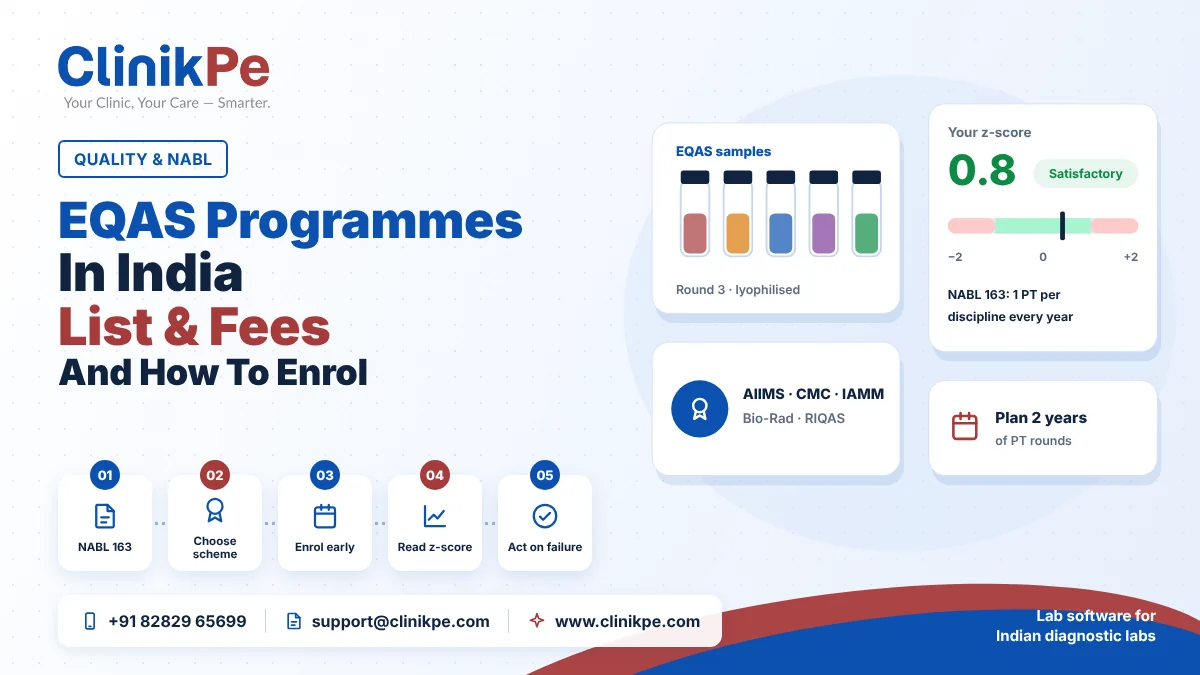
EQAS (proficiency testing) compares your lab’s results with other labs on the same unknown samples. NABL 163 requires at least one satisfactory EQAS per discipline before accreditation and one a year afterwards. Main Indian schemes include AIIMS EQAP (haematology, ₹4,000 a year), CMC Vellore (biochemistry, microbiology) and IAMM (microbiology), alongside Bio-Rad and Randox RIQAS.
Key takeaways
- EQAS checks accuracy against other labs; internal QC checks day-to-day stability.
- NABL needs one satisfactory EQAS per discipline before accreditation, then one a year.
- AIIMS EQAP (haematology) costs ₹4,000 a year for private labs; IAMM microbiology ₹9,440.
- A z-score below 2 is satisfactory; act on 2 or more within a month.
- Where no EQAS exists, NABL 112A lists accepted alternatives.
What EQAS is, and why NABL insists on it
External Quality Assessment (EQAS), also called proficiency testing (PT), checks your accuracy against other labs. A provider sends the same unknown samples to many labs; each lab tests them like patient samples and reports results; the provider compares every lab with the group and sends back a score.
Internal QC tells you whether your analyzer is stable today. EQAS tells you whether you’re getting the right answer. A lab can have perfect internal QC and still be biased against everyone else.
For NABL, it’s mandatory. NABL 163 (Policy for Participation in Proficiency Testing Activities) requires:
- At least one satisfactory PT or EQA in each discipline before accreditation (clause 3.1)
- At least one PT or EQA a year in each discipline for accredited medical labs, plus a two-year PT plan (clause 3.3)
- Root-cause corrective action within one month of an unsatisfactory result (clause 3.6). Two poor results in a row can lead to reduced scope.
NABL 112A, the specific criteria for ISO 15189:2022 published in December 2024, also asks for EQA when you change method or equipment or add tests to your scope.
EQAS programmes for Indian medical labs
These are the main schemes Indian labs use. Many labs combine an Indian scheme for haematology or microbiology with an international scheme for biochemistry and immunoassays.
| Programme | Run by | What it covers | Fees and cycle (where published) |
|---|---|---|---|
| ISHTM-AIIMS EQAP | Dept of Haematology, AIIMS New Delhi | CBC, red cell indices, reticulocytes, peripheral smear; 8,400+ labs; ISO/IEC 17043 accredited | ₹4,000 a year private, ₹2,500 government; 4 distributions a year; lab code in 2–3 months |
| CMC Vellore QAS and EQAS | Christian Medical College, Vellore | Clinical biochemistry (CMC QAS), microbiology (Micro EQAS), virology (VIROEQAS) | Check CMC’s EQAS pages for current fees |
| IAMM EQAS | Indian Association of Medical Microbiologists, Sir Ganga Ram Hospital, Delhi | Smears, cultures with AST and serology; molecular as a separate scheme | ₹9,440 a year incl. GST; 3 rounds (Mar, Jul, Nov); enrol 15+ days before a cycle |
| ICMR-NITVAR PT Unit | ICMR, Pune | Haematology, microbiology, molecular | See NABL PT provider list |
| RML-QAP | RML Pathology, Lucknow | Haematology, biochemistry, immunology, histology, cytology, microbiology, urine, HbA1c | Enrol with form; fees not published |
| IAC National EQA | Indian Academy of Cytologists | Cytology | ₹5,000 new, ₹2,000 renewal; register 1 Jan–28 Feb |
| Lab-run schemes | Metropolis EQAS, Neuberg Neu-QAP, Max QAP, Dr Lal PathLabs PT | Mainly biochemistry and immunoassay | On application |
| Bio-Rad EQAS | Bio-Rad (international) | About 16 programmes incl. chemistry, immunoassay, haematology; monthly for chemistry | Through Bio-Rad distributors |
| Randox RIQAS | Randox (international) | 36 programmes; 55,000+ participants in 134 countries; haematology fortnightly | Through Randox distributors |
How to choose and enrol
- List your tests by discipline: haematology, biochemistry, immunoassay, microbiology, serology, cytology, histopathology, clinical pathology.
- Match each discipline to a scheme, preferring providers accredited to ISO/IEC 17043. NABL treats these as competent.
- Check analyte coverage. Make sure the scheme includes your actual tests, not just the discipline.
- Enrol before the cycle starts. AIIMS EQAP takes 2–3 months to issue a lab code; IAMM needs enrolment at least 15 days before a cycle; IAC registration closes on 28 February.
- Write a two-year PT plan showing which scheme covers which test, and keep it in your quality manual.
Reading your EQAS report
Most reports score each result with a z-score or SDI (standard deviation index): how many standard deviations your result is from the group mean.
| Score | Meaning | What to do |
|---|---|---|
| |z| or |SDI| below 2 | Satisfactory | File the report; watch for trends across cycles |
| 2 to 3 | Questionable | Investigate; NABL counts this as acceptable only once root-cause action is done within a month |
| 3 or more | Unsatisfactory | Full investigation and corrective action; check patient results run in the same period |
Look across cycles too. Results drifting to one side, even within limits, point to a calibration bias before it becomes a failure.
What to do when you fail an EQAS round
- Rule out clerical errors first: wrong units, transposed digits, wrong sample number or wrong method code. RIQAS reports these as a common cause.
- Re-test the EQAS sample if you still have it and the failure is isolated.
- Look for systematic causes: calibration, reagent lot, analyzer maintenance, pipettes, staff technique and sample handling.
- Check patient results run in the same period and correct reports if needed.
- Record the corrective action with evidence, within a month for NABL, and watch the next cycles.
Internal QC records help here. If your Levey-Jennings charts showed a shift before the EQAS failure, you’ve found your cause.
When there’s no EQAS for a test
For tests without a PT scheme (NABL 112A gives examples such as blood gases, ammonia and G6PD), NABL accepts alternatives, roughly in this order:
- Sample exchange with other labs (inter-laboratory comparison)
- Peer-group comparison of internal QC results
- Testing a different calibrator or trueness-control lot
- Split or blind testing
- Reference materials
- Clinical correlation
- Retained or repository samples
- Replicate testing
- Reference methods
For clinical pathology, stool and semen tests without PT, NABL 112A asks for split-sample comparison every three months.
Frequently asked questions
EQAS (External Quality Assessment Scheme), also called proficiency testing, is a programme in which a provider sends unknown samples to many labs, compares each lab’s results with the group, and returns a score. It checks accuracy, while internal QC checks day-to-day stability.
Yes. NABL 163 requires a medical lab to complete at least one satisfactory PT or EQA in each discipline before accreditation and at least one a year in each discipline afterwards, with a two-year PT plan.
The ISHTM-AIIMS EQAP run by AIIMS New Delhi is the most widely used Indian haematology scheme, with 8,400+ labs, ISO/IEC 17043 accreditation and a fee of ₹4,000 a year for private labs. Bio-Rad and Randox RIQAS also run international haematology programmes.
Published fees include ₹4,000 a year for AIIMS haematology EQAP (private labs), ₹9,440 a year including GST for IAMM microbiology EQAS, and ₹5,000 for new registration in the IAC cytology EQA. International schemes are priced through distributors.
Under NABL 163, a z-score below 2 is satisfactory. Scores of 2 or more need investigation, and NABL accepts them only when the lab completes root-cause corrective action within a month. Scores of 3 or more are unsatisfactory.
NABL 112A lists alternatives: sample exchange with other labs, peer comparison of internal QC, testing different calibrator lots, split samples, reference materials, clinical correlation, repository samples, replicate testing and reference methods.
Preparing for NABL?
Tell us your disciplines and timeline. We’ll show how ClinikPe keeps the records your assessor will ask for.
No setup, migration or training fees · Free trial on cloud plans
Sources
- NABL 163: Policy for participation in PT activities
- NABL 112A: specific criteria for ISO 15189:2022
- NABL list of PT programmes
- ISHTM-AIIMS EQAP
- AIIMS EQAP fees 2026
- IAMM EQAS enrolment
- RML-QAP
- IAC National EQA programme
- Bio-Rad EQAS
- Randox RIQAS explained
Written by the ClinikPe lab operations team in Kolkata. General information, not legal, tax or medical advice; check the sources and your state rules before acting.