Quick answer
Lab revenue leakage is income you earned but never collected: tests run without a bill, unapproved discounts, free tests, cancelled bills, unpaid B2B dues and unmatched collector cash. The best single check is to compare each analyzer’s monthly test count with billed tests plus QC, calibration and repeats. Anything left over is unexplained and worth investigating.
Key takeaways
- Most leaks show up when two records that should agree are compared.
- Analyzer runs should equal billed tests plus QC, calibration and repeats.
- Discounts need a reason, a limit per role and an approval above it.
- Close cash and collector collections every day.
- Run a full leakage audit every month and track the gap.
What revenue leakage means in a lab
Revenue leakage is money your lab earned, or should have earned, that never reaches the bank. It isn’t a single theft; it’s lots of small gaps: a test run on the analyzer with no bill behind it, a discount nobody approved, a clinic that hasn’t paid in four months, a collector’s cash that doesn’t match the bookings.
Each one looks small on a busy day. Added up over a year, they can be the difference between a lab that grows and one that struggles, even with good footfall.
The good news: almost every leak shows up when you compare two records that should agree. This guide shows the comparisons that matter most.
The 8 common leaks and how to catch each
| Leak | What it looks like | How to catch it |
|---|---|---|
| Tests run but not billed | Analyzer ran more patient tests than the bills show | Monthly analyzer-vs-billing reconciliation (calculator below) |
| Unapproved discounts | Front desk gives discounts without a reason or approval | Discount report by user, with reason codes and a limit per role |
| Free tests | Tests for staff, family or friends, never recorded | Record every free test as a ₹0 bill with an approver |
| Cancelled or edited bills | Bill cancelled after the patient paid cash | Audit trail of cancellations and edits, reviewed weekly |
| Unpaid B2B and credit bills | Clinic or corporate accounts months overdue | B2B ledger with ageing (30/60/90 days) and credit limits |
| Home collection cash | Collector’s cash doesn’t match the bookings | Daily collector cash report matched to bookings |
| Outsourced tests at a loss | Tests sent out cost more than you charge | Margin report for outsourced tests |
| Reagent loss | Reagent used much faster than billed tests explain | Reagent consumption per test against expected use |
Reconcile analyzer counts with billing
This is the single most useful check. Every analyzer counts what it runs, either on its own screen and log or in the data it sends to your LIS. Every one of those runs should be explained by one of four things:
- A billed patient or client test
- A QC run
- A calibration
- A repeat, rerun or dilution
Anything left over is an unexplained run. Some are innocent, such as a manual rerun that wasn’t logged. A steady gap usually means tests are being done without a bill.
Monthly test reconciliation
Pick one analyzer and one month. The example is a biochemistry analyzer in a mid-sized lab.
Runs you can explain
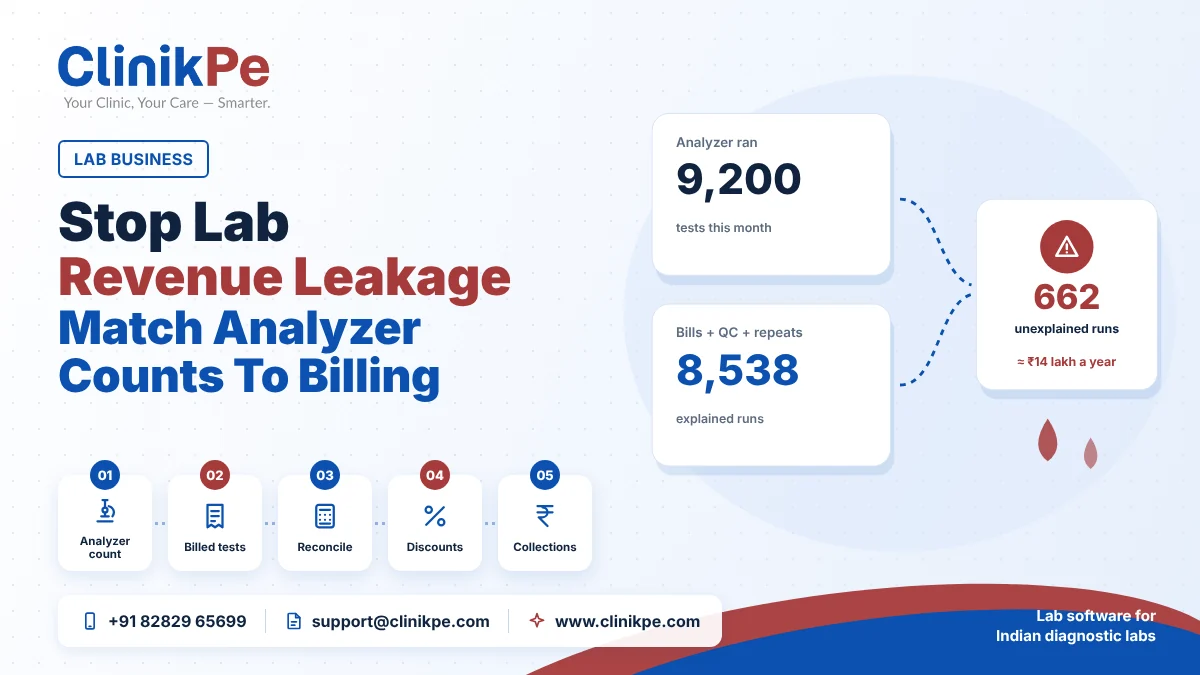
8,538
Unexplained runs
662
Possible lost revenue a year
₹14,29,920
A 7.2% gap is worth investigating: tests run without a bill, free tests, or unlogged repeats.
With the example values, the analyzer ran 9,200 tests. Bills, QC, calibration and repeats explain about 8,538, leaving roughly 660 unexplained runs. At ₹180 a test that’s over ₹14 lakh a year that may never have been billed.
Make leaks hard to happen in the first place
- No result without an order. When the analyzer is interfaced, results attach to a barcode and order. A sample with no bill has nowhere to land.
- Discounts need a reason and a limit. Set a maximum discount per role, require a reason, and have anything above the limit approved by the owner.
- Every change leaves a trail. Bill cancellations, edits and refunds should record who, when and why.
- Close the day. Match cash, UPI and card collections to bills every evening, and collectors’ cash to their bookings.
- Chase credit on a calendar. Review B2B and corporate ageing every week and stop credit at the limit.
- Watch reagent use. Compare reagent consumed with tests billed; see our guide to reagent consumption per test.
A monthly leakage audit, step by step
- Day 1: export last month’s analyzer counts and your billed-tests report. Run the reconciliation above for each analyzer.
- Day 2: pull the discount report by user and the list of cancelled and edited bills. Ask about anything unusual.
- Day 3: review B2B and credit ageing; call every account over 60 days.
- Day 4: compare reagent issued with tests billed for your top 10 tests.
- Day 5: write down what you found, what you changed and who owns it. Repeat next month and track the gap going down.
Doing this every month matters more than doing it perfectly once. Staff behave differently when they know the numbers are checked.
Signs your lab is leaking money
- Footfall is steady or rising but collections aren’t
- Reagent orders grow faster than billed tests
- Discounts are a large share of revenue, with no reasons recorded
- B2B dues keep rising month after month
- Cash in the drawer rarely matches the day’s report exactly
- Nobody can say how many tests the analyzer ran last month
Our guide to reducing lab operating costs covers the cost side of the same problem.
Frequently asked questions
Revenue leakage is income a lab earned or should have earned but never collected: tests run without a bill, unapproved discounts, free tests, cancelled bills after cash payment, unpaid B2B dues, unmatched home collection cash and outsourced tests sold below cost.
Reconcile each analyzer’s monthly test count with billed tests. Add QC runs, calibrations and repeats to billed tests; whatever the analyzer ran beyond that total is unexplained and worth investigating.
There’s no fixed benchmark. A small, stable gap of a percent or two can come from unlogged dilutions or reruns. A larger or growing gap usually means tests without bills, free tests or unrecorded repeats.
Interfaced analyzers attach every result to an order, so results without bills stand out. Software also logs discounts, cancellations and edits by user, reconciles daily collections and tracks B2B ageing.
Set a maximum discount per role, require a reason for every discount, send anything above the limit for owner approval, and review the discount report by user every week.
Monthly for the full reconciliation and discount review, daily for cash and collector reconciliation, and weekly for B2B and credit ageing.
See where your lab’s money goes
Tell us your analyzers and how you bill. We’ll show how ClinikPe ties results to bills and reports leaks before they grow.
No setup, migration or training fees · Free trial on cloud plans
Sources
Written by the ClinikPe lab operations team in Kolkata. General information, not legal, tax or medical advice; check the sources and your state rules before acting.