Quick answer
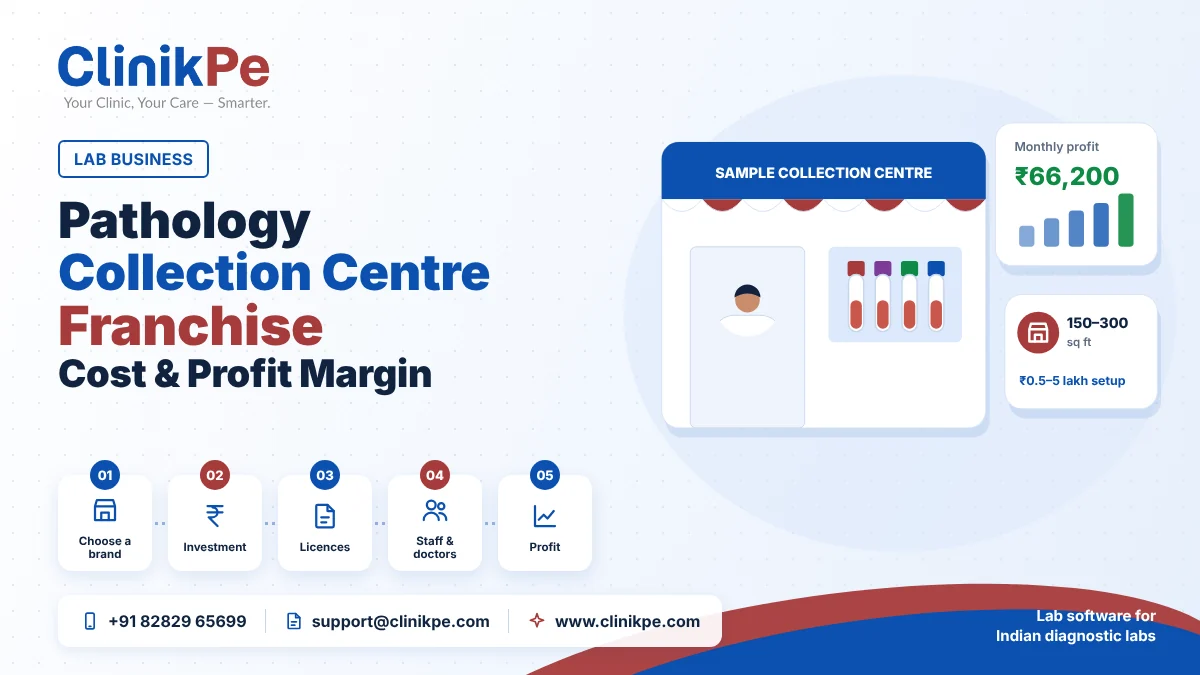
A pathology collection centre franchise in India usually costs ₹50,000 to ₹5 lakh, needs 150–300 sq ft on the ground floor, and pays you a negotiated share of each bill. Brands don’t publish the share. Profit depends on footfall: a centre with 20 patients a day at a ₹700 average bill and a 30% share can clear about ₹66,000 a month.
Key takeaways
- Most collection centre franchises need ₹50,000–5 lakh and 150–300 sq ft on the ground floor.
- No brand publishes its revenue share; negotiate the slab table in writing.
- Footfall decides profit: run the calculator with real local numbers.
- Licences: shop licence, biomedical waste authorisation, and CE registration in some states.
- Franchise fees and commission income are generally taxable under GST.
What a collection centre franchise is
A collection centre (also called a patient service centre or PCC) registers patients, collects blood and other samples, and sends them to the brand’s processing lab. You don’t run analyzers; the parent lab tests the samples and releases reports under its name. You earn a share of each bill.
It’s the lowest-cost way into the diagnostics business. A small lab costs roughly ₹10–20 lakh or more to set up, while most collection centres need ₹50,000 to ₹5 lakh.
What the big brands ask for
| Brand | Published investment | Space | Other conditions |
|---|---|---|---|
| Dr Lal PathLabs | Around ₹3–4 lakh | 200–250 sq ft, ground floor, toilet | Medical or healthcare background preferred |
| Metropolis | Not published (₹2–5 lakh on Franchise India) | 200–300 sq ft, ground floor, bathroom | 3–5 km from existing centres; parking; main road |
| Pathkind | From ₹45,500 per centre plus infrastructure | 200–250 sq ft, ground floor | Must be your main business |
| Redcliffe Labs | “Low initial investment” (no figure) | 150–200 sq ft, ground floor, washroom | Centrifuge, fridge, power backup, barcode scanner; BMW and shop licence |
| Apollo Diagnostics | Not published | Ground floor; standard design | DMLT technicians; centre can’t process samples |
| Lupin Diagnostics | ₹50,000–2 lakh (Franchise India) | 150–250 sq ft | — |
Every brand advertises “attractive margins” without a number. In practice, your share is a negotiated discount on MRP, often in slabs that improve as your monthly business grows. Ask for the slab table in writing, and check whether home collections, corporate camps and packages are paid at the same rate.
Investment: what the money goes on
- Brand or franchise fee, if any, plus a security deposit
- Fit-out: branding to the brand’s design, a phlebotomy chair, waiting seats, washroom
- Equipment: centrifuge, sample refrigerator, power backup, computer, printer and barcode scanner, BP and weight machines
- First stock of vacutainers, needles, swabs and transport boxes
- Licences: shop and establishment licence, biomedical waste authorisation and, in some states, clinical establishment registration
- Working capital for two to three months of rent and salaries
Monthly costs and profit: run your numbers
Your profit depends on four numbers: patients a day, average bill, your share, and fixed costs. Phlebotomist salaries listed on AmbitionBox run from about ₹8,000 to ₹24,000 a month in Kolkata and ₹10,000 to ₹33,000 across India.
Collection centre profit calculator
Example values are for a small tier-2 town centre. Replace them with the brand’s actual terms and your local costs.
Your monthly income
₹1,09,200
Monthly profit
₹66,200
Payback
4.5 months
You break even at about 8 patients a day. Every patient above that adds about ₹210 to profit.
With the example values (20 patients a day, ₹700 average bill, a 30% share, ₹43,000 of monthly costs), the centre earns about ₹1.09 lakh a month and makes about ₹66,000 profit, paying back ₹3 lakh in under five months. At 8 patients a day it barely breaks even. Footfall is everything.
How to start: step by step
- Shortlist two or three brands that are trusted by doctors in your area and don’t already have a centre within 3–5 km.
- Get the terms in writing: investment, fees, revenue-share slabs, payment cycle, who pays for consumables and logistics, and exit terms.
- Find a ground-floor space of 150–300 sq ft on a main road, with a washroom and parking.
- Get licences: shop and establishment licence, biomedical waste authorisation from your State Pollution Control Board, and clinical establishment registration where your state requires it. West Bengal’s act covers sample collection, so collection centres there need registration.
- Hire and train a qualified technician or phlebotomist (most brands want DMLT) and make sure staff are vaccinated against Hepatitis B.
- Plan home collection. It’s often half the business in a busy centre, and needs a reliable collector, a route plan and cold-chain boxes.
- Meet the doctors nearby. Explain your timings, home collection and how fast reports reach them. Don’t offer referral commission; see our guide to what’s legal with doctor referrals.
Collection centre or your own lab?
| Collection centre franchise | Own small lab | |
|---|---|---|
| Setup cost | About ₹0.5–5 lakh | About ₹10–20 lakh or more |
| Space | 150–300 sq ft | 600–1,000 sq ft |
| Staff | 1–3 (phlebotomist, front desk) | Pathologist signatory plus technicians |
| Income per patient | A share of the bill | The full bill, minus reagent and running costs |
| Brand and trust | Borrowed from the parent lab | Built by you over time |
| Control over TAT and quality | Low | High |
| Break-even | Often months, if footfall is good | Commonly 18–30 months (industry estimates) |
Running more than one centre
Once you have two or three centres, or many home collections, paper logs stop working. Samples get mislabelled, collectors’ cash goes unreconciled and nobody knows which samples have left for the lab.
If you’re the parent lab building a franchise network, ClinikPe Growth adds franchise and collection centre management with separate rate slabs per centre.
Frequently asked questions
Published figures range from about ₹45,500 per centre plus infrastructure (Pathkind) to around ₹3–4 lakh (Dr Lal PathLabs). Franchise portals list most brands between ₹50,000 and ₹5 lakh. Add fit-out, equipment, licences and two to three months of working capital.
Brands don’t publish their revenue share; it’s negotiated and often paid in slabs that rise with volume. Profit then depends on patients a day, average bill and your fixed costs. With 20 patients a day, a ₹700 average bill and a 30% share, a small centre could make about ₹66,000 a month after ₹43,000 of costs.
Most brands ask for 150–300 sq ft on the ground floor with a washroom. Metropolis also wants parking and a location 3–5 km from its existing centres.
Typically a shop and establishment licence and biomedical waste authorisation from the State Pollution Control Board. Some states, including West Bengal, also require clinical establishment registration for sample collection centres.
Most brands expect a DMLT or similarly qualified technician to run collections, and the parent lab is responsible for testing and signing reports. Rules on who can staff a pure collection centre aren’t set nationally, so check your state.
A collection centre needs far less money and no pathologist, so it suits first-time owners. An own lab earns the full bill and controls quality and turnaround, but costs ₹10–20 lakh or more and commonly takes 18–30 months to break even.
Running collections? Do it without paper
Tell us how many centres and collectors you have. We’ll show ClinikPe Collect on a basic Android phone and the console for your team.
No setup, migration or training fees · Free trial on cloud plans
Sources
- Dr Lal PathLabs: become a franchise
- Metropolis: become a partner
- Pathkind: franchise opportunities
- Redcliffe Labs: franchising
- Apollo Diagnostics: franchise
- Franchise India: pathology lab listings
- AmbitionBox: phlebotomist salaries
- MoHFW: minimum standards for collection centres (draft)
- West Bengal Clinical Establishments Act 2017
Written by the ClinikPe lab operations team in Kolkata. General information, not legal, tax or medical advice; check the sources and your state rules before acting.