As diagnostic labs expand their operations, many begin opening multiple collection centers or branch laboratories across different locations. While this expansion helps increase patient reach and test volume, it also introduces new operational challenges.
One of the most common challenges faced by multi-branch diagnostic labs in India is managing patient data and operational workflows across different locations.
When each branch maintains its own records using spreadsheets or manual registers, it becomes difficult for lab owners to maintain consistent data and operational visibility. Staff may struggle to access patient history, track sample status between branches, or generate consolidated reports.
These issues can slow down operations and make it difficult to maintain standardized processes across locations. Centralizing operational data is essential for multi-branch labs that want to maintain efficiency and ensure consistent service quality. In this article, we explore the challenges of decentralized data management and the practical strategies multi-branch labs can use to centralize data effectively.
The Problem Explained:
When diagnostic labs operate across multiple locations without centralized systems, data is often stored separately at each branch.
For example, different branches may maintain their own:-
- patient registration records
- test reports
- billing systems
- referral data
- inventory logs
This creates several operational problems.
Common issues include:-
- Difficulty accessing patient history across branches
- Delays in retrieving reports
- Inconsistent data formats
- Duplicate patient records
- Lack of consolidated performance data
For instance, if a patient visits one branch for testing and later visits another branch, the staff may not be able to access the previous test records quickly. These inefficiencies affect both operational workflows and patient experience.
Why This Happens in Indian Labs/Clinics:
Several factors contribute to decentralized data management in multi-branch labs.
Independent branch operations:
Many labs initially allow each branch to operate independently with its own records and workflows.
Manual data systems:
Paper registers and spreadsheets do not easily support centralized data sharing.
Lack of integrated software systems:
Without centralized digital systems, branches must rely on manual communication to exchange data.
Growing operational complexity:
As labs expand into multiple locations, managing consistent workflows becomes increasingly difficult without unified systems. These challenges often become more visible as labs attempt to scale operations.
Practical Solutions:
Multi-branch labs can centralize data and improve operational efficiency through structured systems.
Maintain centralized patient records:
All branches should access a single patient database that stores test history and reports.
This allows staff to retrieve patient information quickly, regardless of location.
Standardize operational workflows:
Consistent processes for patient registration, sample collection, and reporting help ensure uniform service quality across branches.
Consolidate reporting systems:
Centralized reporting systems help labs manage report generation and maintain standardized report formats.
Track branch performance:
Centralized systems allow lab owners to monitor:-
- test volumes across branches
- report turnaround time
- operational efficiency
This helps identify performance trends.
Improve coordination between branches:
Centralized data systems allow staff to coordinate sample transfers, test processing, and report delivery more efficiently.
Technology’s Role:
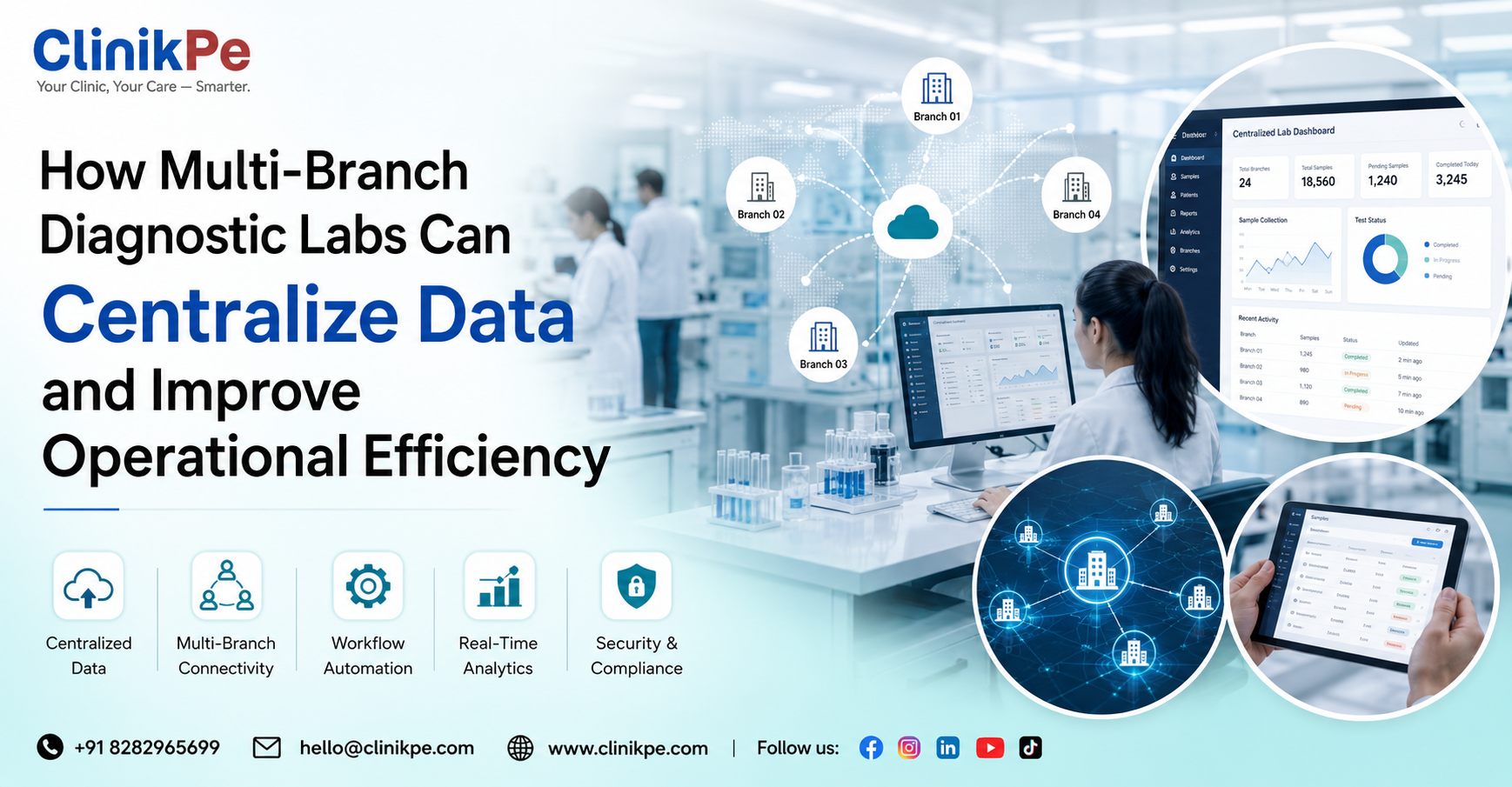
Digital lab systems make it easier for multi-branch labs to manage operations through centralized platforms. A Lab Management System (LIMS) allows labs to store patient data, sample records, and reports in a unified system accessible by all branches.
Key capabilities include:-
- centralized patient database
- digital sample tracking
- automated report generation
- branch-level performance monitoring
- integrated billing systems
Cloud-based LIMS platforms allow lab owners to monitor operations across multiple locations in real time. You can [Explore our Lab Management System] to understand how centralized systems support multi-branch diagnostic labs.
You may also want to read [How to Reduce Report Turnaround Time in Labs] to learn how digital workflows improve operational efficiency.
Implementation Tips:
Labs expanding into multiple branches should implement centralized systems gradually.
Implementation Checklist:
✔ Standardize patient registration processes across branches
✔ Implement centralized digital databases
✔ Train staff on unified operational workflows
✔ Monitor data consistency regularly
✔ Track branch-level operational performance
✔ Use centralized reporting formats
✔ Implement scalable lab management software
These steps help maintain consistent operations while allowing labs to scale efficiently. If you’re evaluating digital lab software, you can also [View Lab Management System Pricing].
Final Takeaway:
As diagnostic labs expand to multiple locations, managing data efficiently becomes increasingly important. Decentralized data systems can create operational confusion, slow down workflows, and limit visibility into overall lab performance.
By centralizing patient records, reporting systems, and operational workflows, multi-branch labs can maintain efficiency while delivering consistent diagnostic services. Digital lab management systems play a critical role in enabling this centralized approach. For labs planning to scale across multiple locations, investing in centralized digital infrastructure is essential for long-term operational success.
Explore our Lab Management System
FAQ Section
Multi-branch labs manage patient data through centralized systems that allow all branches to access patient records and test reports.
Centralized data improves operational visibility, reduces duplicate records, and ensures consistent workflows across branches.
Yes. With centralized systems, patients can access reports regardless of the branch where the test was performed.
Labs may face issues such as duplicate records, difficulty accessing patient history, and inconsistent reporting formats.
Yes. Many LIMS platforms allow multiple branches to access a centralized system for patient records, sample tracking, and reporting.