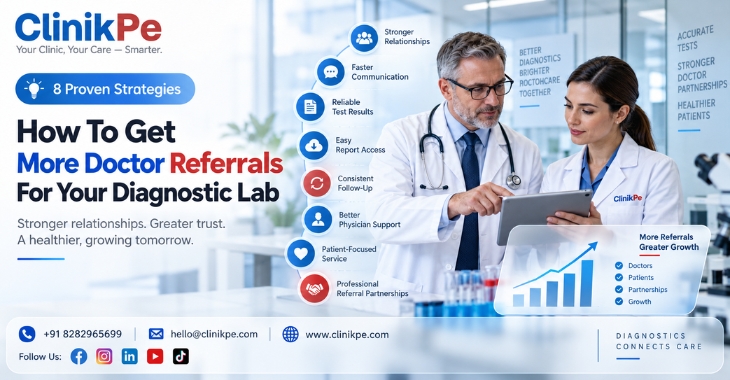
80% of diagnostic lab patients arrive through doctor referrals. If your lab is not growing, the referral network is where the problem almost always lies. These 8 strategies are what consistently working labs in India use to build and protect their referral base with the help of Pathology Lab Management Software.
Strategy 1: Systematic Doctor Visits — Not Random Drop-ins
Most lab owners visit doctors reactively — when business is slow or when a new lab opens nearby. The labs with strong referral networks visit systematically:
- Map every doctor within 1km of your lab. Create a list with name, specialty, clinic hours, and estimated patient volume.
- Prioritise by specialty — GPs, general physicians, and gynaecologists refer the highest routine pathology volumes. Endocrinologists, cardiologists, and nephrologists send high-value panels.
- Visit each on a schedule — minimum once a month for your top 10, once every 2 months for the rest.
- Bring data when revisiting — show the doctor how many patients they referred last month and their most-ordered tests. Doctors respond to data about their own practice patterns.
Strategy 2: Deliver TAT Commitments — Every Time
Turnaround time (TAT) is the single biggest driver of referral retention. When you tell a doctor “results by 4pm,” the doctor tells the patient “results by 4pm.” If you deliver by 3:45pm consistently, that doctor trusts you. If you miss twice, the referrals quietly shift.
TAT Benchmarks for Common Tests
| Test | Target TAT |
| CBC (haematology) | 1–2 hours |
| LFT / KFT / lipid panel | 2–4 hours |
| Thyroid panel (TSH/T3/T4) | 3–5 hours |
| HbA1c | 2–3 hours |
| Urine R/E | 1–2 hours |
| Culture & sensitivity | 48–72 hours |
The fastest path to better TAT is direct analyser-to-software integration — results flow from the machine to the report without manual entry. This cuts 30–45 minutes from every routine TAT and eliminates transcription errors.
Strategy 3: WhatsApp Reports Doctors Can Forward
When your lab sends a WhatsApp report, the doctor can share it with the patient in one tap. This makes your lab convenient for the doctor — and patients associate the smooth experience with the lab, not just the doctor. Labs that shifted to automated WhatsApp delivery consistently report that doctors tell patients to use their lab because “reports come on WhatsApp.”
Key features of a good WhatsApp report include a branded header, clearly marked reference ranges, highlighted abnormal flags, and your lab’s contact details for queries.
Strategy 4: Build a Structured Referral Reward Program
A Referral Reward program recognises doctors for their referrals in a consistent, transparent, and legal way. It does not mean cash-in-envelope payments — those create legal liability for both parties.
Structured rewards that work:
- Free CME event sponsorship or attendance for high-referring doctors
- Priority sample pickup service with a dedicated time slot at their clinic
- Free diagnostic camp organisation for their clinic’s patient community
- Annual gift at key festivals, proportional to referral volume
- Recognition in your lab newsletter or patient communication
The key is tracking referral volumes accurately per doctor — you cannot run a fair reward program on estimates. Lab software that tracks every referral automatically makes this manageable even with 50+ referring doctors.
Strategy 5: Track Referrals — Know Your Data
Most labs have no idea which doctor sent how many patients last month. This is a massive blind spot. With referral tracking software, you can:
- See your top 10 referrers by patient count and revenue
- Spot when a previously high-referring doctor suddenly drops off, giving you an early warning to visit
- Track which new doctors are emerging as strong referrers
- Bring real data to every doctor visit — for example, showing how referrals have changed month over month
Strategy 6: Offer Home Collection at Clinics
Arrange scheduled phlebotomist visits to your top-referring clinics. The phlebotomist collects samples from waiting patients, eliminating the doctor’s need to tell patients to visit the lab separately. For busy clinic doctors, this is enormously convenient and strongly reinforces the referral relationship.
Strategy 7: Share Quarterly Referral Reports
Print or WhatsApp a simple one-page Referral Summary to each doctor quarterly, including their total referrals, most-ordered tests, and any trends. This professional data-sharing positions you as a serious business partner, not just a vendor. Very few labs do this, which can help differentiate your lab.
Strategy 8: Be Reachable for Queries
When a doctor has an urgent query about a critical value or an unusual result, your response time matters. Have a dedicated WhatsApp number for doctor queries rather than using the same patient-facing number.
A pathologist available for short consultations on complex panels can be a powerful differentiator that larger chains may find difficult to replicate at scale.
Frequently Asked Questions
Visit during non-peak hours, such as late morning or early afternoon, and introduce yourself briefly. Leave your test menu with TAT commitments and offer one specific service, such as free home collection from their clinic for patients. Follow up in two weeks with a WhatsApp message. Persistence combined with genuine service delivery builds the relationship over time.
Direct cash payments for patient referrals are prohibited under the Indian Medical Council (Professional Conduct) Regulations and NMC rules. Labs and doctors can both face regulatory consequences. Structured Referral Reward programs using non-cash recognition, CME sponsorship, diagnostic camps, or service-based rewards are commonly discussed, but legal requirements can depend on the specific program structure. Always consult a qualified legal advisor before implementing any referral incentive program.
Quality is necessary but not always sufficient. Referral drops can happen because a competitor is visiting the doctor more frequently, your TAT has slipped without the doctor telling you directly, your WhatsApp or phone communication has become slow, or a new lab has opened nearby.
Tracking referrals per doctor regularly can help identify a decline early, allowing you to address the relationship before the drop becomes more significant.
Know Which Doctors Drive Your Revenue — Track Every Referral
ClinikPe referral tracking shows patient counts, revenue, and trends per doctor. Know who to visit next.