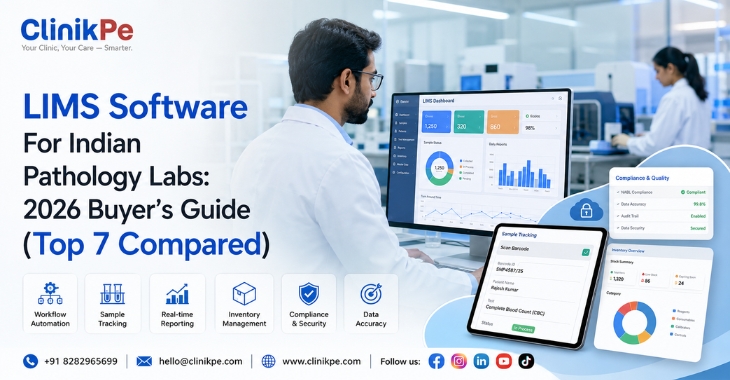
Indian diagnostic labs evaluating LIMS software in 2026 face seven realistic options. Six of them stack price. One doesn’t. Here’s the honest comparison from someone who has watched 200+ labs make this decision.
Choosing the wrong LIMS software doesn’t just cost money — it costs you TAT, NABL compliance, and staff sanity. In 2026, the Indian diagnostic market is flooded with platforms all claiming to be the complete solution. Some are. Most aren’t. This guide cuts through the noise with honest profiles of seven real options, what they actually cost, and the five questions every lab owner must ask before signing anything. No fluff. Just the comparison your procurement decision deserves.
What Counts as “LIMS Software” in 2026:
LIMS software — Laboratory Information Management System software — is the operational core of any modern pathology lab. It handles sample tracking, test workflows, result entry, report generation, billing, and regulatory compliance under one roof.
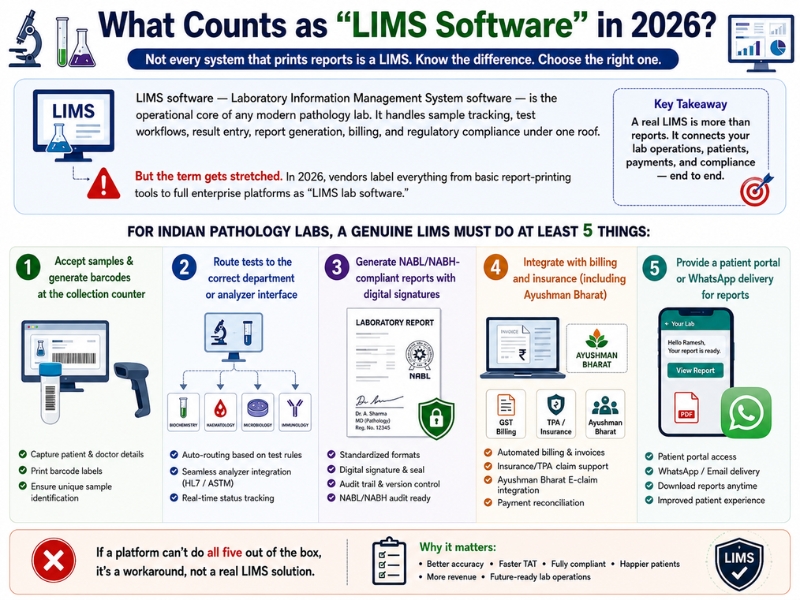
But the term gets stretched. In 2026, vendors label everything from basic report-printing tools to full enterprise platforms as “LIMS lab software.” For Indian pathology labs, a genuine LIMS must do at least five things:
- Accept samples and generate barcodes at the collection counter
- Route tests to the correct department or analyzer interface
- Generate NABL/NABH-compliant reports with digital signatures
- Integrate with billing and insurance (including Ayushman Bharat)
- Provide a patient portal or WhatsApp delivery for reports
If a platform can’t do all five out of the box, it’s a workaround, not a real LIMS lab management software solution.
How We Compared These 7 LIMS Software Platforms:
We evaluated each platform across six dimensions relevant to Indian labs:-
| Criteria | Why It Matters |
| India-specific compliance | NABL, ICMR, Ayushman Bharat, GST billing |
| Analyzer integration | Seamless LIS middleware or direct HL7/ASTM |
| Pricing model | Per-test, per-user, flat annual, or hidden modules |
| Implementation timeline | Days vs. months — critical for smaller labs |
| Support quality | Local vs. offshore; response time SLA |
| Scalability | Single branch to 50+ collection centers |
Data comes from vendor demos, published pricing, user reviews on platforms like Capterra and G2, and direct conversations with lab owners across Maharashtra, Tamil Nadu, Delhi NCR, and West Bengal.
The 7 LIMS Software Options for Indian Labs:
1. Athenasowft LabNet (Best Overall for Mid-Size Indian Labs)
Who it’s for: Labs processing 200–2,000 samples/day with multi-branch ambitions.
LabNet is purpose-built for the Indian diagnostic market. It offers flat-fee annual pricing — no per-test stacking — making it the standout on this list. NABL documentation is built in, analyzer interfacing covers 150+ instruments, and the patient WhatsApp portal works out of the box. Implementation takes 3–5 days per branch.
Pricing: ₹1.8L–₹4.5L/year depending on branch count. No hidden modules.
Weakness: Limited international language support — not ideal if you serve non-Hindi/English patients heavily.
SoftClinic GenX:
Who it’s for: Small labs and clinics wanting an affordable starting point.
SoftClinic GenX is widely used across tier-2 and tier-3 cities. It covers basic lims system software functions — sample registration, report printing, billing — but more advanced features like analyzer interfacing and multi-branch consolidation require paid add-ons.
Pricing: ₹15,000–₹40,000/year base. Add-ons push the real cost to ₹70,000–₹1.2L/year.
Weakness: Support is inconsistent; power users report slow bug resolution.
Neusoft HLIS:
Who it’s for: Large hospital-attached labs and corporate chains.
Neusoft is an enterprise-grade lims lab software platform with deep HL7 integration and HIS connectivity. It’s powerful but priced accordingly, and implementation requires a dedicated IT team. Indian-specific compliance features exist but need configuration — they’re not pre-loaded.
Pricing: Custom enterprise quotes. Expect ₹8L–₹25L+ for initial deployment.
Weakness: Overkill for independent labs; long implementation timelines (3–6 months).
Lifesoft LIMS:
Who it’s for: Mid-size standalone labs wanting strong billing features.
Lifesoft balances lab workflow management with robust GST-compliant billing. It’s popular in South India. The lims lab management software capability is solid for single-branch operations; multi-branch management is functional but less polished than dedicated enterprise tools.
Pricing: ₹60,000–₹1.5L/year. Per-branch licensing adds up quickly for chains.
Weakness: UI feels dated; mobile experience needs improvement.
Metropolis MedLab (White-Label / Partner Model):
Who it’s for: Labs interested in a franchise or co-branding arrangement.
Metropolis offers its internal LIMS as a partner-facing product for labs joining its network. It’s not a standalone purchase — you get the lims software as part of a larger business arrangement. Excellent quality reports and brand recognition.
Pricing: Not available as a standalone. Revenue-sharing model applies.
Weakness: You’re locked into their ecosystem and referral network rules.
PathSys Pro:
Who it’s for: Diagnostic chains with 10+ branches needing central oversight.
PathSys Pro excels at central reporting dashboards, TAT monitoring across branches, and role-based access for a distributed team. It’s a strong lims system software choice for growing chains that need visibility without micromanagement.
Pricing: ₹2L–₹6L/year. Per-branch pricing model — costs scale linearly.
Weakness: Sample management module is less refined than competitors; better suited for chains than high-volume single labs.
HealthConnect LIS:
Who it’s for: Labs with telemedicine integration needs or teleconsultation tie-ups.
HealthConnect bridges LIMS and teleconsultation — reports feed directly into doctor consultation workflows. It’s a niche but growing need, especially for labs partnered with digital health platforms.
Pricing: ₹1.2L–₹3L/year. Teleconsultation features are priced separately.
Weakness: Core LIMS features are secondary; not recommended as a standalone lab management solution for high-volume operations.
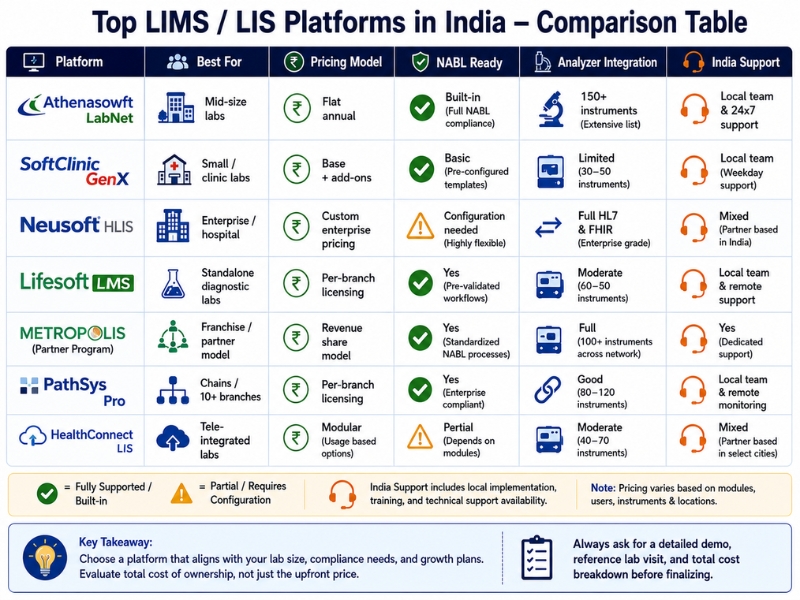
Comparison Table:
| Platform | Best For | Pricing Model | NABL Ready | Analyzer Integration | India Support |
| Athenasowft LabNet | Mid-size labs | Flat annual | ✅ Built-in | 150+ instruments | ✅ Local |
| SoftClinic GenX | Small/clinic labs | Base + add-ons | ✅ Basic | Limited | ✅ Local |
| Neusoft HLIS | Enterprise/hospital | Custom enterprise | ⚠️ Config needed | Full HL7 | ⚠️ Mixed |
| Lifesoft LIMS | Standalone labs | Per-branch | ✅ Yes | Moderate | ✅ Local |
| Metropolis (Partner) | Franchise model | Revenue share | ✅ Yes | Full | ✅ Yes |
| PathSys Pro | Chains 10+ branches | Per-branch | ✅ Yes | Good | ✅ Local |
| HealthConnect LIS | Tele-integrated labs | Modular | ⚠️ Partial | Moderate | ⚠️ Mixed |
Five Questions to Ask Any LIMS Software Vendor:
Before signing anything, run every vendor through these five questions:-
- Is NABL documentation generated automatically, or is it manually filled out?
Many LIMS providers advertise NABL-ready systems, but some still require manual entry for audit logs, quality records, and compliance documents. This increases staff workload and raises the risk of errors during inspections. Always ask vendors to demonstrate live NABL document generation, including audit trails, QC reports, calibration logs, and corrective action records. Automated compliance workflows can save significant time and improve audit readiness.
- How is pricing structured when I add a branch or increase test volume?
A low starting price may become expensive as your laboratory grows. Some vendors charge separately for additional branches, users, analyzers, or higher testing volumes. Request a detailed pricing breakdown for future expansion, including projected Year 2 and Year 3 costs. Transparent pricing helps avoid unexpected expenses and ensures the software remains affordable as operations scale.
- What is your average implementation timeline for a lab of our size?
Implementation delays can disrupt daily lab operations and postpone staff training. Reliable vendors provide a structured onboarding schedule with clear milestones for setup, data migration, analyzer integration, and user training. Avoid providers who give vague estimates without a defined rollout plan tailored to your lab’s workflow and size.
- Which analyzers are pre-integrated, and what is the process for new ones?
Confirm whether your exact analyzer models are already integrated. Ask how long new integrations take and whether there are any additional costs.
- What is your support for SLA, and is there a local team in India?
Fast technical support is essential for diagnostic labs. Ensure the vendor offers quick response times and reliable India-based support during operational hours.
Common LIMS Software Buying Mistakes:
Choosing on demo aesthetics alone: A polished interface during a scripted demo can hide workflow gaps that only appear in daily use. Always ask for a trial period or reference lab visits.
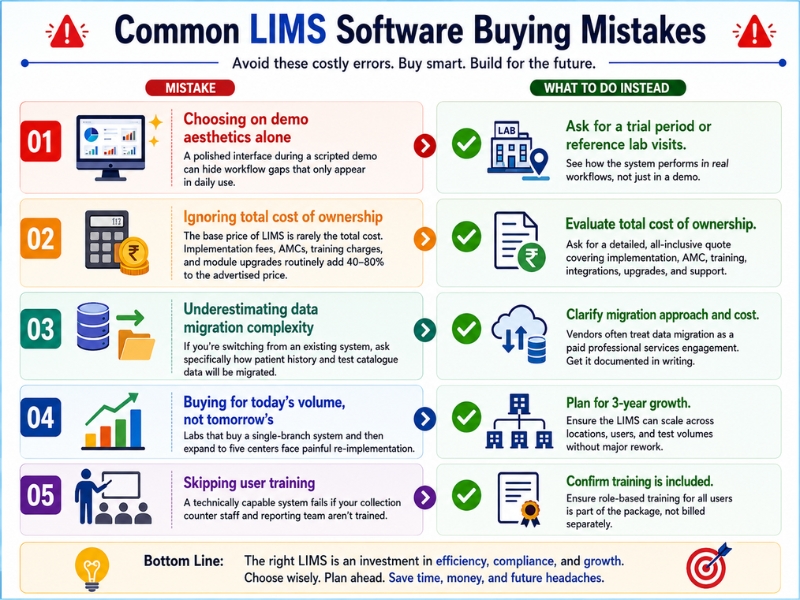
Ignoring total cost of ownership: The base price of lims lab software is rarely the total cost. Implementation fees, annual maintenance contracts (AMCs), training charges, and module upgrades routinely add 40–80% to the advertised price.
Underestimating data migration complexity: If you’re switching from an existing system, ask specifically how patient history and test catalogue data will be migrated. Vendors often treat this as a paid professional services engagement.
Buying for today’s volume, not tomorrow’s: Labs that buy a single-branch system and then expand to five centers face painful re-implementation. Plan for 3-year growth when evaluating lims lab management software.
Skipping user training: A technically capable system fails if your collection counter staff and reporting team aren’t trained. Confirm that training is included, not billed separately.
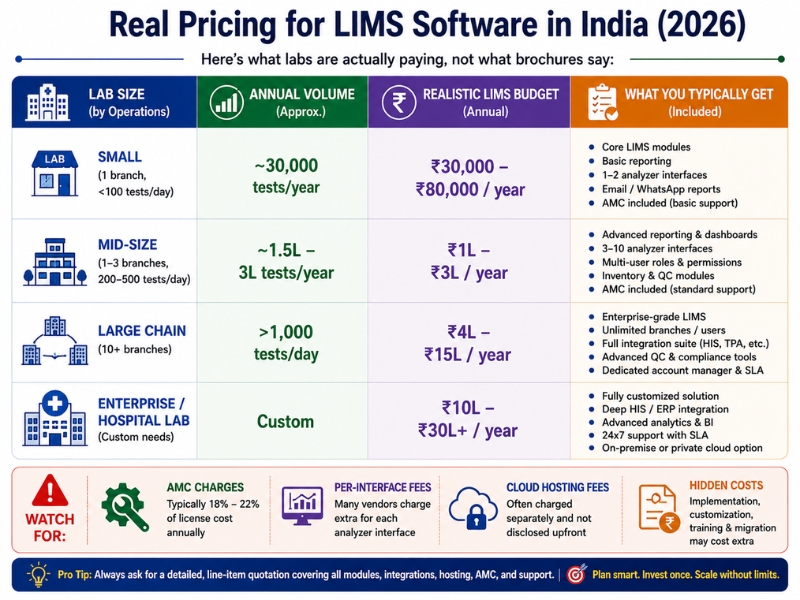
Real Pricing for LIMS Software in India (2026):
Here’s what labs are actually paying, not what brochures say:-
| Lab Size | Annual Volume | Realistic LIMS Budget |
| Small (1 branch, <100 tests/day) | ~30,000/year | ₹30,000–₹80,000/year |
| Mid-size (1–3 branches, 200–500/day) | ~1.5L–3L/year | ₹1L–₹3L/year |
| Large chain (10+ branches) | >1,000/day | ₹4L–₹15L/year |
| Enterprise/hospital lab | Custom | ₹10L–₹30L+ |
Watch for: AMC charges (typically 18–22% of license cost annually), per-interface fees for each analyzer, and “cloud hosting” fees that aren’t disclosed upfront.
FAQs: LIMS Software for Indian Labs
LIMS software manages the end-to-end lab workflow — from patient registration and sample collection to test processing, result entry, report generation, and billing.
NABL doesn’t mandate a specific system, but the document management, traceability, and audit-trail requirements in ISO 15189 are practically impossible to meet manually at scale. Most NABL-accredited labs use LIMS lab software.
LIS (Laboratory Information System) typically refers to clinical lab workflow; LIMS (Laboratory Information Management System) has broader roots in research labs. In Indian pathology, the terms are used interchangeably.
Yes. Most enterprise-grade lims system software platforms support HL7 or FHIR integration with hospital information systems.
For a single-branch pathology lab, 3–7 days is realistic with a well-prepared vendor. Multi-branch or hospital-attached implementations take 4–12 weeks.
Cloud-based lims lab management software offers easier updates and remote access; on-premise suits labs with data sovereignty concerns or unreliable internet. Both are viable in 2026.
Labs report 15–30% reduction in TAT, 20–40% reduction in report errors, and meaningful staff efficiency gains within 6 months of implementation.
Leading Indian LIMS platforms now include AB-PMJAY claim integration. Confirm this is pre-built, not a future roadmap feature.
Yes. Entry-level lims lab software starts at ₹30,000–₹50,000/year and delivers immediate workflow improvements even for labs doing 50–100 tests daily.
Ask vendors for a formal data migration plan, including format specifications and a test migration before go-live. Never agree to “we’ll figure it out during implementation.”
The Bottom Line
Most LIMS software vendors in India will charge you more as you grow — per-test fees, per-branch licenses, per-analyzer interfaces. One flat-fee platform changes that equation entirely. If you’re a mid-size Indian pathology lab evaluating your options in 2026, the honest recommendation is to shortlist platforms that offer transparent pricing, built-in NABL compliance, and local support — not the one with the best demo.
ClinikPe stands apart in this lims lab software landscape as the only platform offering flat-fee annual pricing — no per-test stacking, no per-branch surprises. Built for Indian pathology labs, it includes NABL-ready workflows, 150+ analyzer integrations, and WhatsApp report delivery out of the box. Ready to see what a genuinely flat-fee LIMS looks like for your lab? Book a Free Demo.No sales pitch. Just a live walkthrough of your actual workflow.