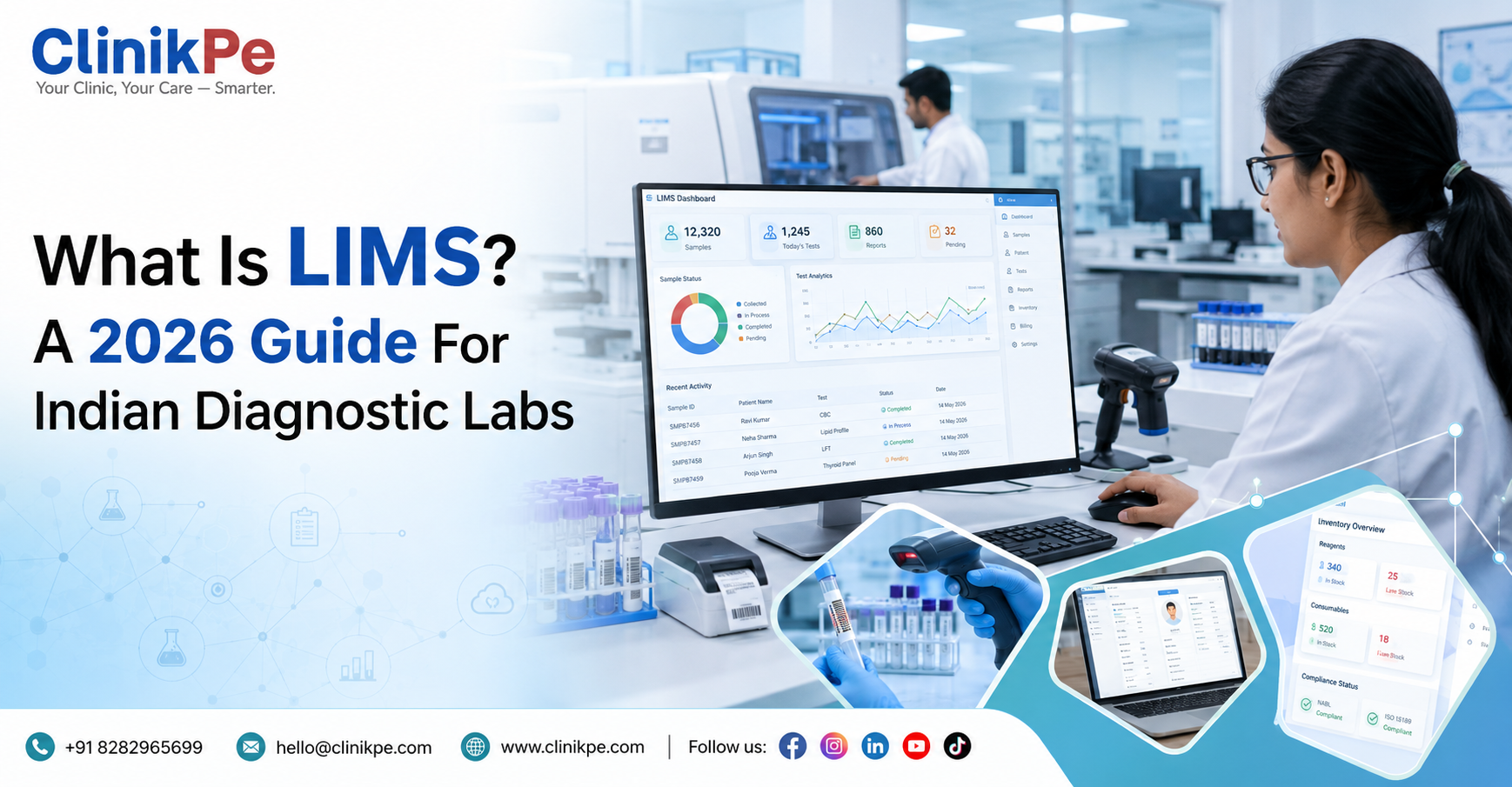
If you run a pathology lab in India and someone tells you that you need a LIMS, here’s the question you actually need answered: what is LIMS, and do you really need one, or is the older lab software you already have enough?
This guide cuts through the jargon. By the end, you’ll know exactly what LIMS means, how it works inside a diagnostic lab, what it costs in India, and whether a platform like ClinikPe fits your needs better than a traditional setup.
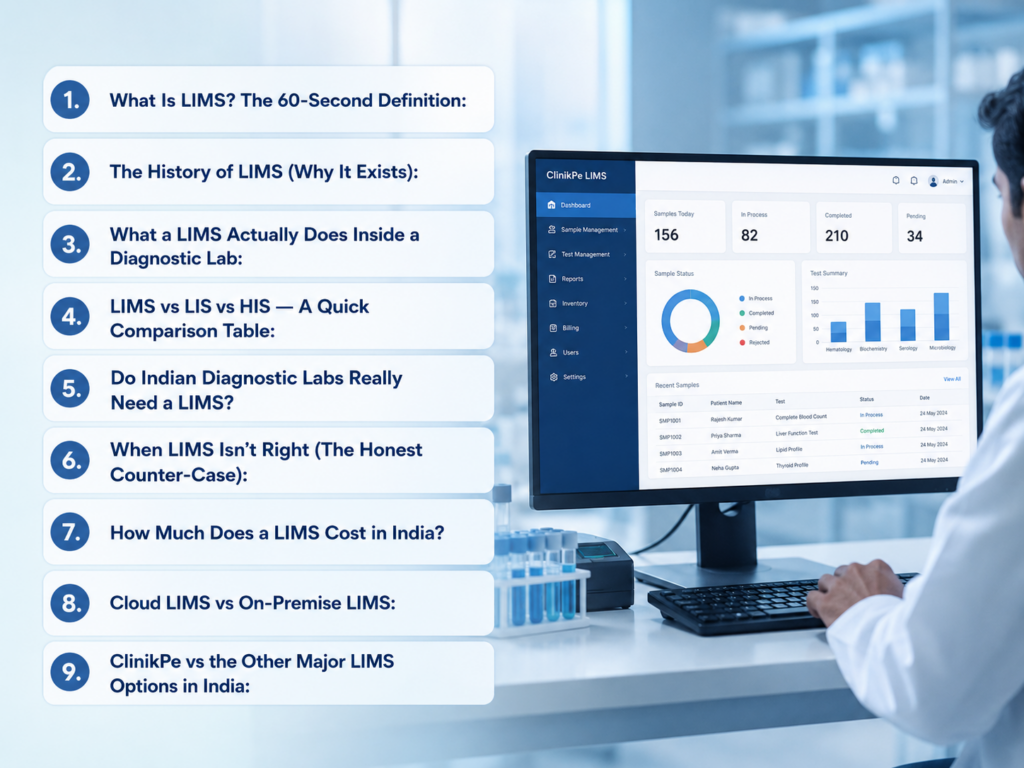
1. What Is LIMS? The 60-Second Definition:
LIMS full form: Laboratory Information Management System.
A LIMS is software that manages the end-to-end workflow of a diagnostic or pathology lab — from the moment a patient walks in to the moment a verified report lands on their phone. It replaces paper registers, manual data entry, and disconnected billing spreadsheets with one unified digital system.
At its core, a LIMS handles:
- Patient registration and sample collection
- Sample tracking (barcodes, chain of custody)
- Instrument/analyzer integration
- Result capture and verification
- Report generation and delivery
- Billing, inventory, and compliance
LIMS meaning in simple terms: it is the operating system of a modern laboratory.
2. The History of LIMS (Why It Exists):
LIMS originated in the 1980s in large pharmaceutical and industrial research labs in the United States and Europe. Back then, labs were drowning in paper — hundreds of samples, thousands of data points, and zero automation. Early LIMS were mainframe-based and required dedicated IT teams.
By the 2000s, LIMS moved onto desktop servers. Indian diagnostic chains began adopting them, but only the large ones — Metropolis, SRL, Dr. Lal PathLabs — could afford the ₹10–20 lakh+ installation costs.
The shift happened in the 2010s when cloud computing made LIMS accessible to standalone labs. Today, a single-center pathology lab in Pune or Patna can run a full-featured cloud LIMS for under ₹5,000 per month — a price point unimaginable a decade ago.
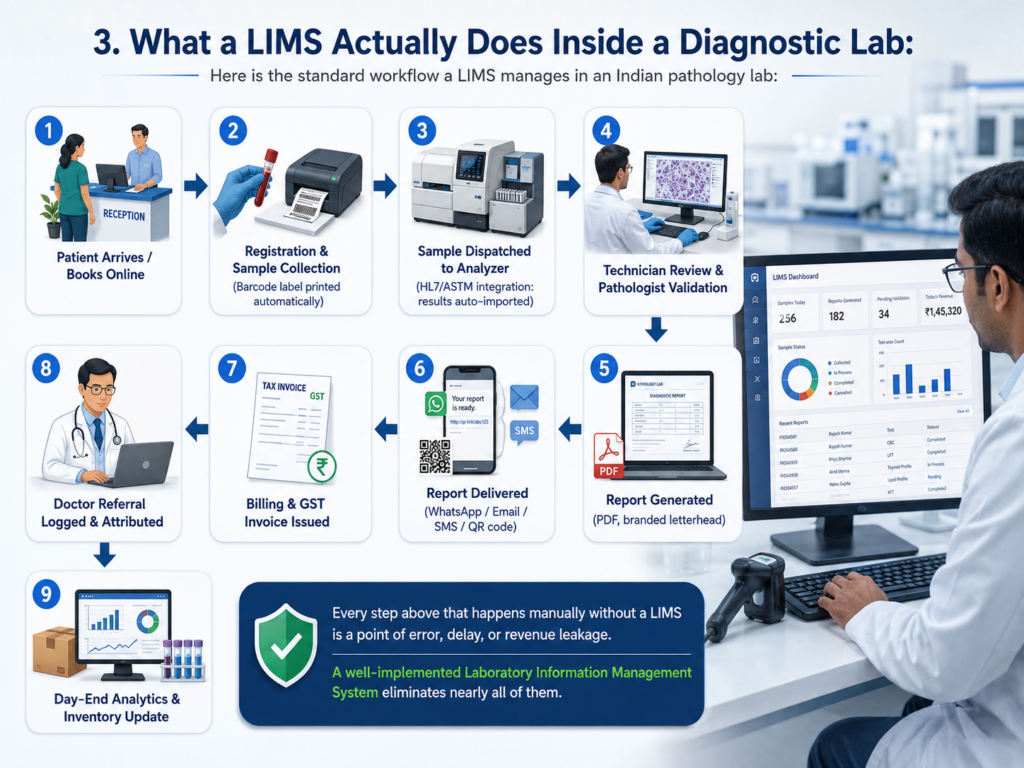
3. What a LIMS Actually Does Inside a Diagnostic Lab:
Here is the standard workflow a LIMS manages in an Indian pathology lab:-
Patient Arrives / Books Online
↓
Registration & Sample Collection
(Barcode label printed automatically)
↓
Sample Dispatched to Analyzer
(HL7/ASTM integration: results auto-imported)
↓
Technician Review & Pathologist Validation
↓
Report Generated (PDF, branded letterhead)
↓
Report Delivered (WhatsApp / Email / SMS / QR code)
↓
Billing & GST Invoice Issued
↓
Doctor Referral Logged & Attributed
↓
Day-End Analytics & Inventory Update
Every step above that happens manually without a LIMS is a point of error, delay, or revenue leakage. A well-implemented Laboratory Information Management System eliminates nearly all of them.
4. LIMS vs LIS vs HIS — A Quick Comparison Table:
These three terms are often confused. Here is a clear breakdown:-
| Term | Full Form | Primary Focus | Who Uses It |
| LIMS | Laboratory Information Management System | Sample tracking, data integrity, lab workflow | Pathology & diagnostic labs, research labs |
| LIS | Laboratory Information System | Clinical test results, patient reports, billing | Hospital-attached labs, diagnostic centres |
| HIS | Hospital Information System | Full hospital operations (OPD, IPD, pharmacy, lab) | Multi-specialty hospitals |
Key distinction: LIS and LIMS overlap heavily in the Indian diagnostic market. Many vendors (including ClinikPe) use both terms for the same product. HIS is broader — it includes the lab module but also manages wards, pharmacy, and HR. For standalone pathology labs, a LIMS or LIS is the right fit. A full HIS is overkill.
5. Do Indian Diagnostic Labs Really Need a LIMS?
Short answer: if you process more than 50 samples per day, yes.
Here is the honest case for it:-
Manual data entry causes errors. A single transposed digit in a blood glucose result can cause patient harm. A LIMS with analyzer integration eliminates this risk by auto-importing results directly from the machine.
WhatsApp report delivery is now a patient expectation. In 2026, patients expect their CBC report on their phones within 2 hours. Printing, stamping, and handing over a physical report is a competitive disadvantage.
NABL accreditation requires documented traceability. Whether you are pursuing NABL certification or simply maintaining quality standards, a LIMS provides the audit trails, QC logs, and chain-of-custody records that manual systems cannot.
Doctor referral tracking is invisible without software. If 40% of your tests come from three referring doctors and you don’t know which ones, you are leaving referral relationship management entirely to chance.
Revenue leakage is silent. Unbilled tests, missed home collection charges, and untracked reagent consumption are nearly impossible to catch in a manual system. LIMS-driven billing closes these gaps.
6. When LIMS Isn’t Right (The Honest Counter-Case):
Not every lab needs a LIMS today. Here are legitimate situations where it may not be the priority:
You process fewer than 20–30 samples per day
At this volume, basic billing software and paper registers may be sufficient. The ROI on a ₹3,000–5,000/month LIMS subscription only materializes once you have meaningful daily volume.
You have no analyzer integration needed
If your lab outsources all technical testing and only handles collection and report handover, a simple LIS with billing may be all you need.
Your staff resistance is high
A LIMS that no one uses correctly is worse than a paper system. If you have an older team with zero digital exposure and no plan to train them, a rushed LIMS implementation can disrupt operations for weeks.
You are in a pre-launch phase
If your lab is not yet operational, focus on setup, equipment, and licensing first. Implement LIMS in Month 2, not Day 1.
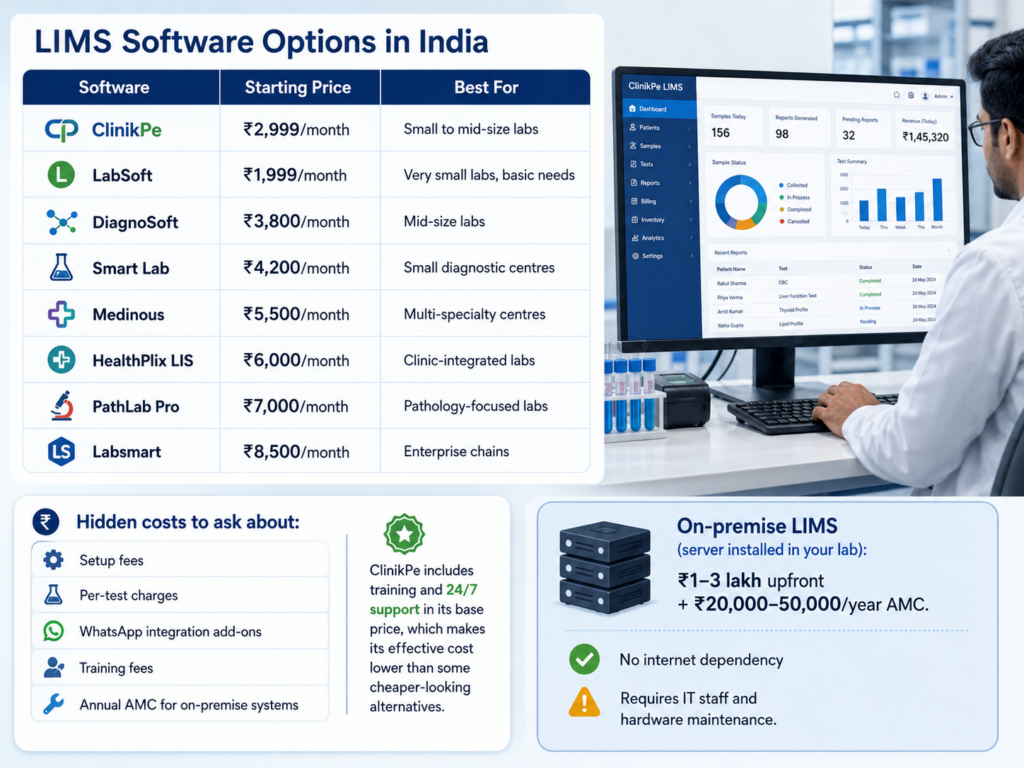
7. How Much Does a LIMS Cost in India?
LIMS pricing in India varies widely depending on whether it is cloud-based or on-premise, and the size of the lab.
| Software | Starting Price | Best For |
| ClinikPe | ₹2,999/month | Small to mid-size labs |
| LabSoft | ₹1,999/month | Very small labs, basic needs |
| DiagnoSoft | ₹3,800/month | Mid-size labs |
| Smart Lab | ₹4,200/month | Small diagnostic centres |
| Medinous | ₹5,500/month | Multi-specialty centres |
| HealthPlix LIS | ₹6,000/month | Clinic-integrated labs |
| PathLab Pro | ₹7,000/month | Pathology-focused labs |
| Labsmart | ₹8,500/month | Enterprise chains |
Hidden costs to ask about: setup fees, per-test charges, WhatsApp integration add-ons, training fees, and annual AMC for on-premise systems. ClinikPe includes training and 24/7 support in its base price, which makes its effective cost lower than some cheaper-looking alternatives.
On-premise LIMS (server installed in your lab): typically ₹1–3 lakh upfront + ₹20,000–50,000/year AMC. No internet dependency, but requires IT staff and hardware maintenance.
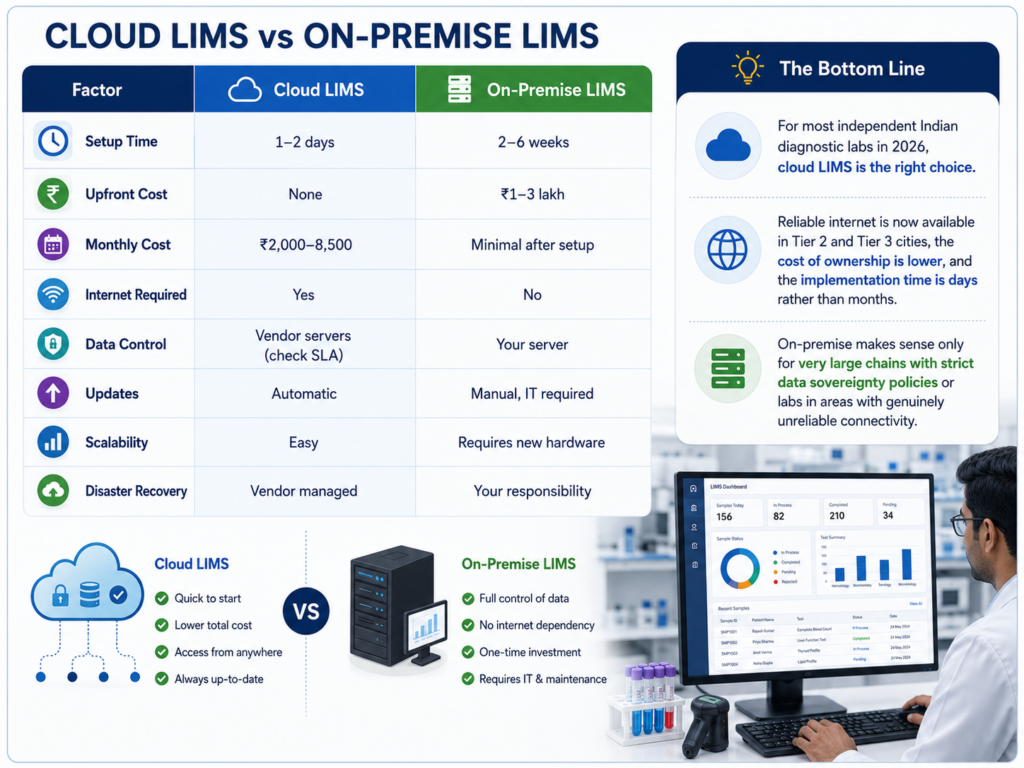
8. Cloud LIMS vs On-Premise LIMS:
| Factor | Cloud LIMS | On-Premise LIMS |
| Setup Time | 1–2 days | 2–6 weeks |
| Upfront Cost | None | ₹1–3 lakh |
| Monthly Cost | ₹2,000–8,500 | Minimal after setup |
| Internet Required | Yes | No |
| Data Control | Vendor servers (check SLA) | Your server |
| Updates | Automatic | Manual, IT required |
| Scalability | Easy | Requires new hardware |
| Disaster Recovery | Vendor managed | Your responsibility |
For most independent Indian diagnostic labs in 2026, cloud LIMS is the right choice. Reliable internet is now available in Tier 2 and Tier 3 cities, the cost of ownership is lower, and the implementation time is days rather than months. On-premise makes sense only for very large chains with strict data sovereignty policies or labs in areas with genuinely unreliable connectivity.
9. ClinikPe vs the Other Major LIMS Options in India:
ClinikPe is a cloud-based LIMS software built specifically for Indian diagnostic labs, clinics, and independent doctors. It is designed around one core idea: every patient interaction should be measurable, traceable, and growth-driving.
What ClinikPe does differently:
- Zero manual data entry — 100% analyzer integration via HL7/ASTM protocols means results flow directly from your machine to the report.
- WhatsApp report delivery with QR verification — reports reach patients in under 30 seconds after sign-off, with a scannable QR code for authenticity.
- Doctor referral tracking — every test attributed to the referring doctor, automatically. This gives you real data to manage and grow referral relationships.
- Online lab booking via QR code — no website needed. Patients scan, book, and get confirmed.
- NABL-ready compliance — built-in QC logs, audit trails, and documentation meet accreditation requirements.
- Revenue intelligence — day-end reports, unbilled test detection, and inventory consumption tracking in a single dashboard.
ClinikPe vs CrelioHealth: CrelioHealth is enterprise-grade software suited for large diagnostic chains with dedicated IT teams and budgets above ₹5,000/month. ClinikPe is designed for small to mid-size labs that want full automation without a 2-week implementation process. Most single-location and 2–3 branch labs will find ClinikPe easier to deploy, faster to learn (1–2 days), and more cost-effective.
ClinikPe vs Labsmart: Labsmart starts at ₹8,500/month and is excellent for enterprise chains. For a lab doing 100–500 tests per day, ClinikPe delivers equivalent core functionality at roughly one-third the price. ClinikPe starts at ₹2,999/month with a 14-day free trial and no credit card required.
FAQs About LIMS for Indian Diagnostic Labs:-
LIMS stands for Laboratory Information Management System. It is software that automates and manages the complete workflow of a diagnostic or pathology lab.
In the Indian diagnostic market, LIMS and LIS (Laboratory Information System) are often used interchangeably. Technically, LIS focuses more on clinical reporting and patient results, while LIMS emphasizes sample tracking and data management. Most modern platforms like ClinikPe combine both functions.
If you process 50+ samples per day, yes. The reduction in errors, the WhatsApp delivery capability, and the billing automation typically pay for the monthly subscription cost within the first week of operation.
Reputable cloud LIMS platforms use encrypted storage and access controls. Check that your vendor complies with India’s DPDP Act (Digital Personal Data Protection Act, 2023) and provides a clear data processing agreement.
Yes, if the LIMS supports HL7 or ASTM protocols — the two universal standards for lab instrument communication. ClinikPe supports both. Always confirm compatibility with your specific analyzer model before purchasing.
Cloud LIMS platforms like ClinikPe go live in 1–2 days. On-premise systems can take 2–6 weeks. Most of the setup time is spent on data migration (importing patient history and test menus) rather than on software installation.
A HIS covers the entire hospital — OPD, IPD, pharmacy, HR, and the lab — as a single module. A LIMS is purpose-built for the lab workflow. Standalone diagnostic centers need a LIMS, not a full HIS.
Significantly. NABL requires documented QC procedures, audit trails, equipment calibration records, and a sample chain of custody. A LIMS generates all of these automatically. Doing it manually is possible but extremely time-consuming.
Yes. Platforms like ClinikPe automatically log which doctor referred each test, giving you data on referral volumes, high-value referrers, and trends over time. This turns referral management from guesswork into a measurable growth strategy.
The five non-negotiables: analyzer integration (HL7/ASTM), WhatsApp/digital report delivery, GST-compliant billing, NABL-ready QC features, and responsive local support. Pricing matters, but hidden costs — setup fees, per-test charges, add-on integrations — matter more than the headline monthly rate.
The Bottom Line
LIMS is not optional for a growing Indian diagnostic lab in 2026. It is the infrastructure that separates labs that scale from labs that stagnate. Manual systems create errors, lose revenue, and increasingly frustrate patients who expect digital-first service.
The right LIMS for most small to mid-size pathology labs in India is one that is cloud-based, integrates with your analyzers, delivers reports on WhatsApp, and costs under ₹5,000/month — all without requiring an IT team or a 6-week implementation.
ClinikPe was built for exactly this use case. If you want to see what automated lab operations look like in practice, the 14-day free trial requires no credit card and takes less than a day to set up. Book a free demo today.