Quick answer
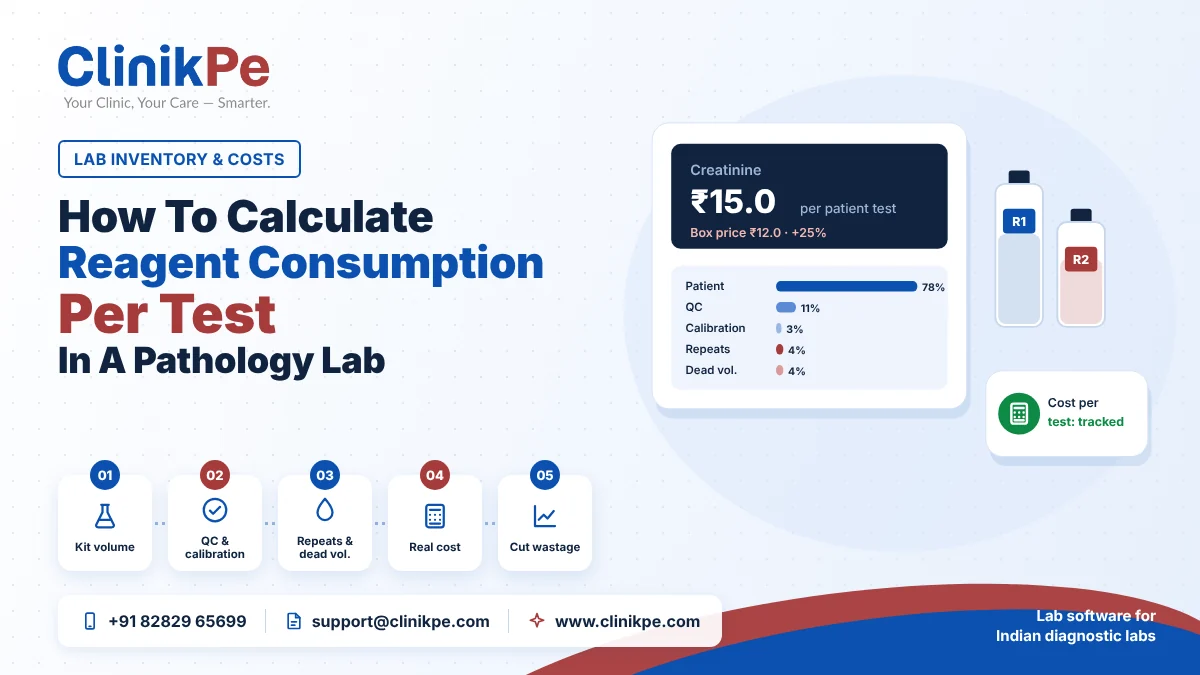
Reagent consumption per test is the reagent volume used per run (from the kit insert) plus a share of QC, calibration, repeats, dead volume and expired reagent. Real cost per patient test = kit price ÷ patient tests actually reported from the kit. It’s usually 10–50% higher than the price on the box, and highest on low-volume tests.
Key takeaways
- The tests a kit gives are set by whichever reagent (R1 or R2) runs out first.
- QC, calibration, repeats, dead volume and on-board expiry all use reagent but never reach a patient report.
- Real cost per patient test = kit price ÷ patient tests actually reported.
- Low-volume tests have the biggest gap between box price and real cost.
- Matching pack size to volume and using FEFO are the quickest savings.
Why the price on the kit isn’t your cost per test
A reagent kit rated for 400 tests almost never produces 400 patient reports. Some reagent goes to quality control, some to calibration, some to repeats, and some stays in the bottle as dead volume the analyzer can’t aspirate. If the kit expires on board before you finish it, the rest goes in the bin.
Labs that price tests from the box figure (kit price divided by rated tests) consistently under-estimate their cost. On low-volume tests the gap can be 50% or more, which is enough to turn a profitable test into a loss.
The fix is simple: count everything the kit is used for, not just patient tests. The rest of this guide shows how.
Step 1: Work out how many tests the kit can really give
Start with the kit insert. It lists the volume of each reagent (R1, R2) and the volume used per test on your analyzer. The reagent that runs out first sets the number of tests.
| R1 | R2 | |
|---|---|---|
| Volume in kit | 2 × 50 mL = 100 mL | 2 × 12.5 mL = 25 mL |
| Volume per test (from insert) | 180 µL | 45 µL |
| Tests possible | 100,000 ÷ 180 = 555 | 25,000 ÷ 45 = 555 |
Two points matter here:
- Semi-automatic analyzers use much more reagent per test. Many semi-auto methods use 500 µL to 1 mL of working reagent per test, against 100 to 250 µL on most fully automatic systems. The same kit gives far fewer tests.
- Dead volume comes off the top. Every bottle leaves some reagent the probe can’t reach. Take 3 to 8% off as a starting figure, then measure your own by checking what’s left in finished bottles.
Step 2: Add the tests that never reach a patient
Next, list everything else the kit is used for during its life on the analyzer.
| Use | How to count it | Typical figure |
|---|---|---|
| Quality control | Number of QC levels × runs a day × days the kit is open | 2 levels a day for most chemistry tests |
| Calibration | Calibrator levels × replicates × calibrations (new lot, new bottle, QC failure) | 4 to 12 tests a month |
| Repeats and reruns | Repeat rate × patient tests | 2 to 5%, higher for dilutions and flags |
| Expiry on board | Tests left when opened-kit stability runs out | Depends on volume; often the biggest loss on low-volume tests |
On a busy test such as glucose, QC and calibration are a small share of the kit. On a test you run five times a day, two QC levels a day are almost a third of your reagent use. That’s why low-volume tests carry the highest real cost per test.
Step 3: Calculate the real cost per patient test
The formula is:
Real reagent cost per patient test = kit price ÷ patient tests actually reported from that kit
And patient tests from a kit are what’s left after QC, calibration, repeats, dead volume and expiry. Try it with your own numbers:
Reagent cost-per-test calculator
Example values are for a creatinine kit on a fully automatic analyzer. Change them to match your kit insert and workload.
Price per test on the box
₹12.00
Real cost per patient test
₹15.05
Patient reports per kit
319 of 400
Each patient test really costs 25% more than the box price. The kit lasts about 21 days at this workload.
With the example values (a ₹4,800 creatinine kit rated for 400 tests, 15 patient tests a day, 2 QC runs a day), the real cost is about ₹15 per patient test, not the ₹12 on the box. That’s 25% more than the box figure, before you add tips, cuvettes, sample cups and tubes.
Step 4: Add consumables and the rest of the test cost
Reagent is usually the biggest variable cost, but it isn’t the only one. For a full cost per test, add:
- Sample collection: vacutainer, needle, swab and label
- Analyzer consumables: cuvettes, tips, cleaning solution and system water
- Controls and calibrators, if you haven’t already counted them in the kit
- A share of fixed costs: staff, rent, power, equipment and software
Our cost per test guide walks through the full calculation, including how to share fixed costs across tests.
How to cut reagent cost per test
- Match pack size to volume. If the calculator shows kits expiring before they’re used up, buy smaller packs even if the price per test on the box is higher.
- Batch low-volume tests. Running a rare test twice a week instead of daily cuts QC runs sharply. Check that your turnaround time promises still hold.
- Bring repeats down. Track why you repeat (hemolysis, insufficient sample, flags, dilutions) and fix the top cause. Our guide to reducing sample rejection helps here.
- Use FEFO, not FIFO. Issue the kit that expires first, not the one that arrived first, and record the lot number when you open it.
- Reconcile every month. Compare tests billed with tests the analyzer ran and kits consumed. A big gap means wastage, unbilled tests or both.
Tracking consumption in software instead of registers
A register or spreadsheet can work for a handful of tests, but it breaks down as test menus grow. Lab software makes the calculation automatic when it links three things:
- Test-to-reagent mapping: each test knows which kit it uses and how much per run
- Kit and lot records: when each kit was opened, its lot number and its expiry
- Billing and QC data: how many patient, QC and repeat runs actually happened
With those linked, the software can deduct stock as you report, warn you before you run out, and show real cost per test by month. That’s also what NABL assessors want to see under ISO 15189 for reagent records. Read more about lab inventory management.
Frequently asked questions
Divide the volume of each reagent in the kit by the volume used per test on your analyzer (from the kit insert or application sheet). The reagent that runs out first sets the number of tests. Then subtract dead volume, QC runs, calibrations, repeats and any reagent that expires on board to get the number of patient tests the kit really gives.
Real reagent cost per patient test = kit price ÷ patient tests actually reported from that kit. The box figure (kit price ÷ rated tests) is always lower because it ignores QC, calibration, repeats, dead volume and expiry.
It varies with test volume. On busy tests, QC, calibration and dead volume may add 10 to 20% to the box cost per test. On low-volume tests, where QC is a large share of runs and kits can expire on board, the real cost can be 50% or more above the box price.
Semi-automatic analyzers usually need a larger working-reagent volume per test, often 500 µL to 1 mL, because of their flow cells and manual pipetting. Fully automatic analyzers commonly use 100 to 250 µL, so the same kit produces several times more tests.
Yes. QC uses the same reagent as patient tests and is required for every run. Share the QC reagent across the patient tests in the period. The same applies to calibration.
Yes, if it maps each test to its reagent and deducts stock as tests are reported. ClinikPe’s automatic reagent consumption tracking, now in early access, does this and shows low-stock alerts and real cost per test.
See your real cost per test, every month
Tell us your test menu and analyzers. We’ll show how ClinikPe tracks reagent use and cost per test, and add you to the auto-consumption early access list.
No setup, migration or training fees · Free trial on cloud plans
Sources
- ISO 15189:2022 Medical laboratories — Requirements for quality and competence (ISO)
- ClinikPe: cost per test calculation guide
Written by the ClinikPe lab operations team in Kolkata. General information, not legal, tax or medical advice; check the sources and your state rules before acting.