Quick answer
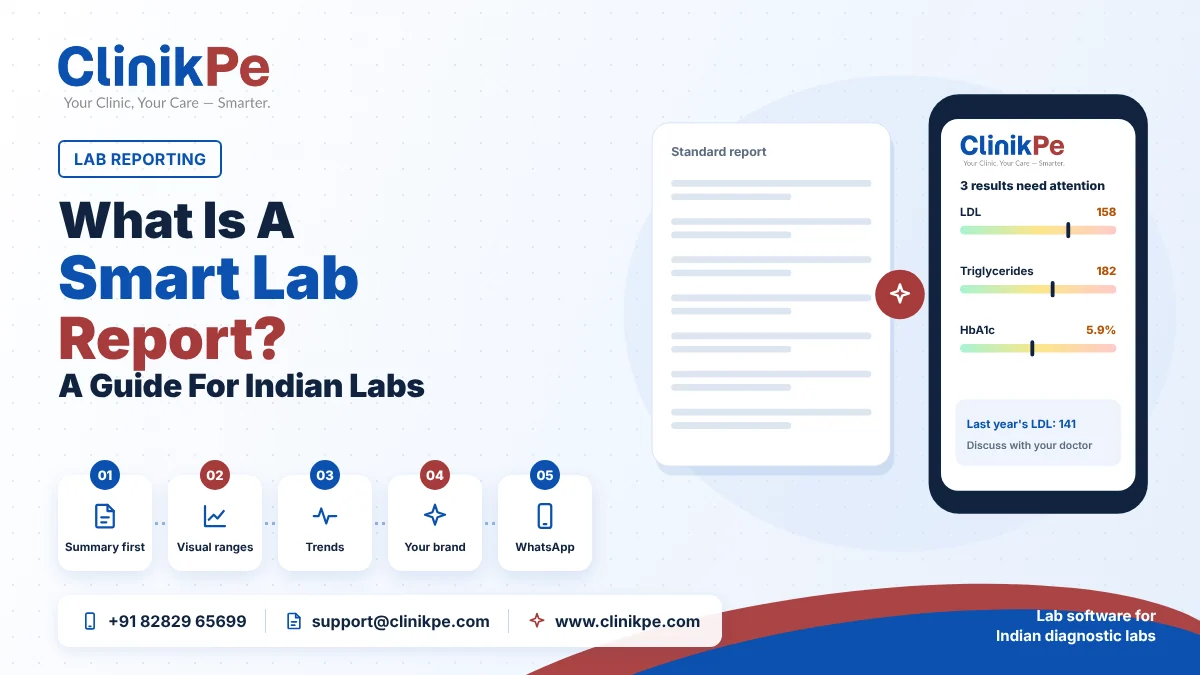
A smart lab report presents the same validated results as a standard report, but puts out-of-range results first, shows each value against its reference range, adds previous results and short plain-language notes, and wraps it in a branded cover. The full report, units and pathologist’s signature stay intact. It doesn’t diagnose; it helps patients and doctors read results faster.
Key takeaways
- A smart report adds a summary, visual ranges, trends and plain notes to the standard report.
- The full report and pathologist’s signature stay; the smart layer doesn’t replace them.
- It mustn’t diagnose; notes explain what a test measures and point to the doctor.
- Packages and numeric tests benefit most; narrative reports don’t fit.
- Correct age- and sex-based reference ranges come first.
What a smart lab report is
A smart lab report presents the same validated results as a standard report, but organised for the person reading it. It usually adds:
- A summary page that lists the results outside the reference range first
- Visual ranges: a bar or gauge showing where each result sits
- Trends: the patient’s previous results for the same test
- Plain-language notes on what each test measures
- Branding: a cover page with the lab’s name, a QR code to verify the report, and contact details
The full standard report, with units, methods, reference ranges and the pathologist’s signature, stays in the document. The smart layer sits on top of it; it doesn’t replace it.
| Test | Result | Units | Ref. range |
|---|---|---|---|
| Total cholesterol | 236 | mg/dL | <200 |
| LDL cholesterol | 158 | mg/dL | <100 |
| HDL cholesterol | 42 | mg/dL | >40 |
| Triglycerides | 182 | mg/dL | <150 |
| HbA1c | 5.9 | % | <5.7 |
3 results need attention
- LDL cholesterolHigh · 158
- TriglyceridesHigh · 182
- HbA1cBorderline · 5.9%
Last year’s LDL: 141. Please discuss these results with your doctor.
Illustration only, with made-up values. The smart summary doesn’t diagnose; it points the patient to their doctor.
Why labs are switching
- Patients understand their reports. A typical health package runs to 60–80 parameters over several pages. Patients look for the red flags first; a summary page shows them.
- Doctors read faster. Seeing abnormal results and the previous value side by side saves time in a busy OPD.
- Fewer “is this normal?” calls to the front desk.
- The report markets the lab. Patients share reports on WhatsApp with family and doctors. A clear, branded report is the lab’s most-viewed marketing material, and it’s a reason for a patient to come back.
What a smart report must not do
Making reports friendlier mustn’t make them less accurate or more alarming:
- No diagnosis. Plain-language notes should explain what a test measures and that results should be discussed with a doctor, not say what disease the patient has.
- No hidden detail. Doctors still need units, methods, reference ranges and the pathologist’s signature, as ISO 15189 requires.
- Correct reference ranges by age and sex, so the colours are right.
- Critical results are still phoned, not just coloured red; see our guide to critical value reporting.
- Not every test fits. Histopathology, cytology and culture reports are narrative and shouldn’t be squeezed into gauges.
Standard vs smart: what changes
| Standard report | Smart report | |
|---|---|---|
| Order of results | By department and test | Out-of-range results first, then the full report |
| Reference ranges | Numbers in a column | Numbers plus a visual range |
| Previous results | Rarely shown | Shown as a trend where available |
| Explanations | None | Short, non-diagnostic notes on what each test measures |
| Branding | Letterhead | Cover page, QR verification, contact and booking details |
| Pathologist signature and method details | Yes | Yes, unchanged |
How to start smart reporting in your lab
- Fix your reference ranges by age and sex in your software first. Colours are only as good as ranges.
- Start with packages (full body, diabetes, thyroid, lipid), where patients struggle most with long reports.
- Agree the wording of test explanations with your pathologist.
- Choose a cover design that carries your lab’s name and colours.
- Deliver on WhatsApp with a PDF that opens well on phones.
- Ask doctors whether the summary helps them, and adjust.
See the report cover designs for examples.
Frequently asked questions
A smart lab report shows the same validated results as a standard report, but adds a summary of out-of-range results, visual reference ranges, previous results for comparison and short plain-language notes, usually with a branded cover. The full standard report and pathologist’s signature remain part of it.
No. A smart report changes how results are presented; it doesn’t diagnose. Explanations should describe what a test measures and advise the patient to discuss results with their doctor.
Yes, when the full standard report is still included. Doctors generally welcome a summary of abnormal results and previous values, as long as units, reference ranges, methods and the pathologist’s signature are all there.
Numeric tests and health packages suit them best: CBC, lipid profile, thyroid, liver and kidney function, HbA1c and vitamins. Narrative reports such as histopathology, cytology and culture are better left in their standard format.
It can, if the report still contains everything ISO 15189 requires, including patient identification, results with units, reference intervals, method where relevant, critical-result indication and authorisation. The smart summary is an addition, not a replacement.
Put out-of-range results first, show where each value sits in its reference range, include previous results, add short non-diagnostic explanations, and send the report as a phone-friendly PDF on WhatsApp. Lab software with smart reporting does this automatically.
See your report as a smart report
Send us one of your current reports. On the demo we’ll show the same results as a ClinikPe Smart Report on your letterhead.
No setup, migration or training fees · Free trial on cloud plans
Sources
Written by the ClinikPe lab operations team in Kolkata. General information, not legal, tax or medical advice; check the sources and your state rules before acting.