Quick answer
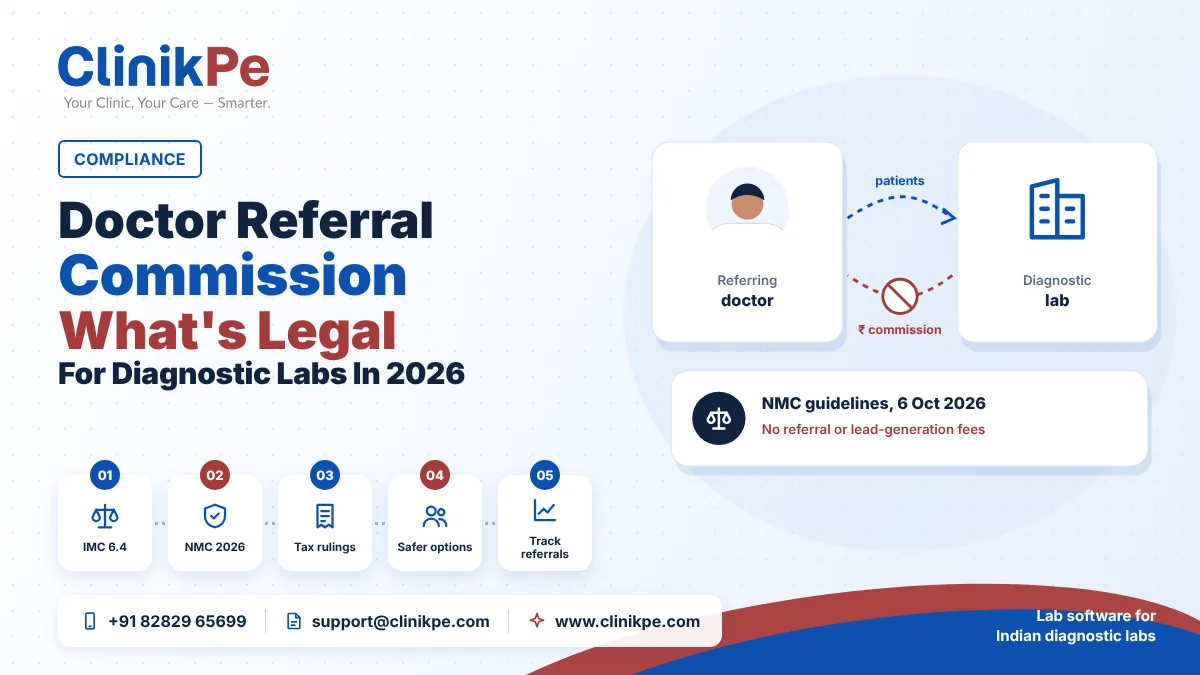
Paying doctors commission for referring patients or samples is prohibited for doctors under clause 6.4 of the IMC Ethics Regulations 2002. NMC’s new advertising guidelines of 6 October 2026 explicitly bar referral and lead-generation fees. Labs also can’t deduct such payments for tax (Apex Laboratories, 2022). Tracking referrals is fine; paying for them is the risk.
Key takeaways
- IMC Regulations 2002, clause 6.4, bars doctors from taking commission for referring patients or specimens.
- NMC’s 6 October 2026 guidelines explicitly bar referral and lead-generation fees.
- Referral fees paid by labs aren’t tax-deductible (Apex Laboratories, Fidelity Diagnostics).
- Paying for genuine professional work, B2B rates and better service are the common alternatives.
- Tracking referrals to manage service quality is legitimate and useful.
Is paying doctors for referrals legal?
For the doctor, no. Clause 6.4 of the Indian Medical Council (Professional Conduct, Etiquette and Ethics) Regulations 2002 bars a physician from giving, soliciting, receiving or offering any gift, gratuity, commission or bonus for referring a patient. Clause 6.4.2 extends this to referring “specimen or material for diagnostic purposes”, which covers labs directly.
The National Medical Commission’s 2023 professional conduct regulations were put on hold within weeks, so the 2002 regulations still apply.
On 6 October 2026 the NMC went further with its Guidelines on Ethical Advertising and Public Communication:
- Clause 8.1(vii) bars any “commission, rebate, bonus, referral fee, lead-generation fee” linked to referring patients or specimens.
- Clause 8.1(viii) bans agency, influencer or platform payments tied to referrals.
- Clause 8.1(x) bars discounts, coupons or free procedures likely to encourage unnecessary tests.
- Penalties run from a warning to suspension of the doctor’s registration; “inducement for patients” counts as serious.
The guidelines bind doctors, hospitals and platforms rather than labs directly. But a lab that pays a commission is the other side of the same transaction, and state clinical establishment laws can treat it as an unfair practice.
What it means for your lab
Even setting medical ethics aside, three risks fall on the lab itself:
- Tax: in Apex Laboratories v DCIT (2022) the Supreme Court held that freebies to doctors are prohibited by law and can’t be deducted as business expenses. In Fidelity Diagnostics v DCIT (ITAT Pune, 2022) about ₹1 crore of referral fees paid by a diagnostic centre to doctors and nursing homes was disallowed. The new Income-tax Act, in force from 1 April 2026, keeps the same bar on expenses that are “prohibited by law”.
- Licence: state acts, such as the West Bengal Clinical Establishments Act 2017, make “unethical or unfair trade practices” a licence condition and a complaint ground. No court has yet applied this to lab commissions specifically, but it’s an obvious route.
- Reputation: patients and doctors increasingly know about cut practice, and a complaint to a state medical council names the lab as well as the doctor.
What labs can do instead
Labs still need doctors to trust them and send patients. These are common, more defensible ways to build that relationship. None is a guaranteed safe harbour, and any payment linked to referral volume is risky.
| Approach | Why it’s lower risk | Watch out for |
|---|---|---|
| Pay a pathologist or consultant for real work | Fees for genuine professional services, such as supervising or reporting, are expected; deduct TDS on professional fees | Payments with no real work behind them, or that scale with referrals |
| B2B rates to clinics and hospitals that bill patients themselves | The clinic is your customer and sets its own patient price | Rates so low they act as a disguised commission |
| Salaried marketing staff | Staff visit doctors, explain your tests and fix service problems | Incentives tied to individual doctors’ referral volumes |
| Better service | Fast TAT, home collection, WhatsApp reports to the doctor, critical-value calls | Nothing; this is what doctors value most |
| Patient discounts and health packages | Reduce cost for the patient | Offers that encourage unnecessary tests (NMC 2026 cl. 8.1(x)) |
What doctors value most is reliable results on time, a report they can read quickly, and a lab that calls them when something is critical. Our guide on getting more doctor referrals covers the service side in detail.
Why you should still track referrals, carefully
Tracking which doctor sent each patient is legitimate and useful. It’s the payment you link to it that creates risk. Good referral tracking shows you:
- Which doctors and clinics send you patients, and how that changes month to month
- When a doctor’s referrals suddenly drop, often a sign of a service problem such as a late report or a lost sample
- Which tests each doctor orders most, so you can stock and staff for them
- TAT and repeat-sample rates by referring doctor, so you can fix service issues before you lose the relationship
How to set up referral tracking
- Capture the referrer at registration. Make “referred by” a required field, with a master list of doctors and clinics so names aren’t spelled five ways.
- Separate B2B clients from referring doctors. A clinic that pays you and bills its own patients is a B2B account with its own rate list and credit terms.
- Review monthly. Look at volume by referrer, drops of 30% or more, TAT and complaints.
- Act on service, not payments. When referrals drop, call the doctor and ask what went wrong.
- Keep records clean. Every payment to a doctor should be a documented professional fee for real work, with TDS deducted.
Read our guide on how to track doctor referrals for report formats.
Frequently asked questions
No, not for the doctor. Clause 6.4 of the IMC (Professional Conduct, Etiquette and Ethics) Regulations 2002 bars doctors from receiving any commission or bonus for referring patients or specimens, and NMC’s Guidelines on Ethical Advertising (6 October 2026) explicitly bar referral fees and lead-generation fees linked to patient or specimen referrals.
No. Following the Supreme Court’s Apex Laboratories ruling (2022), payments to doctors that are prohibited by law aren’t deductible. In Fidelity Diagnostics v DCIT (2022), the Pune ITAT disallowed about ₹1 crore of referral fees paid by a diagnostic centre.
Cut practice is paying a doctor a share of the patient’s bill, usually 20–40%, for referring tests to a lab. It raises costs for patients, can encourage unnecessary tests, and is prohibited for doctors under medical ethics regulations.
NMC’s Guidelines on Ethical Advertising and Public Communication, issued on 6 October 2026, bar any commission, rebate, bonus, referral fee or lead-generation fee linked to patient or specimen referrals, ban platform and influencer payments tied to referrals, and restrict discounts that encourage unnecessary tests. Penalties range from a warning to suspension.
Many labs supply tests to clinics and hospitals at B2B rates, with the clinic billing its own patients. This is common business practice, but rates that work as a disguised commission to a doctor carry the same risk. Document the arrangement and take advice.
Yes. Recording which doctor referred each patient is normal practice and helps a lab manage service quality, spot drops and plan capacity. The risk comes from linking payments to those referrals.
Track referrals without the risk
See referral volume, drop-offs and TAT by doctor and clinic in ClinikPe, alongside B2B rate lists for the clinics you supply.
No setup, migration or training fees · Free trial on cloud plans
Sources
- NMC Guidelines on Ethical Advertising and Public Communication, 6 Oct 2026
- IMC Regulations 2002 clause 6.4 (Telangana council notice, Medical Dialogues)
- NMC 2023 regulations put on hold (DT Next)
- Apex Laboratories v DCIT, Supreme Court 2022 (ITATonline)
- Fidelity Diagnostics v DCIT, ITAT Pune 2022
- Income-tax Act 2025, section 34
- West Bengal Clinical Establishments Act 2017
Written by the ClinikPe lab operations team in Kolkata. This is general information as of October 2026, not legal or tax advice. The rules changed this month, so take professional advice about your own arrangements.