Prescriptions are one of the most important components of clinical consultations. Traditionally, doctors have written prescriptions by hand during patient visits. While handwritten prescriptions remain common in many clinics across India, they often create challenges for both patients and healthcare providers.
Illegible handwriting, misplaced prescription copies, and difficulty maintaining prescription records can create operational inefficiencies in clinic workflows. Patients may also struggle to interpret handwritten prescriptions, leading to confusion when purchasing medications from pharmacies. As clinics adopt digital tools to manage patient records and appointments, digital prescription systems are becoming increasingly popular.
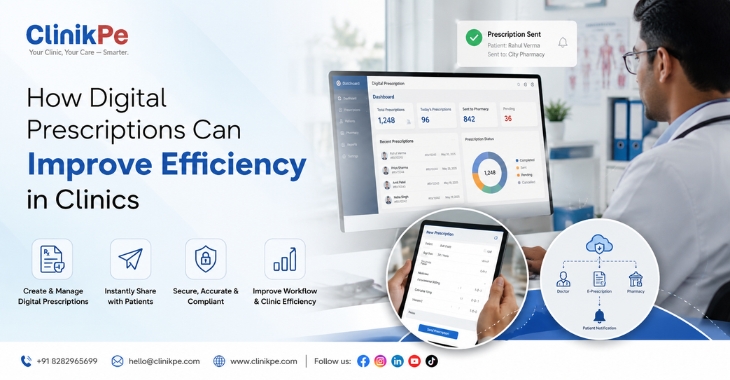
Electronic prescriptions allow doctors to generate prescriptions digitally, store them as part of the patient’s medical record, and share them instantly with patients. Digital prescriptions not only improve documentation but also help clinics maintain organized patient records while reducing administrative workload.
In this article, we explore the practical benefits of digital prescriptions and how clinics can use them to improve operational efficiency.
The Problem Explained:
Handwritten prescriptions have been used in clinical practice for many years, but they can create several operational challenges.
Common issues include:-
- difficulty reading handwritten prescriptions
- misplaced prescription copies
- lack of centralized prescription records
- difficulty retrieving previous prescriptions
- limited documentation for patient history
For example, when a patient returns for a follow-up consultation, doctors may not have immediate access to the previous prescription unless physical records were stored carefully. Similarly, pharmacists sometimes struggle to interpret handwritten prescriptions, which can lead to clarification calls or medication confusion. These issues make it harder for clinics to maintain consistent documentation.
Why This Happens in Indian Labs/Clinics:
Several factors contribute to the continued use of handwritten prescriptions.
Traditional clinical practices
Many clinics have used handwritten prescriptions for decades and are comfortable with these workflows.
Lack of digital systems
Clinics without digital record systems often rely on manual documentation.
Limited patient record management
Without centralized patient records, clinics may not have structured systems to store prescription history.
Time constraints during consultations
Doctors may feel that handwritten prescriptions are quicker during busy consultation hours.
However, as patient volumes grow, maintaining organized prescription records becomes increasingly important.
Practical Solutions:
Clinics can improve prescription management by gradually introducing digital prescription systems.
1. Generate prescriptions digitally
Doctors can create prescriptions using digital templates that ensure clear and structured formatting.
2. Maintain prescription history
Digital systems allow clinics to store all prescriptions as part of the patient’s medical record.
3. Share prescriptions electronically
Patients can receive prescriptions through email, SMS links, or downloadable formats.
4. Improve medication clarity
Digital prescriptions eliminate handwriting issues, making instructions easier for patients and pharmacists to read.
5. Reduce administrative workload
Digital systems automatically store prescriptions, reducing the need for manual record management.
Technology’s Role:
Digital clinic systems often include electronic prescription features that integrate with patient management workflows.
A Clinic Management System can support digital prescriptions through features such as:
- electronic prescription templates
- patient record integration
- digital prescription storage
- secure prescription sharing
- consultation history tracking
These capabilities allow doctors to maintain organized patient records while improving documentation quality. Digital systems also make it easier for clinics to retrieve previous prescriptions during follow-up visits. You can [Explore our Clinic Management System] to understand how digital prescription tools support clinic workflows. You may also want to read [Manual vs Digital Clinic Management] to see how digital systems improve clinic operations.
Implementation Tips:
Clinics planning to introduce digital prescriptions can follow a structured approach.
Implementation Checklist
✔ Implement digital patient record systems
✔ Use standardized digital prescription templates
✔ Train doctors and staff on electronic prescription workflows
✔ Maintain secure prescription storage
✔ Provide patients with digital prescription access
✔ Ensure compliance with patient data privacy practices
✔ Monitor feedback from patients and pharmacists
These steps help clinics transition smoothly to digital prescription systems.
If you’re evaluating clinic software tools, you can also [View Clinic Software Pricing].
Final Takeaway
Digital prescriptions offer several advantages for modern clinics. They improve documentation, reduce handwriting errors, and help clinics maintain organized patient records.
As healthcare services become increasingly digitized, electronic prescription systems allow clinics to streamline workflows while improving communication with patients and pharmacies.
By adopting digital prescription systems, clinics can improve both operational efficiency and the overall patient experience.
Explore our Clinic Management System
FAQ Section
A digital prescription is an electronically generated prescription that doctors create using clinic management software.
Yes. Digital prescriptions are permitted as long as they follow appropriate medical guidelines and include necessary doctor details.
Digital prescriptions help maintain organized patient records, reduce handwriting errors, and simplify prescription storage.
Yes. Digital systems allow patients to access prescription records whenever needed.
Yes. Electronic systems automatically store prescriptions and integrate them with patient records.