The diagnostic laboratory industry in India has seen rapid growth over the past decade. Increasing health awareness, preventive diagnostics, and rising demand for medical testing have created significant opportunities for new labs. However, many small diagnostic labs struggle to scale their operations even when patient demand exists.
A lab may start with a steady flow of patients and a small team, but as test volumes grow, operational challenges begin to appear. Manual workflows, inefficient sample tracking, and delayed reporting can quickly create bottlenecks that limit growth.
For lab owners, the problem is not always a lack of demand—it is often a lack of structured operational systems. Without efficient processes, labs find it difficult to manage increasing test volumes while maintaining accuracy and timely report delivery.
Understanding why small labs fail to scale is important for diagnostic lab owners who want to grow sustainably in a competitive healthcare environment. In this article, we explore the common operational challenges that prevent many small labs from scaling and the practical steps labs can take to overcome these barriers.
The Problem Explained:
Many diagnostic labs start operations with basic systems such as:-
- manual registers
- spreadsheets for patient records
- handwritten reports
- separate billing systems
These systems may work when the lab processes 20–30 samples per day. However, as test volumes increase to 100 or more samples per day, manual workflows begin to create operational inefficiencies.
Common scaling problems include:-
- delayed report generation
- difficulty tracking samples
- data duplication
- billing inconsistencies
- staff dependency on manual processes
For example, when sample tracking is handled manually, staff may spend several minutes locating the status of a particular sample.
These small inefficiencies accumulate over time and slow down the entire workflow. As a result, labs may struggle to handle increasing patient volume even when demand exists.
Why This Happens in Indian Labs/Clinics:
There are several reasons why many small labs in India face difficulties when trying to scale operations.
Dependence on manual workflows:
Many labs rely on manual data entry and spreadsheet-based management systems.
As operations grow, these systems become difficult to manage.
Limited operational visibility:
Lab owners often lack access to real-time operational data such as:-
- sample status
- test turnaround time
- daily workload distribution
Without these insights, identifying bottlenecks becomes difficult.
Staff overload:
When administrative tasks increase, lab staff spend more time on paperwork instead of core lab operations. This reduces productivity.
Lack of digital infrastructure:
Labs without digital management systems often struggle to maintain operational consistency as patient volume grows.
Practical Solutions:
Labs that want to scale successfully must focus on improving operational efficiency.
Here are several practical strategies:-
Standardize lab workflows:
Create clear processes for:-
- patient registration
- sample collection
- test processing
- report generation
Standardization improves operational consistency.
Improve sample tracking:
Each sample should have a unique identifier to track its progress throughout the testing process. This reduces confusion and prevents delays.
Automate report generation:
Manual report preparation slows down workflows. Automated reporting systems help deliver results faster while maintaining consistency.
Monitor operational performance:
Labs should regularly track metrics such as:-
- daily test volume
- report turnaround time
- staff workload
This helps identify operational bottlenecks.
Strengthen referral relationships:
Doctor referrals remain an important source of patients for diagnostic labs. Maintaining reliable service quality encourages repeat referrals.
Technology’s Role:
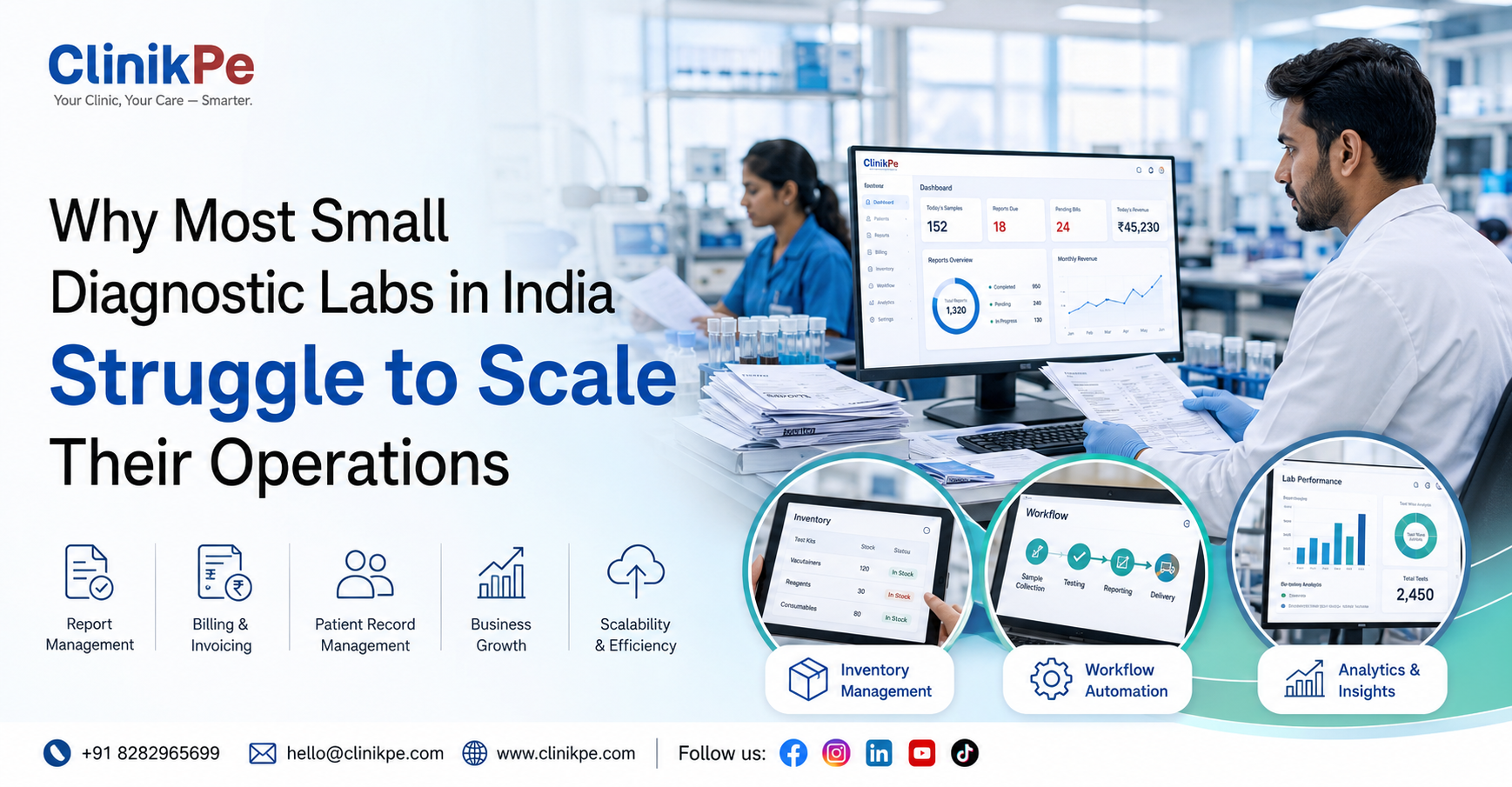
Technology plays an important role in helping diagnostic labs scale operations efficiently. A Lab Management System (LIMS) helps labs manage the entire workflow through a centralized platform.
Typical capabilities include:-
- patient registration
- sample tracking
- automated report generation
- billing integration
- referral management
- operational analytics
These systems reduce administrative workload and improve workflow transparency. Digital platforms also allow lab owners to monitor operations remotely and manage growing patient volumes more effectively. You can [Explore our Lab Management System] to see how digital tools streamline lab operations.
You may also want to read [Complete Guide to Lab Digitization] to understand how digital systems improve healthcare workflows.
Implementation Tips:
Labs planning to scale their operations should take a structured approach.
Implementation Checklist:-
✔ Review existing lab workflows
✔ Identify operational bottlenecks
✔ Introduce digital sample tracking
✔ Automate report generation
✔ Train staff on standardized processes
✔ Monitor turnaround time regularly
✔ Implement scalable lab management systems
Labs that improve operational efficiency are better prepared to handle higher patient volumes. If you’re evaluating lab software options, you can also [View Lab Management System Pricing].
Final Takeaway:
Many small diagnostic labs struggle to scale, not because of limited demand, but because of operational inefficiencies.
Manual workflows, lack of structured processes, and limited operational visibility can slow down lab operations as test volumes increase.
By improving workflow management and adopting digital lab management systems, labs can streamline operations and prepare for sustainable growth.
As the diagnostic industry continues to expand in India, labs that invest in efficient systems will be better positioned to scale their services and compete with larger diagnostic chains.
Explore our Lab Management System
FAQ Section
Many labs struggle to scale due to manual workflows, inefficient sample tracking, and limited operational visibility.
Labs can improve efficiency by standardizing workflows, automating reporting, and implementing digital lab management systems.
A Lab Management System (LIMS) is software designed to manage lab operations such as patient registration, sample tracking, and reporting.
Yes. Digital systems streamline workflows, reduce administrative workload, and improve operational transparency.
Yes. Many modern LIMS platforms are designed specifically for small and mid-sized diagnostic labs.