The diagnostic laboratory sector in India has grown rapidly over the past decade. Rising health awareness, preventive diagnostics, and increasing demand for medical testing have created significant opportunities for both new and established labs.
However, growth in the diagnostic industry is also accompanied by intense competition. Large diagnostic chains, hospital laboratories, and independent labs often compete for the same patient base.
For small and mid-sized diagnostic labs, growth is not only about acquiring new equipment or expanding test menus. Sustainable growth depends on efficient operations, strong referral networks, and patient trust.
Many labs struggle to grow because operational inefficiencies limit their ability to handle increasing test volumes. Delayed reports, poor sample tracking, and inconsistent referral management can prevent labs from scaling effectively.
This is why successful labs focus not only on diagnostic services but also on structured workflow management and technology adoption.
In this article, we explore practical strategies that diagnostic labs in India can use to grow test volumes, improve operational efficiency, and remain competitive in an evolving healthcare market.
The Problem Explained:
Many diagnostic labs reach a stage where growth slows down despite steady patient demand.
Common growth barriers include:-
- delayed report turnaround time
- inefficient sample tracking
- inconsistent referral management
- manual operational workflows
- lack of patient retention strategies
For example, a lab that processes 80 tests per day may struggle to increase its capacity to 150 tests per day if operational workflows remain manual.
When staff spend significant time on administrative tasks such as:-
- entering patient details
- preparing reports manually
- reconciling billing records
it becomes difficult to handle higher patient volumes efficiently.
As a result, labs may lose potential patients to competitors who deliver faster and more reliable services.
Why This Happens in Indian Labs/Clinics:
There are several reasons why many diagnostic labs find it difficult to scale operations.
Limited operational visibility:
Lab owners often lack access to data that shows:-
- test volume trends
- operational bottlenecks
- referral performance
Without these insights, planning growth becomes difficult.
Manual workflows:
Many labs continue using spreadsheets and paper registers to manage operations. These systems become inefficient as test volumes increase.
Weak referral networks:
In India, a large percentage of diagnostic patients come through doctor referrals. Labs that do not actively manage referral relationships may struggle to grow.
Lack of patient engagement:
Patients rarely return to labs that provide slow reports or inconsistent service. Operational inefficiencies therefore directly affect growth potential.
Practical Solutions:
Labs that want to grow should focus on improving both operations and patient acquisition strategies.
Improve report turnaround time:
Fast report delivery is one of the most important factors influencing patient and doctor satisfaction.
Labs that deliver reports quickly are more likely to receive repeat referrals.
Strengthen referral networks:
Diagnostic labs should actively build relationships with:-
- general physicians
- specialists
- clinics
- hospitals
Maintaining clear referral tracking also helps labs manage commissions and performance.
Expand test offerings strategically:
Adding high-demand diagnostic tests can help attract more patients. However, labs should expand test menus carefully based on local demand.
Improve patient experience:
Simple improvements can increase patient retention:-
- faster report delivery
- clear communication
- digital report access
Monitor operational performance:
Labs should regularly review metrics such as:-
- daily test volume
- turnaround time
- referral sources
These insights help identify growth opportunities.
Technology’s Role:
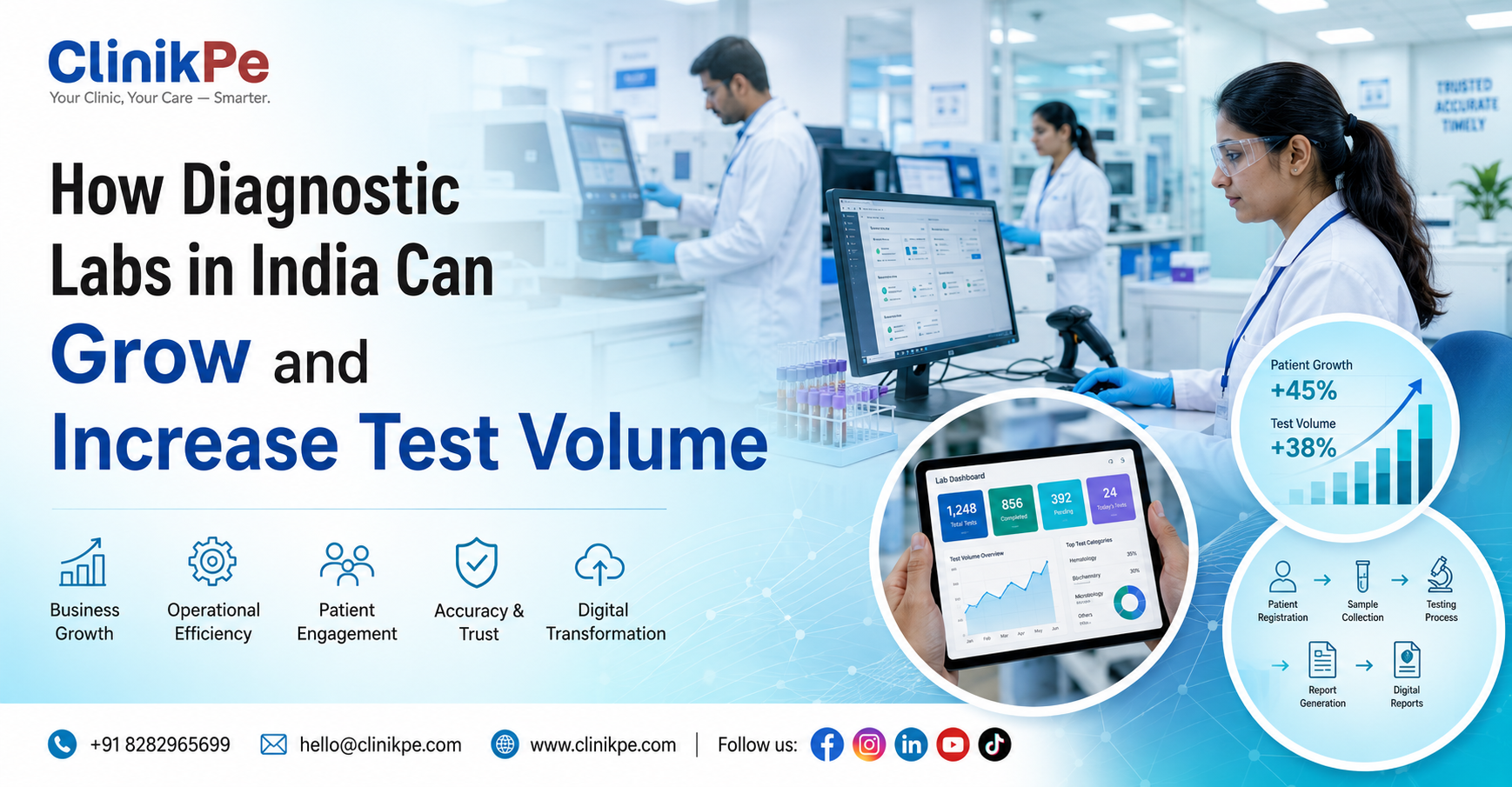
Technology plays an increasingly important role in helping diagnostic labs scale operations. A Lab Management System (LIMS) helps labs streamline workflows by automating many operational tasks.
Typical capabilities include:-
- patient registration
- sample tracking
- automated report generation
- billing integration
- referral tracking
- operational analytics
With centralized data, lab owners can monitor operational performance and identify areas for improvement. Digital systems also help labs manage multi-branch operations more efficiently. You can [Explore our Lab Management System] to see how digital tools improve lab operations. You may also want to read [] for a deeper understanding of digital healthcare workflows.
Implementation Tips:
Labs looking to grow should focus on gradual operational improvements.
Implementation Checklist:
✔ Analyze current test volume and workflow capacity
✔ Identify operational bottlenecks
✔ Improve report turnaround time
✔ Build strong referral partnerships
✔ Implement digital sample tracking
✔ Monitor patient feedback regularly
✔ Invest in scalable lab management systems
Labs that combine operational efficiency with strong referral networks often experience sustainable growth. If you’re evaluating digital lab tools, you can also [View Lab Management System Pricing].
Final Takeaway:
Growing a diagnostic lab requires more than increasing patient numbers. Sustainable growth depends on efficient operations, strong referral relationships, and consistent service quality. Labs that invest in structured workflows and digital infrastructure are better positioned to scale their operations and compete with larger diagnostic chains.
By improving operational efficiency and strengthening referral networks, diagnostic labs in India can steadily increase test volumes and build long-term success.
Explore our Lab Management System
FAQ Section
Labs can increase patient volume by improving referral networks, expanding test offerings, and delivering faster reports.
Faster reports improve patient satisfaction and encourage doctors to refer more patients to the lab.
Doctors and clinics often refer patients for diagnostic tests, making referral partnerships an important source of patient volume.
Yes. By focusing on service quality, faster reporting, and strong local relationships, small labs can compete effectively.
Lab software automates workflows, improves operational efficiency, and provides data insights that support growth strategies.