Quick answer
Fake lab reports are forged copies, reports from unqualified labs using rented signatures, or documents made from scratch, and they’re a crime under the Bharatiya Nyaya Sanhita. The best defence is a QR code on every report that opens a verification page on the lab’s own website, using a unique report ID, so anyone can compare a copy with the original in seconds.
Key takeaways
- Forging or using a fake medical report is punishable under BNS sections 336, 340 and 318.
- A QR code only helps if it leads to a page on the lab’s own website.
- Unique report IDs, digital signatures and audit trails make forgery easy to catch.
- NABL has moved to ULR numbers and QR codes for accredited labs.
- Tell insurers, employers and doctors how to verify your reports.
The problem: fake and forged reports are everywhere
Fake lab reports come in three forms. Some are forged copies of a real lab’s report, with values or names changed, often for insurance claims, leave or visas. Some come from labs that shouldn’t exist, run without a qualified pathologist and using a rented or forged signature. And some are made from scratch with templates or “report generator” tools.
Each one damages the lab whose name is on it. When a forged report surfaces, patients, doctors and insurers call the real lab, and its reputation takes the hit.
| When | Where | What happened |
|---|---|---|
| Sep 2025 | Uttar Pradesh | A newspaper sting found doctors “renting” their names to labs run by unqualified staff, for around ₹10,000 a month. False reports followed; five illegal labs were sealed in Agra. |
| Sep 2025 | Kochi, Kerala | Two partners of a lab were arrested for issuing medical fitness certificates for job seekers without examinations, using fake doctors’ seals. |
| Feb 2026 | Pune, Maharashtra | A pathologist who died in November 2025 kept “signing” reports until January 2026. An insurer spotted it during claim checks; the civil surgeon and municipal health department opened inquiries. |
| May 2026 | Sikar, Rajasthan | A doctor and a private lab operator were arrested for allegedly uploading fake reports to the state health scheme portal and altering report dates. |
What the law says
Making or using a fake medical report is a crime, not a shortcut. Under the Bharatiya Nyaya Sanhita 2023:
- Forgery (section 336) is punishable with up to 2 years, and up to 7 years when the forgery is for cheating.
- Using a forged document or electronic record as genuine (section 340) is punished as if you had forged it.
- Cheating (section 318) carries up to 7 years where it induces someone to hand over property, such as an insurance payout.
The IT Act adds offences for identity theft and cheating by personation using a computer resource (sections 66C and 66D). For labs, regulators have also acted against “selling signatures”: the Delhi Medical Council has suspended pathologists for it, and the Supreme Court has made clear that a qualified pathologist must sign medical reports.
How QR verification stops forgeries
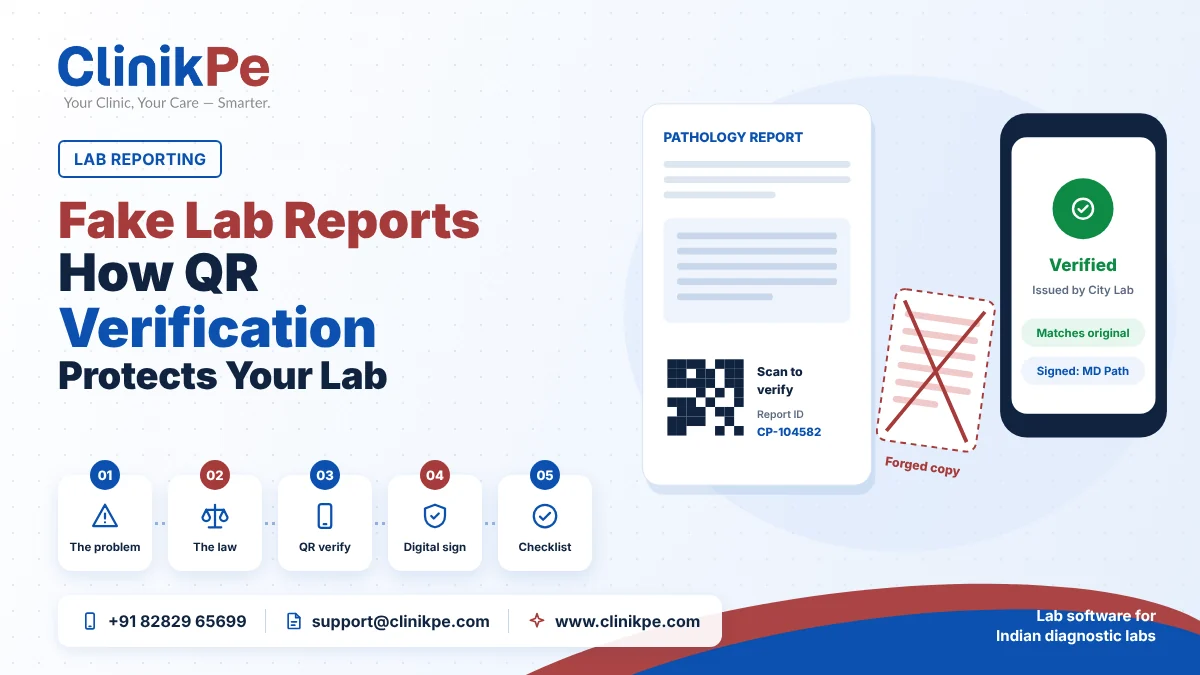
A QR code on its own proves nothing: anyone can print one. What matters is where it leads. A proper verification QR:
- Points to the lab’s own website, so the person checking sees the lab’s domain, not a random link.
- Uses a unique report ID that can’t be guessed from other IDs.
- Shows the key facts of the original: patient initials, sample and report times, tests, and who authorised it, or the original PDF itself.
- Says clearly when a report wasn’t issued, so a fake ID fails loudly.
The person checking compares the page with the copy in their hand. Any change to a value, name or date shows up straight away.
How a verification page works (demo)
Scanning the QR on a report opens a page on the lab’s own website. Try the demo IDs: CP-104582 (genuine) or CP-999999 (not issued).
Genuine report
- Patient: R. S*** (M, 46) · Sample: 10 Oct 2026, 08:40
- Tests: CBC, Lipid profile, HbA1c
- Authorised by: Dr A. Sen, MD Pathology · 10 Oct 2026, 17:12
- Compare these details with the copy you were given. Any difference means the copy was altered.
Where NABL and ISO 15189 stand
ISO 15189:2022, the standard NABL uses for medical labs, already asks for unique identification on every page of a report and a record of who reviewed and authorised it (clause 7.4.1.6). Revised reports must be clearly marked as revisions.
NABL has gone further on report authenticity. Its software generates a Unique Laboratory Report (ULR) number and QR code, and in June 2026 it clarified that accredited labs must put the ULR on all in-scope reports, with a six-month transition. Check the current NABL circulars for what applies to your lab’s scope.
Protect your lab: a checklist
- Put a verification QR on every report, linking to a page on your own domain.
- Give every report a unique, non-sequential ID.
- Use digital signatures applied by the pathologist’s own login, never a scanned image anyone can paste.
- Keep an audit trail of who entered, approved and amended each report.
- Mark amended reports clearly and keep the original.
- Tell insurers, employers and doctors how to verify your reports; print a short line on the report itself.
- Send reports straight to patients on WhatsApp or email from your system, so there’s less reason to pass around edited PDFs.
- Watch for your name on fake reports; ask insurers to report mismatches to you.
For insurers, employers and doctors: how to check a report
- Scan the QR and check the page is on the lab’s real website.
- Compare patient details, dates, tests and values line by line.
- Check the authorising doctor’s name and qualification.
- If there’s no QR, call the lab with the report ID and ask them to confirm.
- Be wary of reports with no lab address, no registration details or a signature that looks pasted.
Frequently asked questions
Scan the QR code on the report and make sure it opens a page on the lab’s own website, then compare the patient details, dates, tests and values with your copy. If there’s no QR code, call the lab with the report ID and ask them to confirm the report.
Yes. Forgery under section 336 of the Bharatiya Nyaya Sanhita carries up to 2 years, or up to 7 years when done to cheat, and using a forged document as genuine (section 340) is punished the same way. Cheating to obtain money, such as an insurance claim, can carry up to 7 years.
Only if it links to a verification page on the lab’s own website using a unique report ID. Then any change to the copy shows up when it’s compared with the original. A QR that just encodes text can be faked as easily as the report.
NABL’s software generates a Unique Laboratory Report (ULR) number and QR code for accredited labs, and in June 2026 NABL clarified that the ULR must appear on all in-scope reports, with a six-month transition. Check the latest NABL circulars for your scope.
It’s risky. Regulators have acted against labs using pathologists’ signatures without real supervision, and a scanned image can be copied onto fake reports. A digital approval applied through the pathologist’s own login, with an audit trail, is far safer.
Keep evidence, confirm to the insurer or employer in writing that the report wasn’t issued, file a police complaint for forgery and cheating, and add QR verification to future reports so forgeries are caught quickly.
Make every report verifiable
See ClinikPe reports with QR verification, digital pathologist approval and an audit trail, on your own letterhead.
No setup, migration or training fees · Free trial on cloud plans
Sources
- Deceased pathologist’s signature on lab reports, Pune (Medical Dialogues, Feb 2026)
- Doctors renting names to labs, UP (Medical Dialogues, Sep 2025)
- Kochi lab partners arrested (PTI via The Week, Sep 2025)
- Sikar health scheme fraud (ETV Bharat, May 2026)
- NABL QR code authentication (Digital Health News)
- NABL ULR clarification, June 2026 (TeamLease RegTech)
- BNS forgery sections explained
- Delhi Medical Council suspends pathologist for selling signatures
Written by the ClinikPe lab operations team in Kolkata. General information, not legal, tax or medical advice; check the sources and your state rules before acting.