Quick answer
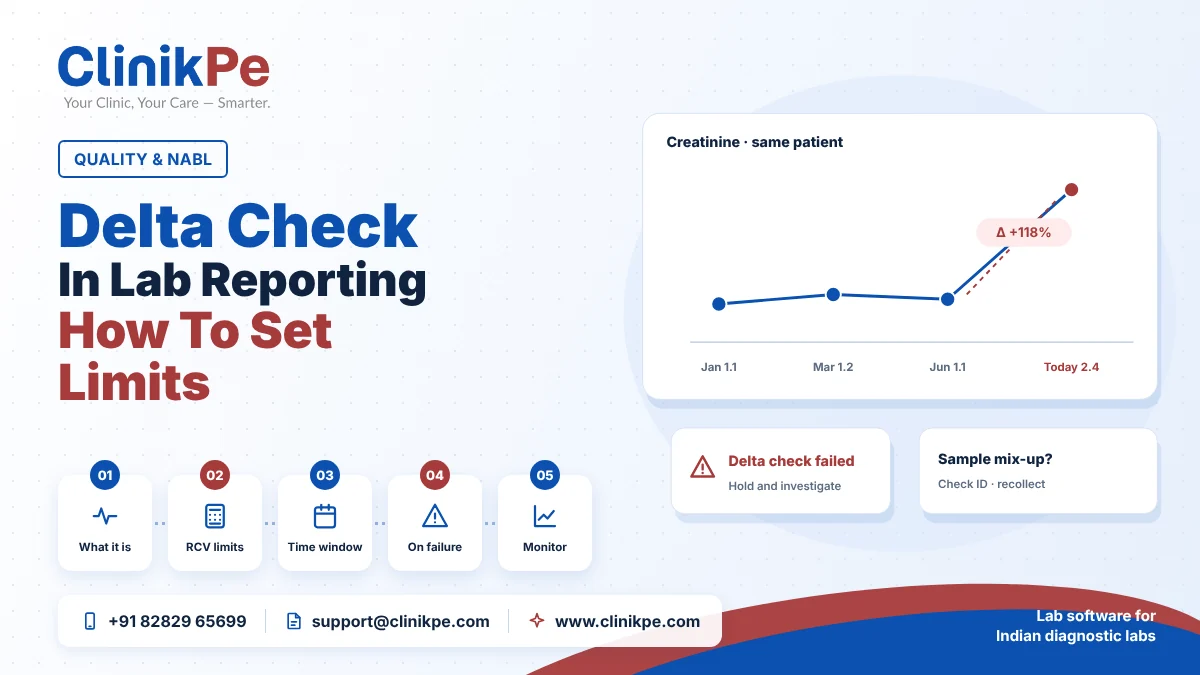
A delta check compares a patient’s new result with their previous one and holds it for review if the change exceeds a set limit within a set time window. It catches sample mix-ups and contamination as well as real clinical change. A defensible limit is the reference change value: √2 × Z × √(CVa² + CVi²). MCV is the best single test for spotting mislabelled samples.
Key takeaways
- Delta checks compare current and previous results within a time window.
- They catch wrong-patient samples and contamination, plus real clinical change.
- RCV = √2 × Z × √(CVa² + CVi²) gives a test-specific limit.
- MCV, MCH and RDW are the best markers of a sample mix-up.
- Most failures are real change, so investigate before assuming error.
What a delta check is
A delta check compares a patient’s new result with their previous result for the same test. If the change is bigger than a set limit within a set time window, the result is held for review instead of being released.
It catches two very different things:
- Real clinical change that the doctor should know about quickly, such as creatinine doubling in two days.
- Errors, especially a sample from the wrong patient (often called wrong blood in tube) or a sample contaminated with drip fluid.
The idea dates back to 1974. The current guidance is CLSI EP33, first published in 2016 with a second edition in 2023. It covers which tests to check, how to set limits and how to investigate failures. It doesn’t give a fixed list; each lab customises its own.
Ways to set a delta limit
| Method | Example | Good for |
|---|---|---|
| Absolute difference | Sodium changes by more than 13 mmol/L | Tests with a narrow range |
| Percent change | Creatinine changes by more than 20% | Most chemistry tests |
| Rate of change | Change per day between the two results | Inpatients with frequent repeats |
| Reference change value (RCV) | Based on analytical and biological variation | A defensible, test-specific limit |
Setting limits with the reference change value
The reference change value tells you how much two results can differ just from normal analytical and biological variation. A bigger change is unlikely to be noise:
RCV = √2 × Z × √(CVa² + CVi²)
- CVa is your analytical imprecision, from your internal QC.
- CVi is the within-person biological variation, from the EFLM database (creatinine 4.4%, potassium 3.9%, sodium 0.6%, glucose 4.7%, haemoglobin 2.7%, MCV 0.8%).
- Z is 1.96 for 95% confidence or 2.58 for 99%.
Delta limit calculator (reference change value)
CVi values from the EFLM biological variation database. Replace the analytical CV with your own from QC.
Delta limit (RCV)
±14.8%
Actual change
+36.4%
Result
Delta check fails: hold and investigate
Labs often use the RCV as a starting point, then widen limits for tests that flag too often. Studies show most delta failures are genuine clinical change, so limits that are too tight create a lot of work for little benefit.
Which tests to delta-check
- MCV, MCH and RDW: the best markers of a sample mix-up, because they barely change in a person over days. An Indian study at Chettinad Hospital found MCV detected simulated mix-ups best (ROC area 0.90).
- Potassium, creatinine and glucose in chemistry, and haemoglobin, platelets and WBC in haematology: the tests labs check most, according to a national survey in China.
- Not much use: tests that swing a lot day to day. One study found delta checks on glucose and magnesium caught very few errors.
Time window: most labs compare with a result from the last few days. The Chinese survey found a median window of 5 days; outpatients often have longer gaps.
What to do when a delta check fails
- Check identity first: patient name, ID and barcode on the tube and the request.
- Check the sample: haemolysis, clots, lipaemia, drip-arm contamination or a short draw.
- Check the clinical story: transfusion, dialysis, surgery or a change in medication can explain a big change. In a Korean CBC study, transfusion explained 60% of haemoglobin and platelet flags.
- Repeat or recollect if the cause isn’t clear.
- Release with a comment once confirmed, and call the doctor if the change is clinically significant or critical.
- Record the outcome so you can review how useful each delta rule is.
Delta checks in lab software
Delta checks only work if the software can find the patient’s previous result reliably, which depends on consistent patient IDs. Good lab software:
- Shows the previous result and date next to the current one on the approval screen
- Applies delta rules per test and holds failing results for review
- Feeds delta checks into autoverification rules; see our guide to autoverification
- Shows trends on the report, which doctors appreciate; see smart lab reports
Frequently asked questions
A delta check compares a patient’s current result with their previous result for the same test. If the difference exceeds a set limit within a set time window, the result is held and investigated before release. It catches sample mix-ups and contamination as well as real clinical change.
A common approach is the reference change value: RCV = √2 × Z × √(CVa² + CVi²), where CVa is your analytical CV from QC, CVi is the within-person biological variation from the EFLM database, and Z is 1.96 for 95% confidence. Labs also use simple absolute or percent limits.
MCV is the classic marker, because it barely changes within a person over short periods. Studies, including one from Chettinad Hospital in India, found MCV the best single predictor of mislabelled samples, followed by MCH and RDW.
CLSI EP33, Use of Delta Checks in the Medical Laboratory, was first published in 2016 as the first consensus guideline on delta checks, with a second edition in 2023. It covers selecting tests, setting limits, configuring LIS alerts and investigating flagged results.
Check patient identification and sample quality, look for a clinical explanation such as transfusion or dialysis, repeat or recollect if needed, then release with a comment or correct the result, and record the outcome.
ISO 15189:2022, which NABL uses, asks labs to review results before release and to have criteria for automated release, but it doesn’t mandate delta checks by name. Most accredited labs use them as part of result review, and assessors may ask how you detect sample mix-ups.
Catch mix-ups before they reach a doctor
See how ClinikPe shows previous results at approval and supports result review for your tests.
No setup, migration or training fees · Free trial on cloud plans
Sources
- CLSI EP33: Use of Delta Checks in the Medical Laboratory
- CLSI EP33 2nd edition announcement (2023)
- ARUP Laboratories: delta checks lecture
- JALM Talk: to delta check or not (ADLM, 2017)
- Biological variation values (EFLM database, via Bio-Rad)
- National survey of delta checks in China (CCLM 2020)
- Kim et al., delta checks for CBC (Ann Lab Med 2023)
- Delta check study, Chettinad Hospital (JCDR 2019)
Written by the ClinikPe lab operations team in Kolkata. General information, not legal, tax or medical advice; check the sources and your state rules before acting.