Quick answer
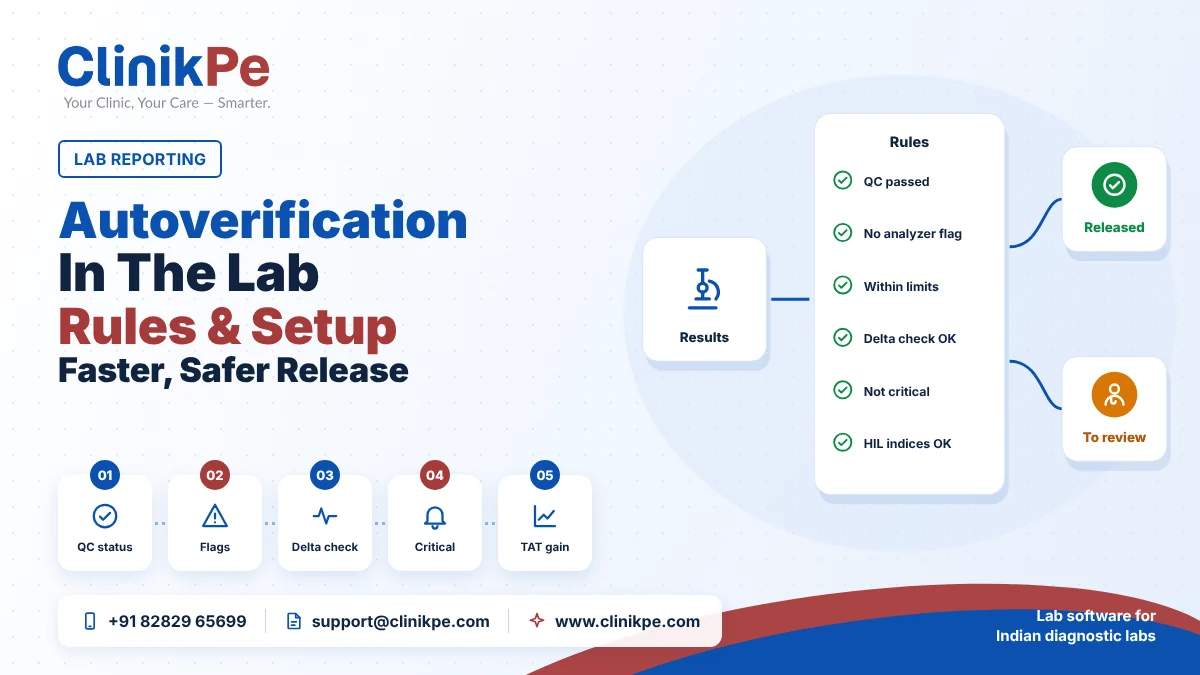
Autoverification releases lab results automatically when they pass rules the lab has approved: QC passed, no analyzer flags, within range, acceptable sample quality, delta check passed and not critical. Anything that fails is held for a person. Published studies show big turnaround gains, and ISO 15189:2022 allows it when rules are validated, reviewed and can be switched off quickly.
Key takeaways
- Autoverification releases only results that pass every approved rule; the rest are held.
- Core rules: QC, flags, range, HIL, delta check, critical values, consistency.
- Studies report TAT reductions of around a third for suitable tests.
- ISO 15189:2022 clause 7.4.1.5 requires validated, reviewed rules and a quick off switch.
- Start with high-volume routine tests and validate on past data.
What autoverification means
Autoverification is the automatic release of results that pass a set of rules agreed by the lab, with no person reviewing them one by one. Results that fail any rule are held for a technician or pathologist.
It doesn’t remove the pathologist from the process. The pathologist approves the rules, reviews everything that’s held, and stays responsible for the reports. What changes is that dozens of perfectly normal glucose and lipid results don’t queue behind one abnormal culture.
The guidance documents are CLSI AUTO10 (2006) and AUTO15 (2019). AUTO15 encourages labs to aim for autoverification rates above 90% for suitable tests, noting that many labs stop below 60%.
The rules every autoverification set needs
| Rule | What it checks | Why |
|---|---|---|
| QC status | Internal QC for the run passed | No release from an out-of-control run |
| Instrument flags | No error or warning flag from the analyzer | Clots, bubbles, short samples |
| Measuring range | Result within the analyzer’s reportable range | Results that need dilution |
| Sample indices | Haemolysis, icterus and lipaemia (HIL) below limits | Interference, especially potassium and LDH |
| Delta check | Change from the last result within the limit | Sample mix-ups and contamination |
| Critical values | Not a critical result | Critical results need a phone call |
| Consistency | Related results make sense, such as albumin not above total protein | Analytical or entry errors |
| Completeness | All ordered tests in the panel have results | Partial reports |
Try it: which results would release on their own?
Turn rules off to see what slips through. Ten sample results, QC passed.
- Glucose 98 mg/dLReleased
- Potassium 6.9 mmol/LHeld for review
- Creatinine 2.4 mg/dL (last week 1.1)Held for review
- ALT 35 U/L, haemolysedHeld for review
- TSH 2.1 µIU/mLReleased
- Hb 13.4 g/dLReleased
- Platelets with clump flagHeld for review
- Cholesterol 182 mg/dLReleased
- CRP above range, needs dilutionHeld for review
- Urea 28 mg/dLReleased
Autoverified
50%
How much faster does it make reporting?
| Study | What they found |
|---|---|
| University of Iowa (J Pathol Inform 2014) | Autoverification rose from 40% to 99.5% of chemistry results over 13 years; basic metabolic panels reached 99.6% |
| Zagazig, Egypt, thyroid panel (Ann Saudi Med 2014) | 63.8% autoverified; total turnaround time fell by 34.9% |
| China, HbA1c (Biochem Med 2024) | About 84% of results autoverified; around 2 hours of TAT saved |
| Thailand, urinalysis (J Clin Lab Anal 2020) | Mean TAT fell from 35.9 to 26.4 minutes |
What ISO 15189 and NABL expect
ISO 15189:2022 deals with automated release in clause 7.4.1.5. The lab must:
- Define and approve the release criteria, and make sure staff who release results understand them
- Validate the rules before use and review them regularly, including after any system change
- Make held results identifiable, with the date, time and reviewer recorded
- Be able to suspend automated release quickly
An Indian review of NABL practice (J Lab Physicians, 2026) notes that automated release is permitted for non-interpretative tests when systems are validated, that reports should be marked as auto-verified, and that a manual fallback plan is needed. Interpretative tests, such as smears, cultures and histopathology, stay with the pathologist.
How to start in your lab
- Pick a few high-volume tests such as glucose, urea, creatinine, lipids and thyroid.
- Write the rules with your pathologist, using the table above, and get them approved.
- Validate on past data: run the rules against a few weeks of results already reviewed by hand and check every disagreement.
- Run in shadow mode for two weeks: the software marks what it would release, a person still reviews everything.
- Switch on, monitor the autoverification rate and any results that should have been held, and review the rules every quarter.
- Keep a fallback: a documented way to switch back to full manual review if something goes wrong.
Delta checks are one of the most important rules; see our guide to delta checks and how to set limits.
Frequently asked questions
Autoverification is the automatic release of lab results that pass rules defined and approved by the lab, such as QC status, analyzer flags, measuring range, sample quality, delta checks and critical values. Results that fail any rule are held for review by a technician or pathologist.
ISO 15189:2022 clause 7.4.1.5 allows automated selection, review and release of results when the criteria are defined, approved, validated and regularly reviewed, and when the lab can suspend automated release quickly. Indian practice limits it to non-interpretative tests and marks reports as auto-verified.
Common rules check QC status, analyzer error flags, the measuring range, haemolysis, icterus and lipaemia, delta checks against previous results, critical values, consistency between related results and completeness of the panel.
Published studies report large gains: a thyroid panel study in Egypt cut total TAT by about 35%, a urinalysis study in Thailand cut mean TAT from 35.9 to 26.4 minutes, and an HbA1c study in China saved around two hours.
CLSI AUTO15 encourages rates above 90% for suitable tests, noting that many labs stop below 60%. Start with high-volume routine chemistry and expand as the rules prove reliable.
Tests that need interpretation, such as peripheral smears, cultures, histopathology and cytology, and any result that’s critical, flagged or fails a delta check should be reviewed by a qualified person.
Get reports out faster, safely
See analyzer results flow straight into reports in ClinikPe, with every approval recorded.
No setup, migration or training fees · Free trial on cloud plans
Sources
- CLSI publishes AUTO15 (press release)
- ISO 15189:2022 gap analysis (NATA)
- Krasowski et al., autoverification at Iowa (J Pathol Inform 2014)
- Autoverification of thyroid panel (Ann Saudi Med 2014)
- HbA1c autoverification (Biochem Med 2024)
- Urinalysis autoverification (J Clin Lab Anal 2020)
- ISO 15189 and NABL practice (J Lab Physicians 2026)
Written by the ClinikPe lab operations team in Kolkata. General information, not legal, tax or medical advice; check the sources and your state rules before acting.