Quick answer
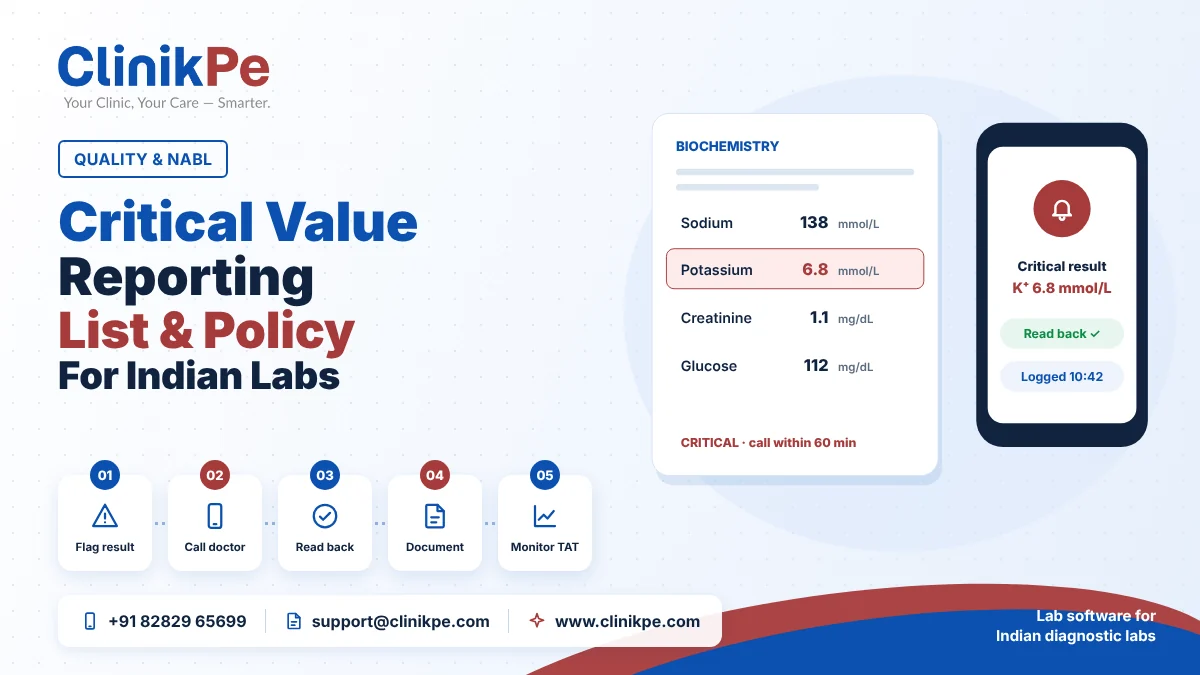
A critical value is a result that may signal an immediate threat to life, such as potassium ≥6.0 mmol/L or platelets below about 10,000–40,000/µL, and must be phoned to the responsible doctor straight away. ISO 15189:2022 (used by NABL) requires prompt notification, read-back, a documented record and an escalation procedure. Most labs aim to notify within an hour.
Key takeaways
- A critical value needs a phone call to a doctor, not just a report.
- ISO 15189:2022 clause 7.4.1.3 sets out notification, records and escalation.
- There’s no single Indian list; adapt published lists with your pathologist.
- Use read-back of two identifiers and the result on every call.
- Aim to notify within 30–60 minutes and track it monthly.
What counts as a critical value
A critical value (also called a critical result or panic value) is a result so far outside the expected range that it may mean an immediate risk to the patient’s life, and needs urgent action from a doctor. Examples are potassium of 6.8 mmol/L, glucose of 35 mg/dL, platelets of 8,000 per µL or P. falciparum on a smear.
It’s different from an abnormal result. A cholesterol of 280 mg/dL is abnormal but not urgent; it can go out with the routine report. A critical value can’t wait for the patient to collect the report.
What NABL and ISO 15189 require
ISO 15189:2022, which NABL uses for medical labs, deals with critical results in clause 7.4.1.3. When a result falls within the lab’s critical limits, the lab must:
- Notify the doctor or another authorised person as soon as possible, based on the clinical information available
- Record the date, time, responsible lab person, person notified, result conveyed, confirmation that it was communicated accurately, and any difficulty in reaching someone
- Have an escalation procedure for when the responsible person can’t be contacted
The final report must also show that the result was critical (clause 7.4.1.6).
This isn’t only paperwork. A College of American Pathologists Q-Probes study of 163 labs found only 56% had a written critical value policy. Assessors check both the policy and the register.
Critical value limits: published examples
There’s no single national list in India. Labs set their own limits with their pathologists and the clinicians they serve. These published lists are useful starting points:
| Test | Mayo Clinic Labs (US) | RCPath (UK, 2025 draft) | Indian examples |
|---|---|---|---|
| Potassium | ≤2.5 or ≥6.0 mmol/L | <2.5 or >6.5 mmol/L | ≤3.0 or ≥5.5 mmol/L (SVIMS Tirupati) |
| Sodium | ≤120 or ≥160 mmol/L | <120 or >160 mmol/L | ≤120 or ≥150 mmol/L (SVIMS) |
| Glucose | ≤50 or ≥400 mg/dL | <2.5 or >25 mmol/L (≈45 or 450 mg/dL) | ≤40 or ≥450 mg/dL (SVIMS) |
| Calcium (total) | ≤6.5 or ≥13.0 mg/dL | Adjusted <1.5 or >3.5 mmol/L | ≤8.0 or ≥11.0 mg/dL (SVIMS) |
| Haemoglobin | ≤6.0 or ≥20.0 g/dL | <7.0 or >19.0 g/dL | <5.0 or >22.0 g/dL (CAHO deck) |
| Platelets | ≤40,000 or ≥10,00,000 /µL | <30,000 or >10,00,000 /µL | <10,000 /µL (CAHO deck) |
| WBC / neutrophils | WBC ≥1,00,000 /µL; ANC ≤500 /µL | Neutrophils <500 or >50,000 /µL | WBC <2,000 or >50,000 /µL (CAHO deck) |
| INR | ≥5.0 | >5.0 on warfarin | >5.0 (CAHO deck) |
| APTT | ≥150 s | — | >50 s outpatient, >100 s inpatient (CAHO deck) |
| Creatinine | — | >354 µmol/L (≈4.0 mg/dL) | ≥8 mg/dL (SVIMS) |
| Bilirubin, infant | ≥15.0 mg/dL (under 1 year) | — | ≥15 mg/dL (SVIMS, total) |
| Microbiology and smears | Any significant organism in blood or CSF | — | P. falciparum or blasts on smear (CAHO deck) |
Two cautions: limits for children and newborns differ (neonatal bilirubin and glucose especially), and troponin cut-offs depend on the assay, so use your manufacturer’s decision limits.
How to report a critical value: step by step
- Verify the result. Check sample identity, sample quality (haemolysis raises potassium), QC status and whether repeating is sensible. Don’t delay the call for a long investigation.
- Call the requesting doctor or the responsible clinical person. For hospital patients, the ward doctor or nurse in charge.
- Use read-back. Ask the receiver to repeat the patient’s name, a second identifier, the test and the value.
- Escalate if you can’t reach anyone within your set time: try the next doctor in the chain, then your lab director. For outpatients, follow your documented process for contacting the patient.
- Record it in the critical alert register or your lab software.
- Flag it on the report.
Most guidelines and Indian accredited hospitals aim for notification within one hour. A study at SVIMS Tirupati found 86.8% of critical calls made within an hour, with a mean of about 20 minutes, and potassium accounted for over half of all calls.
A policy template you can adapt
Critical value policy: template outline
- Purpose and scope: which departments, tests and locations (including collection centres and home collection) it covers.
- Critical value list: test, unit, low and high limits, age bands; approved by the lab director and reviewed every year.
- Who reports: the technician who verifies the result, or the pathologist on duty.
- Who receives: the requesting doctor or a clinical person responsible for the patient. Never only a receptionist; never the patient alone, except per a documented process for outpatients you can’t reach through a doctor.
- Time limit: communicate within 30 to 60 minutes of verification.
- Read-back: the receiver reads back the patient’s name, a second identifier, the test and the result.
- Escalation: if the doctor can’t be reached in 15 minutes, call the next person in the chain, then the lab director.
- Documentation: date, time, result, who called, who received (name and role), read-back confirmed, and any difficulty.
- Report flag: mark the result as critical on the final report.
- Monitoring: track the share of calls made within the time limit each month and review failures.
Making critical alerts reliable with software
Paper registers fail at the busiest times, which is exactly when critical results appear. Lab software can:
- Flag a result as critical the moment it’s entered or received from the analyzer
- Stop the report being released until the call is logged
- Record who called, who received and the read-back
- Show the doctor’s phone number on screen
- Report monthly on time-to-notification
Frequently asked questions
A critical value is a test result far enough outside the normal range to suggest an immediate threat to the patient’s life, such as very high potassium or very low platelets. The lab must tell the responsible doctor at once rather than wait for the routine report.
Yes. ISO 15189:2022 clause 7.4.1.3, used by NABL, requires labs to notify critical results promptly, record the notification including verification of accurate communication, and have an escalation procedure. The report must also indicate critical results.
Common published limits are about 2.5 mmol/L or below and 6.0 to 6.5 mmol/L or above for adults (Mayo Clinic Labs: ≤2.5 or ≥6.0; RCPath draft: <2.5 or >6.5). Some Indian hospital labs use tighter limits such as ≤3.0 or ≥5.5 mmol/L. Rule out haemolysis before calling.
Most guidelines and accredited Indian hospitals aim to notify within one hour of verification, and many labs set 30 minutes. ISO 15189 says as soon as relevant based on the clinical information available.
The requesting doctor or another clinical person responsible for the patient, who confirms by reading back the patient identifiers and result. If they can’t be reached, the lab follows its escalation procedure.
Read-back means the person receiving the call repeats the patient’s name, a second identifier, the test and the result, and the lab records that this was confirmed. It prevents errors in verbal communication.
Make every critical result count
Tell us your test menu and where your doctors are. We’ll show how ClinikPe flags results and gets reports to doctors fast.
No setup, migration or training fees · Free trial on cloud plans
Sources
- ISO 15189:2022 clause 7.4.1.3 (PJLA assessment checklist)
- Mayo Clinic Laboratories: critical values list
- Mayo Clinic Laboratories: critical results policy
- RCPath draft guidance on critical results (2025)
- Thota & Bitla, J Lab Physicians 2024 (SVIMS Tirupati)
- CAHO: critical alerts training deck
- Wagar et al., CAP Q-Probes 2007
Written by the ClinikPe lab operations team in Kolkata. General information, not legal, tax or medical advice; check the sources and your state rules before acting.