Quick answer
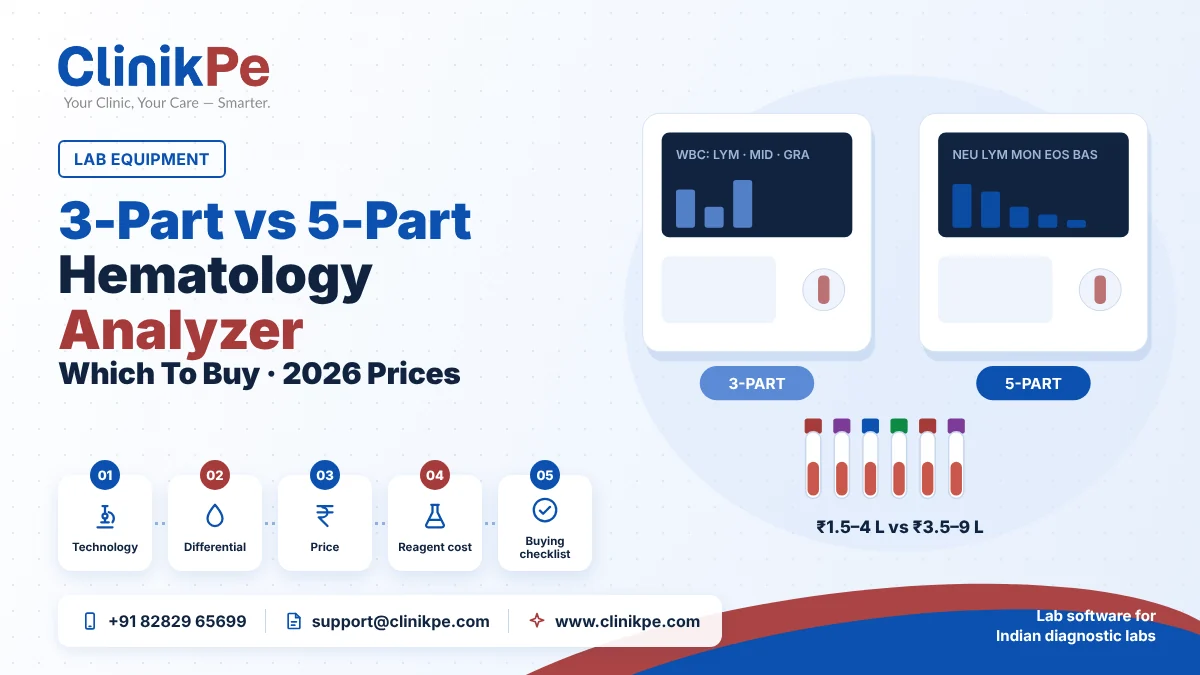
A 3-part hematology analyzer splits white cells into three groups and costs about ₹1.5–4 lakh in India. A 5-part analyzer reports all five white cell types, flags fewer samples for smear review and costs about ₹3.5–9 lakh for compact models. Small labs serving general physicians usually do well with 3-part; labs serving paediatrics, oncology or wards benefit from 5-part.
Key takeaways
- 3-part uses impedance; 5-part adds laser or fluorescence flow cytometry for a full differential.
- Listed prices: about ₹1.5–4 lakh for 3-part and ₹3.5–9 lakh for compact 5-part models.
- Reagent cost per CBC matters more than purchase price over the analyzer’s life.
- 5-part flags fewer samples for review (about 20% vs 30%), but smears are still needed.
- Check service support and LIS interfacing before you buy.
The difference in one paragraph
Both machines count red cells, white cells, platelets and haemoglobin. The difference is the white cell breakdown. A 3-part analyzer uses electrical impedance and splits white cells into three groups by size: lymphocytes, mid-sized cells (monocytes, eosinophils and basophils together) and granulocytes. A 5-part analyzer adds laser light scatter or fluorescence flow cytometry and reports all five types separately: neutrophils, lymphocytes, monocytes, eosinophils and basophils.
Boule, a haematology manufacturer, notes that a 5-part analyzer is essential to separate eosinophils and basophils, which matter mostly in oncology and allergy work. It also estimates that about 30% of samples get flagged for manual review on a 3-part analyzer, against about 20% on a 5-part.
3-part vs 5-part side by side
| 3-part | 5-part | |
|---|---|---|
| Technology | Impedance (Coulter principle) | Impedance plus laser scatter or fluorescence flow cytometry |
| WBC differential | Lymphocytes, mid cells, granulocytes | Neutrophils, lymphocytes, monocytes, eosinophils, basophils |
| Reportable parameters | About 20–24 (e.g. Sysmex XP: 20; Mindray BC-30s: 21; Erba H360: 24) | About 25–37 (e.g. Mindray BC-5150: 25; Sysmex XN-350: 26) |
| Throughput | About 60–70 samples an hour | About 60–70 an hour for compact models; more on large systems |
| Sample volume | About 9–50 µL | About 20–25 µL |
| Reagents | Usually 3 (diluent, lyse, cleaner) | Usually more, including differential reagents and dyes |
| Samples flagged for smear review | About 30% (Boule estimate) | About 20% (Boule estimate) |
| Typical new price in India (listings) | About ₹1.5–4 lakh | About ₹3.5–9 lakh for compact models; more for high-end systems |
Popular models and listed prices in India
These are price points listed online in October 2026. Use them to set a budget, then get written quotes including installation, training, AMC and reagent cost per test.
| Model | Type | Listed price | Where listed |
|---|---|---|---|
| Erba H360 | 3-part | ≈ ₹1.45 lakh | IndiaMART dealer |
| Sysmex XP-100 / XP-300 | 3-part | ≈ ₹1.5–3.75 lakh | IndiaMART, several sellers |
| Mindray BC-20s / BC-30s | 3-part | ≈ ₹2.2–3.3 lakh | IndiaMART, several sellers |
| Agappe Mispa HX-35 | 3-part | ≈ ₹2.45 lakh | IndiaMART dealer |
| Medonic M32B | 3-part | ≈ ₹3.4 lakh | IndiaMART |
| Erba H560 | 5-part | ≈ ₹3.55 lakh | IndiaMART dealer |
| Mindray BC-5130 | 5-part | ≈ ₹5 lakh | IndiaMART |
| Mindray BC-5150 | 5-part | ≈ ₹9 lakh (MRP ₹12 lakh) | GeM |
| Mindray BC-700 series | 5-part with ESR | ≈ ₹8–8.5 lakh | IndiaMART |
| Sysmex XN-350 / XN-550 | 5-part | Quote only | Not listed |
Our lab equipment price guide covers biochemistry, urine and electrolyte analyzers too.
Reagent cost per test: the number that matters more
The purchase price is paid once; reagents are paid on every CBC. Boule estimates reagent cost at under US$1 a test for 3-part systems and US$1.5–3 for 5-part. We couldn’t find reliable published rupee figures, so ask each dealer for a written reagent cost per CBC, including controls and calibrators.
- Closed vs open systems: many analyzers only run the manufacturer’s reagents. Ask what happens to reagent prices after the warranty period.
- Reagent rental: some suppliers place the analyzer free or cheap and charge per reportable test. Government tenders such as RIMS Ranchi buy CBCs this way. Read the minimum-volume commitment carefully.
- Daily QC: 5-part controls usually cost more than 3-part controls. At low volumes this can matter as much as the reagent itself; see how to calculate reagent consumption per test.
Which one should your lab buy?
Answer three questions for a starting point:
3-part or 5-part? Three questions
Our suggestion
3-part
At this budget a good 3-part analyzer from a brand with local service is the sensible choice. Do a peripheral smear on flagged samples and when a doctor needs a full differential.
Our rule of thumb, not a manufacturer recommendation. Check reagent cost and service support in your city before you buy.
Whatever you buy, keep a microscope and a trained technician for peripheral smears. The International Society for Laboratory Hematology’s consensus group publishes 41 rules for when an automated CBC needs slide review, and flagged samples need a smear on any analyzer.
Before you buy: checklist
- Service in your city. Ask how quickly an engineer reaches you and whether spare parts are stocked locally.
- Reagent cost per CBC in writing, for the first year and after warranty.
- LIS interfacing. Check the analyzer can send results to your lab software (most send over serial or TCP/IP using ASTM or HL7). This saves typing and transcription errors.
- Controls and EQAS. Budget for daily controls and an external quality scheme such as AIIMS EQAP for haematology; see our list of EQAS programmes in India.
- Method comparison for NABL. NABL 112A asks labs with more than one haematology analyzer to compare them at least twice a year with 10–20 samples.
Frequently asked questions
A 3-part analyzer uses impedance to split white cells into lymphocytes, mid cells and granulocytes. A 5-part analyzer adds laser or fluorescence flow cytometry to report neutrophils, lymphocytes, monocytes, eosinophils and basophils separately, and usually flags fewer samples for manual smear review.
Online listings in October 2026 show most new 3-part analyzers between about ₹1.5 lakh and ₹4 lakh, for example Erba H360 around ₹1.45 lakh, Mindray BC-20s and BC-30s around ₹2.2–3.3 lakh, and Sysmex XP-series around ₹1.5–3.75 lakh. GST on analyzers is 5% from September 2025.
Compact 5-part analyzers are listed from about ₹3.5 lakh (Erba H560) to around ₹9 lakh (Mindray BC-5150 on GeM). Larger systems such as Sysmex XN models are sold on quotation and cost more.
Often, yes. For a small lab serving general physicians, a 3-part analyzer with peripheral smears on flagged samples covers most needs at lower reagent cost. Labs serving paediatrics, oncology, allergy clinics or hospital wards usually benefit from a 5-part analyzer.
Yes, for flagged or abnormal samples. The International Society for Laboratory Hematology publishes consensus rules on when an automated CBC needs slide review, and these apply to both 3-part and 5-part analyzers.
Most modern hematology analyzers can send results to a LIS over a serial or network connection using ASTM or HL7. Confirm interfacing support for the exact model with your software provider before buying.
Buying an analyzer? Connect it from day one
Tell us the analyzer you’re considering. We’ll confirm whether ClinikPe can interface it and show results flowing into a report.
No setup, migration or training fees · Free trial on cloud plans
Sources
- Boule: 3-part versus 5-part hematology systems
- Mindray BC-30s
- Mindray BC-5150
- Sysmex XN-350
- Transasia Erba H360
- IndiaMART: Mindray cell counter listings
- IndiaMART: Sysmex cell counter listings
- ISLH consensus rules for slide review
- NABL 112A specific criteria
Written by the ClinikPe lab operations team in Kolkata. General information, not legal, tax or medical advice; check the sources and your state rules before acting.