Healthcare has evolved far beyond paper files and filing cabinets. Today, clinics and healthcare providers are expected to deliver faster services, maintain accurate patient records, protect sensitive health information, and coordinate care across multiple departments. As patient expectations continue to grow, traditional record-keeping methods are becoming increasingly difficult to manage.
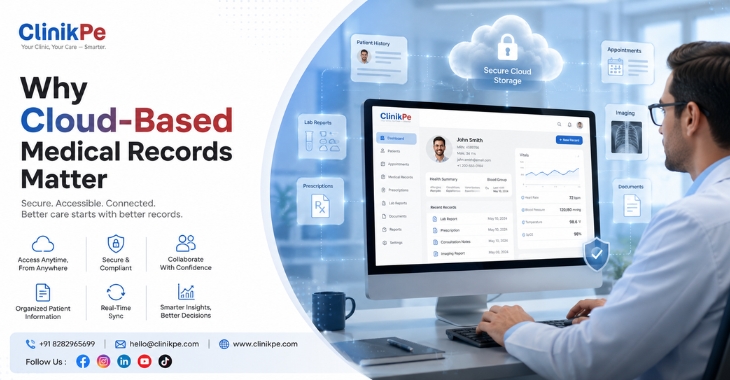
This is where cloud-based medical records are making a significant impact. Cloud-based medical records allow healthcare providers to securely store, access, and manage patient information through an internet-connected platform. Instead of relying on physical files or locally stored databases, clinics can access critical information anytime while improving collaboration among doctors, laboratory professionals, administrative staff, and patients.
When integrated with a Laboratory Management System and Lab Information Management Systems, cloud technology creates a connected healthcare ecosystem where patient records, laboratory workflows, appointments, billing, and reporting work together seamlessly.
If you’re planning to modernize your healthcare practice in West Bengal, India, understanding the value of cloud-based medical records can help improve operational efficiency while enhancing patient care.
What Are Cloud-Based Medical Records?
Cloud-based medical records are electronic patient records stored securely on remote cloud servers rather than on paper files or local computers. Authorized healthcare professionals can access patient histories, prescriptions, consultation notes, laboratory reports, billing information, and treatment plans from any approved device with an internet connection. Unlike traditional storage systems, cloud technology allows information to remain synchronized and updated in real time.
Centralized Patient Information
All medical records are stored in one secure digital platform.
Secure Access Anywhere
Authorized healthcare providers can access patient information whenever required. Healthcare organizations throughout West Bengal, India are increasingly adopting cloud technology to improve healthcare delivery.
Faster Access Improves Patient Care
Quick access to patient information plays an important role in delivering quality healthcare. Searching through paper files or disconnected systems can delay consultations and treatment decisions. Cloud-based records allow doctors to retrieve complete medical histories, prescriptions, allergies, laboratory reports, and previous consultations within seconds. This enables healthcare providers to make faster, more informed clinical decisions.
Reduced Waiting Times
Instant access to patient records helps speed up consultations.
Better Clinical Decision-Making
Complete patient information supports more accurate and efficient healthcare. Fast access benefits both healthcare professionals and patients.
Better Collaboration Across Healthcare Teams
Modern healthcare depends on collaboration between doctors, nurses, laboratory staff, pharmacists, and administrators. Cloud-based medical records allow authorized team members to work with the same updated patient information, reducing communication gaps and duplicate documentation. Everyone involved in patient care can access the information they need without relying on paper files.
Improved Communication
Healthcare teams stay connected through a centralized digital platform.
Fewer Administrative Delays
Shared information reduces repetitive paperwork and manual record transfers. Integrated systems improve coordination throughout the patient’s healthcare journey.
Integration With a Laboratory Management System
Diagnostic testing plays a vital role in patient care. When cloud-based medical records integrate with a Laboratory Management System, doctors and laboratory professionals can coordinate patient testing more efficiently. Laboratory requests, diagnostic reports, and patient records remain connected, reducing delays while improving workflow.
Faster Laboratory Coordination
Digital integration helps laboratory teams process patient requests more efficiently.
Organized Diagnostic Workflows
Connected systems improve communication between clinical and laboratory departments. A Laboratory Management System supports smoother operations while enhancing patient care.
The Role of Lab Information Management Systems
Healthcare laboratories generate large amounts of patient data every day. Lab Information Management Systems help organize laboratory operations by managing sample tracking, testing workflows, quality control, report generation, and laboratory documentation through one centralized platform. When integrated with cloud-based medical records, laboratory information becomes immediately available to authorized healthcare professionals.
Better Laboratory Data Management
Laboratory records remain accurate, organized, and easily accessible.
Improved Operational Efficiency
Automation reduces manual work while improving communication across departments. Combining cloud technology with Lab Information Management Systems creates a more efficient healthcare environment.
Stronger Security and Reliable Data Protection
Protecting patient information is one of the highest priorities in healthcare. Cloud-based medical record systems include advanced security features designed to safeguard sensitive healthcare data.
These typically include:
- Encrypted data storage.
- Role-based user access.
- Automatic system backups.
- Secure authentication.
- Activity logs.
- Disaster recovery capabilities.
Unlike paper records, cloud platforms significantly reduce the risk of data loss caused by fire, theft, hardware failure, or accidental damage.
Secure Patient Records
Advanced security measures help protect confidential healthcare information.
Reliable Backup Systems
Automatic backups help preserve important patient records even during unexpected situations. At ClinikPe, cloud-based healthcare solutions are designed with both operational efficiency and data security in mind, helping clinics confidently manage patient information while supporting future growth.
Why Cloud Technology Supports Future Growth
As healthcare organizations grow, managing patient information becomes increasingly complex. Cloud-based systems provide the flexibility to support larger patient volumes, multiple healthcare providers, expanded laboratory services, and additional clinic locations without requiring major infrastructure upgrades.
Scalable cloud technology allows clinics to adapt to changing healthcare needs while maintaining operational efficiency. Investing in cloud-based medical records prepares healthcare facilities for long-term digital transformation.
FAQ
Cloud-based medical records improve accessibility, data security, collaboration, and operational efficiency while allowing healthcare providers to access patient information securely from authorized devices.
A Laboratory Management System is software that helps healthcare facilities manage laboratory workflows, patient samples, diagnostic reports, inventory, and testing processes more efficiently.
Lab Information Management Systems are digital platforms that organize laboratory operations, sample tracking, report generation, quality control, and laboratory documentation through one integrated system.
Doctors can quickly access complete medical histories, prescriptions, laboratory reports, and treatment information, allowing faster and more informed clinical decisions.
Yes. Modern cloud platforms use encrypted storage, role-based access, automatic backups, secure authentication, and advanced security protocols to protect patient information.
Yes. Modern clinic management software integrates seamlessly with both a Laboratory Management System and Lab Information Management Systems to improve healthcare workflows.
Automation simplifies appointment scheduling, documentation, billing, reporting, and patient record management, reducing repetitive manual tasks.
Absolutely. Cloud solutions improve organization, reduce paperwork, increase efficiency, and easily scale as clinics grow.
Integration improves communication between laboratories and healthcare providers, speeds up report sharing, reduces duplicate data entry, and supports better patient care.
ClinikPe provides a comprehensive cloud-based healthcare platform with secure patient records, appointment scheduling, billing, a Laboratory Management System, and Lab Information Management Systems integration to help healthcare providers streamline operations and deliver exceptional patient care.
Final Thoughts
Cloud-based medical records have become an essential part of modern healthcare by improving accessibility, strengthening collaboration, enhancing data security, and simplifying everyday clinic operations.
When integrated with a Laboratory Management System and Lab Information Management Systems, cloud technology creates a connected healthcare ecosystem that improves laboratory coordination, patient management, and overall operational efficiency. If you’re looking to modernize your healthcare practice in West Bengal, India, adopting cloud-based medical records is a smart investment that supports better patient care, greater productivity, and long-term business growth.
Modernize Your Healthcare Practice With ClinikPe
Ready to move beyond paper records? ClinikPe offers a secure cloud-based clinic management platform with digital patient records, appointment scheduling, billing, and seamless integration with a Laboratory Management System and Lab Information Management Systems. Our intelligent healthcare solution helps clinics improve efficiency, strengthen collaboration, and deliver outstanding patient care while preparing for future growth.