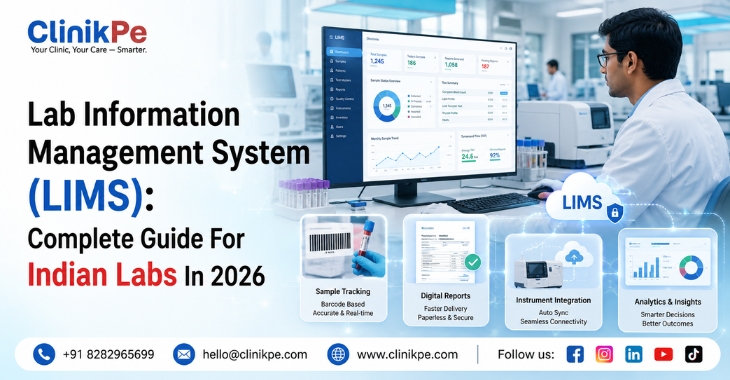
Lab Information Management Systems used to mean enterprise software with six-figure implementation costs — reserved for large hospital chains and reference labs with dedicated IT teams. In 2026, that’s no longer true for Indian diagnostic labs.
Cloud infrastructure, SaaS pricing, and India-focused vendors have completely changed the economics. A standalone lab processing 100 samples a day can now run a full-featured lab information management system — with NABL-ready QC, instrument integration, and WhatsApp report delivery — for less than ₹15,000 a month.
Here is what’s changed, what the market looks like today, and what to actually buy:-
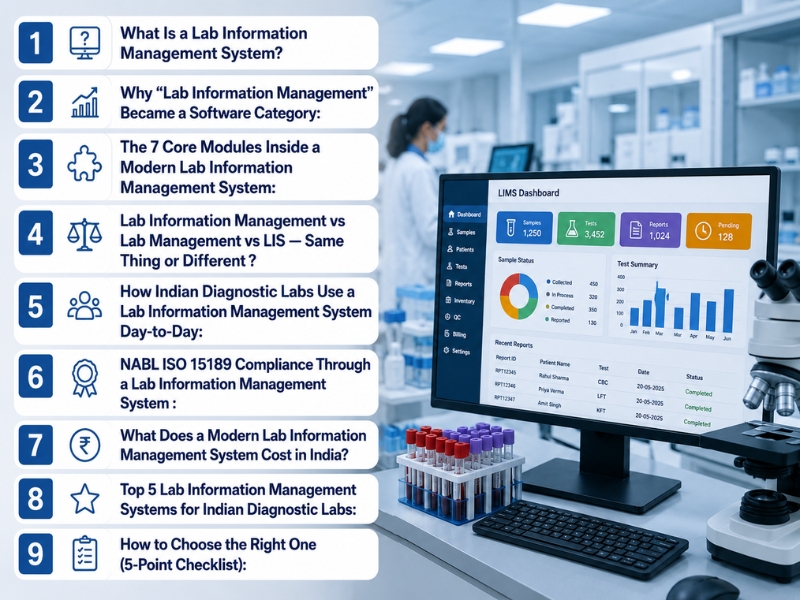
1. What Is a Lab Information Management System?
A lab information management system (LIMS) is software that manages the end-to-end workflow of a diagnostic or clinical laboratory — from patient registration and sample tracking to result generation, quality control, and report delivery. It replaces paper logs, disconnected spreadsheets, and manual entry with a single, auditable digital system.
In plain terms: a LIMS lab information management system is the operational backbone of a modern lab. Every test ordered, every sample processed, and every report signed goes through it.
2. Why “Lab Information Management” Became a Software Category:
For decades, lab information management was handled through a mix of handwritten registers, standalone billing software, and the institutional memory of senior technicians. The problems were obvious — transcription errors, delayed reports, missing samples, and zero audit trails.
Three forces pushed it into a formal software category in India:-
- Regulatory pressure: NABL and ISO 15189 accreditation now mandate documented quality management, which paper systems cannot reliably deliver.
- Diagnostic chain growth: Multi-branch labs like Dr. Lal PathLabs, SRL, and Metropolis needed centralized data visibility across cities.
- Affordable cloud infrastructure: AWS and Azure pricing in India dropped to a point where SaaS LIMS became viable for labs with as few as 50 samples per day.
The result is a market that barely existed in India a decade ago and now has dozens of credible vendors competing on price, compliance features, and integrations.
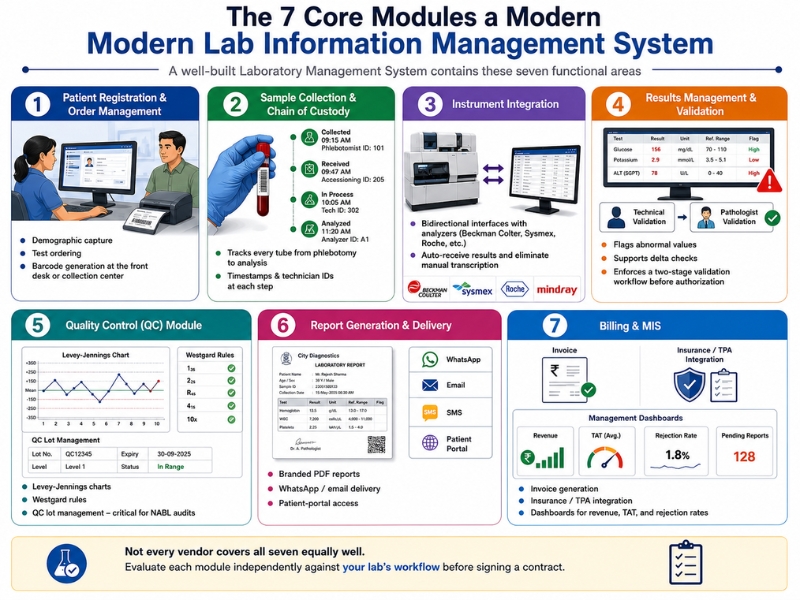
3. The 7 Core Modules Inside a Modern Lab Information Management System:
A well-built laboratory management system contains these seven functional areas:
- Patient Registration & Order Management — Demographic capture, test ordering, and barcode generation at the front desk or collection center.
- Sample Collection & Chain of Custody — Tracks every tube from phlebotomy to analysis, with timestamps and technician IDs at each step.
- Instrument Integration — Bidirectional interfaces with analyzers (Beckman Colter, Sysmex, Roche, etc.) to auto-receive results and eliminate manual transcription.
- Results Management & Validation — Flags abnormal values, supports delta checks, and enforces a two-stage validation workflow before authorization.
- Quality Control (QC) Module — Levey-Jennings charts, Westgard rules, and QC lot management — critical for NABL audits.
- Report Generation & Delivery — Branded PDF reports, WhatsApp/email delivery, and patient-portal access.
- Billing & MIS — Invoice generation, insurance/TPA integration, and management dashboards for revenue, TAT, and rejection rates.
Not every vendor covers all seven equally well. Evaluate each module independently against your lab’s workflow before signing a contract.
4. Lab Information Management vs Lab Management vs LIS — Same Thing or Different?
These three terms are often used interchangeably, and mostly that’s fine — but there are meaningful distinctions:-
A Laboratory Information System (LIS) is a traditional clinical term focused on patient results and physician reporting. It is common in hospital settings.
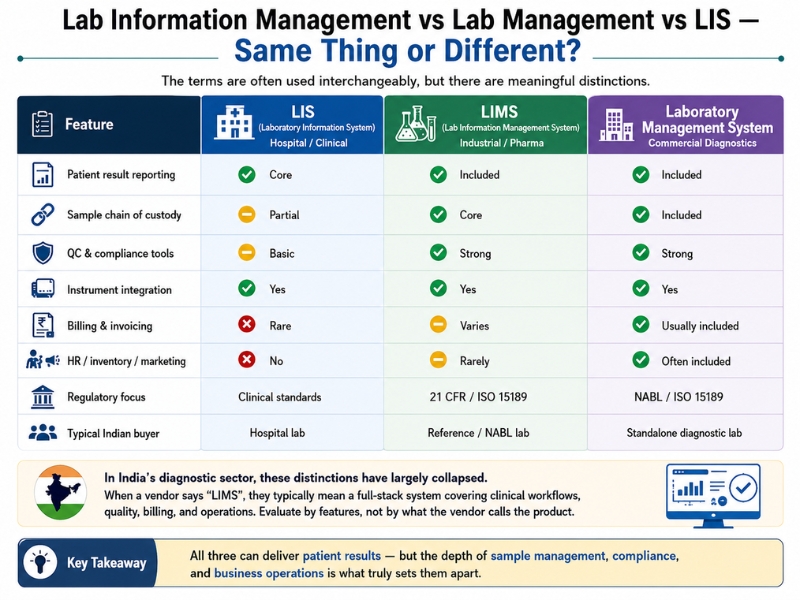
Lab information management (and LIMS) originated in industrial and pharmaceutical labs, where sample tracking, reagent management, and regulatory compliance (21 CFR Part 11) were priorities. It has since expanded to cover diagnostics.
A laboratory management system is a broader commercial term that encompasses both LIS and LIMS features, often with additional modules for HR, inventory, and marketing.
In India’s diagnostic sector, these distinctions have largely collapsed. When a vendor says “LIMS”, they typically mean a full-stack system covering clinical workflows, quality, billing, and operations. Evaluate by features, not by what the vendor calls the product.
| Feature | LIS | LIMS | Laboratory Management System |
| Primary origin | Hospital / clinical | Industrial / pharma | Commercial diagnostics |
| Patient result reporting | ✅ Core | ✅ Included | ✅ Included |
| Sample chain of custody | Partial | ✅ Core | ✅ Included |
| QC & compliance tools | Basic | ✅ Strong | ✅ Strong |
| Instrument integration | ✅ Yes | ✅ Yes | ✅ Yes |
| Billing & invoicing | Rare | Varies | ✅ Usually included |
| HR / inventory / marketing | ❌ No | ❌ Rarely | ✅ Often included |
| Regulatory focus | Clinical standards | 21 CFR / ISO 15189 | NABL / ISO 15189 |
| Typical Indian buyer | Hospital lab | Reference / NABL lab | Standalone diagnostic lab |
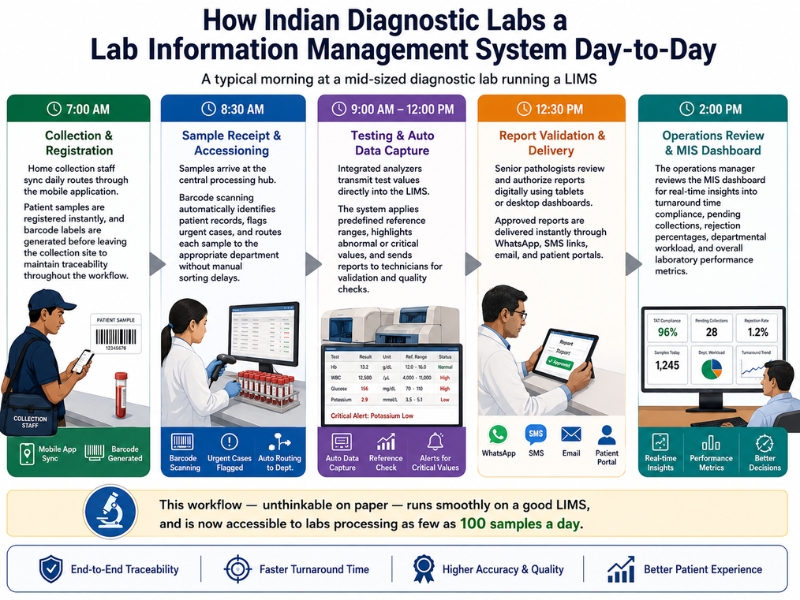
5. How Indian Diagnostic Labs Use a Lab Information Management System Day-to-Day:
Here is a typical morning at a mid-sized diagnostic lab running a lab information management system:
- 7:00 AM — Home collection staff sync daily routes through the mobile application. Patient samples are registered instantly, and barcode labels are generated before leaving the collection site to maintain traceability throughout the workflow.
- 8:30 AM — Samples arrive at the central processing hub. Barcode scanning automatically identifies patient records, flags urgent cases, and routes each sample to the appropriate department without manual sorting delays.
- 9:00 AM–12:00 PM — Integrated analyzers transmit test values directly into the LIMS. The system applies predefined reference ranges, highlights abnormal or critical values, and sends reports to technicians for validation and quality checks.
- 12:30 PM — Senior pathologists review and authorize reports digitally using tablets or desktop dashboards. Approved reports are delivered instantly through WhatsApp, SMS links, email, and patient portals.
- 2:00 PM — The operations manager reviews the MIS dashboard for real-time insights into turnaround time compliance, pending collections, rejection percentages, departmental workload, and overall laboratory performance metrics.
This workflow — unthinkable on paper — runs smoothly on a good best lab management software, and is now accessible to labs processing as few as 100 samples a day.
6. NABL ISO 15189 Compliance Through a Lab Information Management System:
ISO 15189 is the international standard for medical laboratory quality and competence. NABL accreditation in India is based on it. A compliant lab information management system supports accreditation in five direct ways:
- Document control: SOPs, work instructions, and policy documents are version-controlled inside the system with review reminders.
- Equipment records: Calibration schedules, maintenance logs, and downtime records are maintained per instrument.
- QC traceability: Every QC run is logged with lot numbers, operator IDs, and Westgard rule outcomes — exactly what NABL assessors check.
- Sample traceability: The chain of custody from collection to disposal is documented with timestamps and the names of responsible personnel.
- Non-conformance management: Rejections, corrective actions, and complaint logs are captured in a format directly usable for internal audits and NABL submissions.
Labs that manage accreditation manually will immediately recognize how much audit preparation a LIMS removes from the quality manager’s workload.
7. What Does a Modern Lab Information Management System Cost in India?
Pricing has changed significantly. Here is a realistic 2026 breakdown:-
| Lab Size | Monthly SaaS Fee (INR) | Setup / Implementation |
| Small (up to 200 samples/day) | ₹8,000 – ₹18,000 | ₹25,000 – ₹60,000 |
| Mid-size (200–1,000 samples/day) | ₹20,000 – ₹50,000 | ₹75,000 – ₹2,00,000 |
| Large / Multi-branch | ₹60,000 – ₹2,00,000+ | ₹3,00,000 – ₹10,00,000+ |
On-premise perpetual licenses still exist but are rare for new buyers. Most Indian vendors now lead with cloud-based SaaS. Watch for hidden costs: per-branch fees, instrument interface charges, training costs, and annual AMC if on-premise. Always ask for an all-inclusive quote.
8. Top 5 Lab Information Management Systems for Indian Diagnostic Labs:
These five platforms consistently appear in shortlists for Indian diagnostic labs in 2026:-
1. Healthray LIMS — Built specifically for the Indian diagnostic market. Strong NABL compliance features, WhatsApp report delivery, and multi-branch support. Competitive pricing for small-to-mid labs.
2. Drlogy Lab Software — Widely used in standalone and small chain labs. Quick implementation, clean UI, and solid billing integration.
3. SoftClinic GenX (Lab Module) — Popular in hospital-linked labs. Strong HIS integration and pharmacy/billing linkages.
4. LifeSign LIMS — Established mid-market vendor with a good instrument interface library and a dedicated QC module suited for NABL audit trails.
5. CERNER Lab / Oracle Health — Enterprise-grade, primarily for large hospital networks and reference labs. Significantly higher cost; implementation requires dedicated IT resources.
Note: Always run a 30-day pilot on your actual samples before committing. Lab workflows vary; what works for a hematology-heavy lab may not suit a biochemistry-centric operation.
9. How to Choose the Right One (5-Point Checklist):
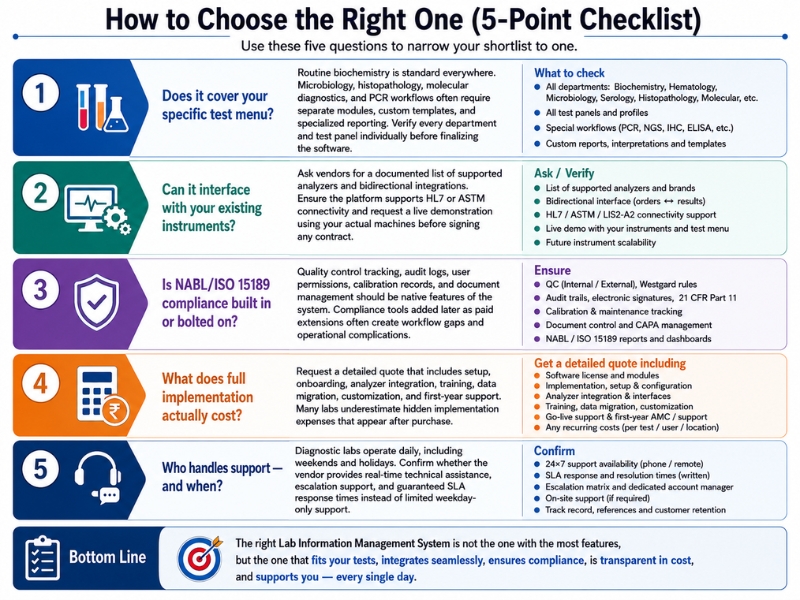
Use these five questions to narrow your shortlist to one:-
- Does it cover your specific test menu?
Routine biochemistry is standard everywhere. Microbiology, histopathology, molecular diagnostics, and PCR workflows often require separate modules, custom templates, and specialized reporting. Verify every department and test panel individually before finalizing the software.
- Can it interface with your existing instruments?
Ask vendors for a documented list of supported analyzers and bidirectional integrations. Ensure the platform supports HL7 or ASTM connectivity and request a live demonstration using your actual machines before signing any contract.
- Is NABL/ISO 15189 compliance built in or bolted on?
Quality control tracking, audit logs, user permissions, calibration records, and document management should be native features of the system. Compliance tools added later as paid extensions often create workflow gaps and operational complications.
- What does full implementation actually cost?
Request a detailed quote that includes setup, onboarding, analyzer integration, training, data migration, customization, and first-year support. Many labs underestimate hidden implementation expenses that appear after purchase.
- Who handles support — and when?
Diagnostic labs operate daily, including weekends and holidays. Confirm whether the vendor provides real-time technical assistance, escalation support, and guaranteed SLA response times instead of limited weekday-only support.
Frequently Asked Questions:–
In India’s diagnostic context, the terms are used interchangeably. Technically, LIS is more clinical (patient/result-focused), and LIMS is more operational (sample/process-focused), but most Indian products combine both.
Yes. SaaS pricing starts under ₹10,000/month for small labs, making it financially viable for labs doing 50–100 samples per day.
For a small lab: 2–4 weeks. For a large multi-branch setup: 2–4 months. The timeline depends on the data migration complexity and the instrument interface setup.
No. The system provides tools and documentation infrastructure — compliance still requires trained staff, validated processes, and ongoing quality oversight.
Most modern Indian LIMS products include a mobile app or a phlebotomist portal for home-collection tracking, route management, and real-time sample status.
Ask every vendor for a data export policy before signing. Insist on CSV/HL7 export rights in the contract. Vendor lock-in via data retention is a real risk.
Reputable vendors host on AWS/Azure with AES-256 encryption, role-based access, and audit logs. Verify ISO 27001 certification and data residency (preferably India-based servers for DPDP Act compliance).
Not if you choose a full-stack product. Most Indian LIMS now bundle billing, TPA management, and MIS reporting. Evaluate whether the billing module meets your operational complexity before relying on it.
The Bottom Line
The era of lab information management reserved for large hospital chains is over. In 2026, a well-run independent diagnostic lab in Tier 2 or Tier 3 India can implement a full-featured LIMS lab information management system for less than a part-time technician’s salary — and get NABL-ready documentation, real-time reporting, and instrument integration as part of the deal.
The cost of staying on paper or patchwork software is now higher than the cost of switching.
If you are evaluating modern lab information management software for your diagnostic center, platforms like ClinikPe offer cloud-based tools specifically designed for Indian labs looking for automation without unnecessary complexity. Book a demo, carefully compare workflows, and choose a system that supports both your current operations and your future growth plans.