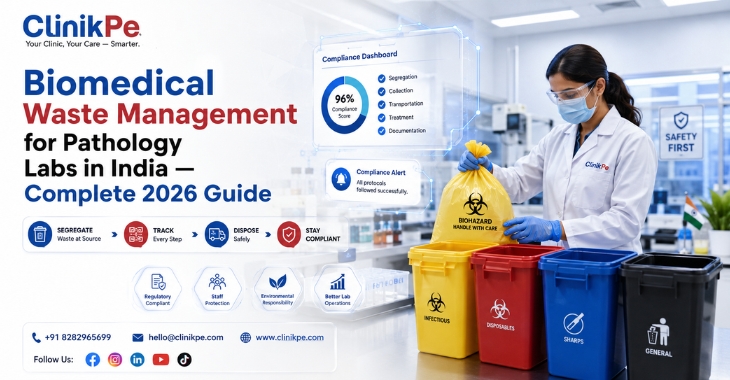
Biomedical waste compliance is non-negotiable for diagnostic labs in India. The BMW Rules 2016 are strictly enforced, and inspections can result in lab closure and significant fines. This guide covers everything you need to be compliant from day one.
The Governing Law: BMW Rules 2016
The Biomedical Waste Management Rules, 2016 (notified under the Environment Protection Act, 1986) govern how biomedical waste must be segregated, stored, transported, and disposed of by all healthcare establishments—including diagnostic labs—in India. Every lab, regardless of size, must comply.
Key obligations under BMW Rules 2016:
- Obtain authorization from State Pollution Control Board (SPCB)
- Segregate waste at source using colour-coded bags and containers
- Tie up with an authorized Common Biomedical Waste Treatment Facility (CBWTF)
- Maintain a log of waste generated and disposed of
- Train all staff on BMW procedures annually
- Display colour-coded BMW charts at all waste generation points
Colour-Coded Waste Segregation — Pathology Lab
| Colour | Container Type | Waste Category (for Labs) |
| Yellow | Non-chlorinated plastic bag | Blood-soaked cotton, bandages, specimen containers with body fluids, chemical waste, expired reagents |
| Red | Non-chlorinated plastic bag | Plastic syringes (without needles), plastic tubes, vacutainer bodies, IV lines, urine containers |
| White | Puncture-proof sharps container | Needles, lancets, scalpel blades, broken glass slides, broken capillary tubes |
| Blue | Cardboard box or bag | Uncontaminated glass slides, glassware, metallic implants |
How to Obtain BMW Authorization
1. Contact your State Pollution Control Board (SPCB)
Find the application form for BMW authorization on your state PCB website or at their office.
2. Identify and contract with a CBWTF
Find your nearest CPCB-authorized CBWTF and sign a collection agreement. This contract must be submitted with your BMW application.
3. Submit the application
Submit the required documents, including the CBWTF contract, CEA registration, lab address proof, and declaration of waste quantities. Pay the prescribed application fee.
4. Inspection
An SPCB inspector verifies your segregation setup and CBWTF tie-up. Ensure all bins are properly placed and labelled.
5. Authorization issued
Once approved, authorization is issued according to the applicable requirements. Ensure renewal is completed before expiry.
⚠️ Penalties for BMW Non-Compliance
Failure to comply with biomedical waste management requirements can lead to serious consequences, including:
- ₹1–5 lakh fine per violation under the Environment Protection Act
- Criminal prosecution, including imprisonment of up to 5 years for wilful violations
- Lab closure by the SPCB for repeat violations
- CEA registration cancellation
- CGHS empanelment suspension for empanelled labs
Frequently Asked Questions
Collection frequency depends on waste generation volume. High-volume labs may receive daily collection, while smaller labs may have alternate-day or twice-weekly collection. BMW Rules require that waste is not stored for more than 48 hours. Your CBWTF contract specifies the schedule, so ensure it matches your actual waste generation rate.
Labs should maintain records such as a daily BMW generation log showing quantities by category, CBWTF collection manifests as proof of handover, staff BMW training records, authorization documentation, and records of incidents such as accidental spills or needlestick injuries. These records should be available during inspections and retained as required.
ClinikPe handles operational documentation so your lab stays inspection-ready. Focus on patient care, not paperwork.
Run a Compliant Lab — ClinikPe Keeps Your Operations Audit-Ready.
Audit trails, test logs, and QC records are automatically maintained in ClinikPe so inspections are never a surprise.