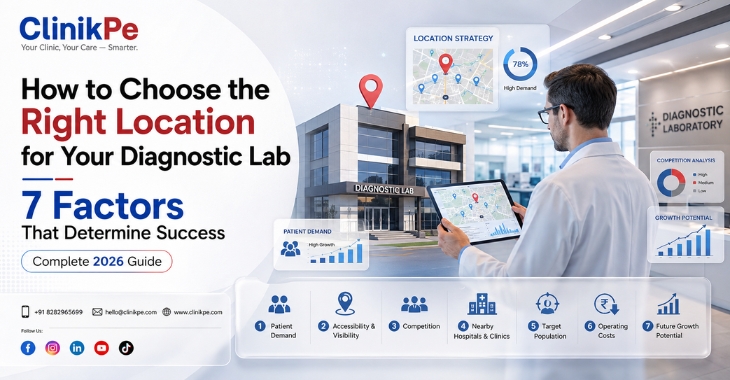
Location is the single factor that most determines a new lab’s ceiling volume. A poorly located lab with excellent equipment will always underperform a well-located lab with average equipment. Evaluate these 7 factors before signing any lease.
Factor 1: Proximity to Referring Doctors
The closer you are to dense doctor clusters, the lower the friction for referrals. When a doctor’s clinic is 3 minutes from your lab, their patients walk over without a second thought. When you’re 2km away, a significant percentage of referred patients go to a lab that’s more convenient.
Ideal: Within 500m of 5+ GP/specialist clinics. Prioritise areas near hospital outpatient departments, multi-doctor clinic buildings, medical complexes, and areas with high physician-to-patient ratios.
Factor 2: Patient Footfall Potential
Evaluate daily foot traffic at the proposed location. High-footfall zones near markets, bus stops, main roads, and residential hubs convert casual awareness into walk-in patients over time. Markets near morning vegetable markets are excellent — fasting blood test patients often combine both errands.
Stand at the proposed location during morning peak hours (7am–10am) and count people passing. Labs on busy corridors see 2–3x the organic walk-in volume of labs on quiet streets with the same doctor proximity.
Factor 3: Competition Assessment
Count labs within 500m. One or two labs nearby validates the location because demand exists, but three or more suggests saturation — unless you can clearly differentiate.
Assess competitors based on:
- Their Google reviews and rating — a weak reputation can be your opportunity
- Whether they offer home collection — if not, you can
- Their approximate TAT — slower service can become your advantage
- Whether they are chains or independent labs — chains have brand recognition, while independent labs can offer more personalised service
Factor 4: Accessibility
Accessibility Checklist
- ✓ Ground floor (strongly preferred)
- ✓ Auto/cab can stop directly outside
- ✓ 2-wheeler parking nearby
- ✓ Visible from the main road with space for signage
- ✓ Ramp or easy entry for elderly patients
- ✓ Near a bus or auto route if car parking is unavailable
Factor 5: Rent vs Revenue Potential
Rent should not exceed 15–20% of projected revenue. A high-rent prime location can be justified if the footfall potential is proportionately higher. For example, if you project ₹5 lakh per month in revenue, rent above ₹75,000–₹1 lakh can start to compress margins significantly. Use the 15% rule as your ceiling when evaluating lease offers.
Factor 6: Infrastructure Quality
Check the following before signing the lease:
- Power supply stability: Labs need 8–12 hours of stable electricity daily. Frequent power cuts mean generator dependency and higher operating costs.
- Water supply: Ensure adequate and reliable availability.
- Drainage quality: Labs generate liquid waste and need suitable drainage infrastructure.
- Internet connectivity: Reliable internet is essential for cloud-based lab software.
- Mobile network signal: Check signal strength inside the premises for smooth communication and operations.
Factor 7: Space for Growth
Take slightly more space than you need today if the price difference is small. Expanding a successful lab later can be disruptive and expensive. A lab that maxes out at 60 patients per day because the collection area is too small leaves revenue on the table. Plan for approximately 18–24 months of volume growth when selecting your space, while using a scalable Laboratory Management Software like ClinikPe to support your growing lab operations.
Frequently Asked Questions
Is a hospital area always the best location for a diagnostic lab?
Hospital areas have very high referral density but also very high competition. Most hospitals have embedded labs or preferred referral arrangements.
A location near a hospital OPD can be excellent if:
- The hospital’s own lab has limited scope and primarily serves in-house patients.
- You are within 200m and easily accessible.
- There are only one or two other independent labs nearby.
If there are already six labs clustered near the hospital entrance, the market may be saturated.
Can I run a diagnostic lab from a residential building?
CEA registration and local municipal rules generally require a commercial or mixed-use premises for a lab. Purely residential buildings are usually not permitted. Some states allow conversion of ground-floor residential units to clinical use, so check local municipal zoning and CEA norms. Regardless of permission, a residential building may reduce visibility, footfall, and patient perception of professionalism.
Great Location + ClinikPe = Your Lab Starts Right.
Software that grows with you — from your first patient to your 100th. 14-day free trial and setup in 2 days.