If you run a pathology lab in India in 2026, the question is no longer whether you need a LIMS. The question is which one will actually fit the way your lab runs — your sample volumes, your reporting templates, your NABL audit cycle, and the ten small operational habits your team has built over the years.
I’ve sat across the table from enough lab owners to tell you this: most pick the wrong LIMS the first time. They either buy something too big (built for 500-bed hospitals), too rigid (templates that can’t match their report formats), or too cheap (no integrations, no support, no roadmap). Six months later, the lab is back on WhatsApp groups and Excel sheets — only now with a SaaS subscription on top.
This guide compares the best LIMS for pathology labs in India in 2026 — the ones lab owners actually use, what they cost, where each one shines, and where each one frustrates. Full disclosure: I’m involved with ClinikPe, one of the platforms covered here. I’ve kept the analysis grounded and called out where each option (including ours) is a poor fit. If you’re evaluating a lab information management system this quarter, read this end-to-end before you sign anything.
Quick CTA — If you’d rather see how a modern LIMS actually runs in a 200–2,000 tests/day lab, book a 20-minute ClinikPe demo. We’ll show you the exact workflow your team will use on day one.
What Is a LIMS — and Why Pathology Labs in India Need One Now
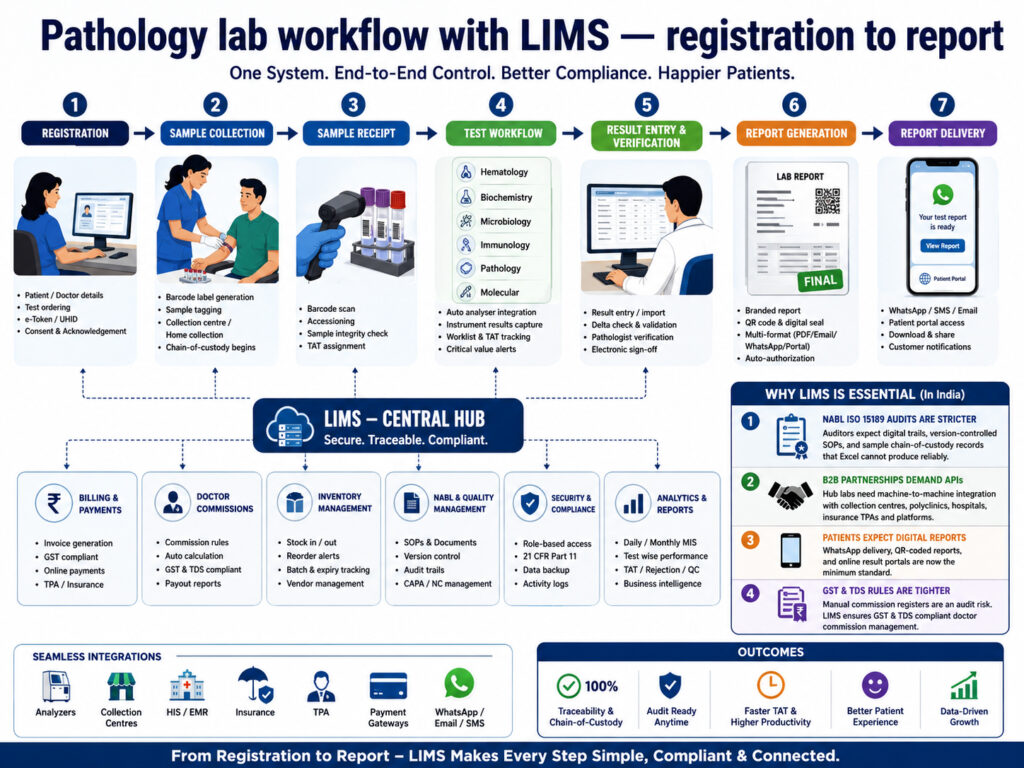
A Laboratory Information Management System (LIMS) is the software backbone of a modern diagnostic lab. It handles patient registration, sample tracking with barcodes, test workflows, result entry, report generation, billing, doctor commissions, inventory, NABL documentation, and analytics — in one place.
In India specifically, the case for a LIMS has sharpened in the last two years because of four shifts:
- NABL ISO 15189 audits are stricter. Auditors now expect digital trails, version-controlled SOPs, and sample chain-of-custody records that Excel simply cannot produce reliably.
- B2B partnerships demand APIs. If you’re a hub lab serving collection centres, polyclinics, or insurance TPAs, you need machine-to-machine integration — not PDF attachments over email.
- Patients now expect digital reports. WhatsApp delivery, QR-coded reports, and online result portals have moved from “nice to have” to “minimum viable.”
- GST and TDS rules around doctor commissions have tightened. Manual commission registers are now an audit risk.
If any one of the above applies to your lab, you’re already paying the cost of not having a best lab management platform in place — in revenue leakage, manual hours, and audit risk. You just don’t see it on a line item.
How We Evaluated the Best LIMS for Pathology Labs in India (2026)
Before the list, the methodology, because most “Top 10 LIMS” blogs you’ll find online are written by people who have never run a lab. We scored each platform across seven dimensions that actually move the needle for Indian pathology labs:
| Dimension | What we looked for |
|---|---|
| NABL & ISO readiness | Pre-built SOP templates, audit trails, sample IDs, internal QC modules |
| Report templates | Indian test report formats (CBC, LFT, KFT, histopath, cytology), reference range customization |
| Billing & GST | Package pricing, doctor/centre commissions, GST invoicing, TDS, B2B accounts |
| Integrations | Analyzer interfacing (Sysmex, Mindray, BS-240, ASTM, HL7), WhatsApp, payment gateways |
| Ease of use | Onboarding time, training load, mobile-friendly result entry |
| Pricing transparency | Predictable per-user or per-test pricing, no hidden integration fees |
| Support quality | India-based support, response time SLAs, dedicated onboarding manager |
We then weighted these against the realities of a lab doing 200 to 2,000 tests per day — the most common segment in India where buying decisions are actively being made in 2026.
Top 8 Best LIMS for Pathology Labs in India (2026)
1. ClinikPe LIMS — Best Overall for Growing Pathology Labs
Best for: Standalone and multi-branch pathology labs doing 100–2,000 tests/day, especially labs running collection centres or B2B partnerships.
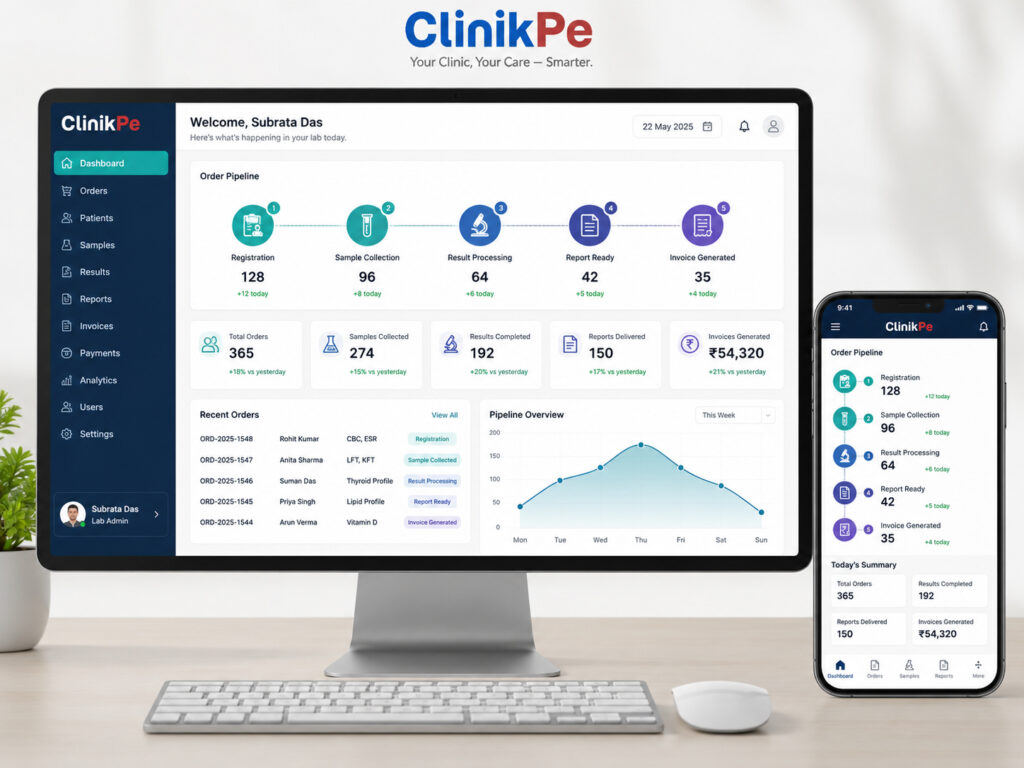
ClinikPe is built ground-up for Indian diagnostic labs — not adapted from a hospital HIMS. That distinction matters more than it sounds. Everything from the registration flow to the doctor commission engine assumes you’re running a pathology operation, not a 100-bed hospital.
What works well:
- NABL-ready out of the box: pre-loaded SOP templates, internal QC charts, calibration logs, and audit trail. Labs we’ve onboarded have cleared NABL surveillance audits within 90 days of going live.
- Two-way analyzer integration (Sysmex, Mindray, Erba, Beckman, Roche) with ASTM and HL7 support — no separate middleware licensing.
- Doctor and collection-centre commissions with auto-TDS deduction, monthly statements, and GST-compliant invoices.
- WhatsApp report delivery built in (no third-party plugin), with QR-verifiable reports.
- Multi-branch support with central pricing control and branch-level P&L — useful if you’re scaling beyond your first centre.
Where it could be stronger:
- Histopathology and cytology modules are solid but newer than the routine biochem/haematology workflows; some specialised labs may want to review templates before signing.
- No on-premise deployment option — ClinikPe is cloud-only. For most labs in 2026 this is a feature, not a bug, but worth knowing.
Pricing: Flat ₹4,999/month for standalone single-centre labs. Multi-branch labs typically land between ₹12,000 and ₹25,000/month including analyzer interfacing.
Try it — book a ClinikPe demo at clinikpe.com. Most labs get a working environment within 5–7 days of signing.
2. CrelioHealth — Strong for Mid-to-Large Labs
Best for: Mid-to-large reference labs with established processes and dedicated IT staff.
CrelioHealth (formerly LiveHealth) is one of the more established names in the Indian LIMS market. The product is feature-dense, with strong B2B and franchise modules.
What works well:
- Mature B2B portal for collection centres and corporate clients.
- Wide analyzer interface library.
- Good audit and compliance reporting.
Where it could be stronger:
- Pricing is on the higher side for sub-500 tests/day labs.
- Onboarding can take 4–8 weeks; smaller labs sometimes find the depth overwhelming.
- Customisation requests often go through formal change-request cycles.
Pricing: Typically ₹15,000–₹60,000/month depending on modules and volume.
3. SuvarnaTech LIMS — Enterprise-Grade for Hospital Labs
Best for: Hospital-attached labs and reference labs needing deep HIMS integration.
Suvarna’s strength is its hospital lineage. If your lab sits inside a multi-specialty hospital and needs to talk to the HIMS, OPD, IPD, and radiology systems, Suvarna handles that cleanly.
What works well:
- Deep integration with hospital information systems.
- Robust on-premise deployment for hospitals with that policy.
- Strong inventory and procurement modules.
Where it could be stronger:
- Overkill for standalone pathology labs.
- Interface feels enterprise-era — not the cleanest UX in this list.
- Implementation cost is significant.
Pricing: Project-based, typically ₹4–15 lakh implementation plus AMC.
4. Birlamedisoft Quanta LIMS — Established Player
Best for: Mid-sized labs comfortable with traditional software workflows.
Quanta has been around long enough to have ironed out most operational edge cases. It’s a workhorse rather than a showpiece.
What works well:
- Stable feature set across haematology, biochemistry, immunology, microbiology.
- Decent NABL documentation support.
- Wide hardware compatibility.
Where it could be stronger:
- UI hasn’t aged as gracefully as newer competitors.
- Mobile experience is limited.
- Reporting flexibility requires admin help.
Pricing: Available in both perpetual licence and subscription models; subscriptions typically start around ₹8,000/month.
5. Attune LIMS (Creliant) — Standards-Driven Choice
Best for: Labs prioritising ISO 15189 compliance and standards-based workflows.
Attune is built around laboratory standards and has a strong following among labs that have already been through one or two NABL audits and want a system that mirrors their existing SOPs.
What works well:
- Standards-first design.
- Good quality control modules — Levey-Jennings charts, Westgard rules built in.
- Reasonable analyzer integration coverage.
Where it could be stronger:
- Learning curve is steeper than the newer SaaS options.
- B2B / collection-centre flows are less polished than ClinikPe or Crelio.
Pricing: Mid-market pricing, typically ₹10,000–₹30,000/month.
6. LifeTrenz LIS — Modern UI for Tech-Forward Labs
Best for: Mid-sized labs that prioritise clean interfaces and tighter EMR/HIMS interoperability.
LifeTrenz has invested heavily in UX and platform integration. For labs attached to a clinic chain or hospital that already runs a modern EMR, the integration story is one of the cleaner ones in this segment.
What works well:
- Modern, mobile-friendly interface that requires less training.
- HL7 and FHIR support — useful for labs integrating with clinic groups.
- Decent rule engine for auto-validation and reflex testing.
Where it could be stronger:
- Smaller installed base than CrelioHealth or Quanta — fewer peer references.
- India-specific compliance modules (NABL templates, doctor TDS) need extra configuration.
- Custom report design typically routes through the vendor’s professional services.
Pricing: Tier-based, generally ₹12,000–₹35,000/month for mid-sized lab deployments.
7. Halemind LIS — Lightweight Option for Smaller Labs
Best for: Single-centre labs doing under 200 tests/day looking for affordable digital basics.
If you’re moving from Excel and a printer to your first real LIMS, Halemind is a reasonable starting point.
What works well:
- Low entry cost.
- Quick to set up.
- Covers the basics: registration, reports, billing.
Where it could be stronger:
- Limited depth for B2B operations.
- Analyzer integration is more limited than mid-tier players.
- May need to be replaced once you cross 300–400 tests/day.
Pricing: Starts around ₹2,500–₹3,500/month.
8. Medeil LIMS — Budget Choice with Trade-offs
Best for: Very price-sensitive small labs willing to trade depth for cost.
Medeil offers an entry-level pathology module that gets the basics done.
What works well:
- Low cost.
- Simple to operate.
Where it could be stronger:
- Pathology is not its primary focus — it started in pharmacy/inventory.
- Limited NABL-specific tooling.
- Support response times vary.
Pricing: Entry-level, often under ₹2,000/month for basic plans.
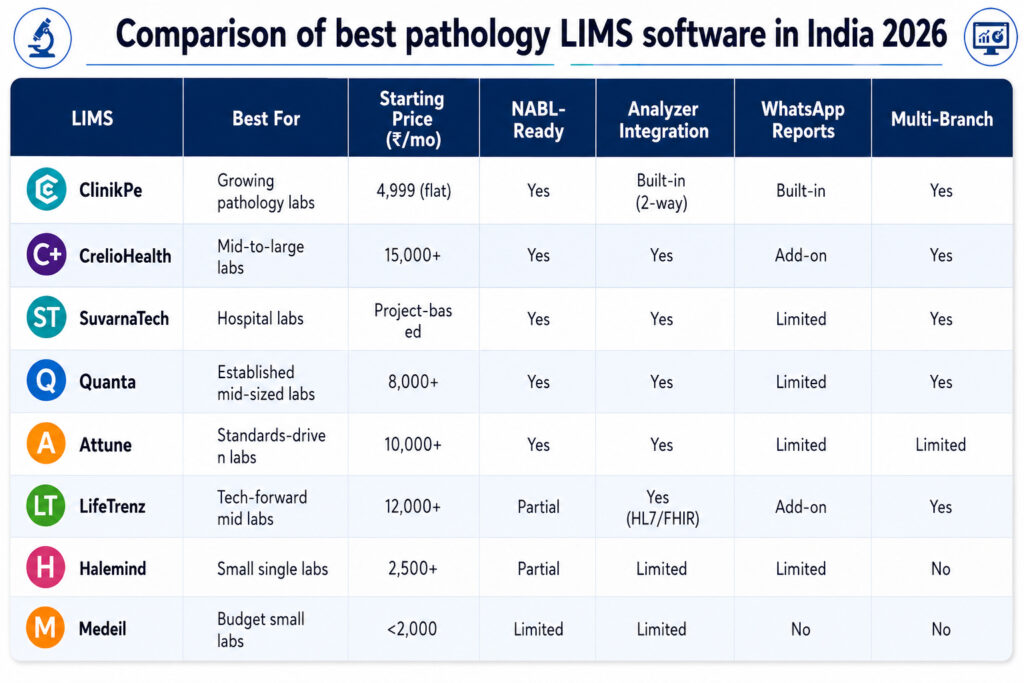
Comparison Table: Best LIMS for Pathology Labs in India 2026
| LIMS | Best For | Starting Price (₹/mo) | NABL-Ready | Analyzer Integration | WhatsApp Reports | Multi-Branch |
|---|---|---|---|---|---|---|
| ClinikPe | Growing pathology labs | 4,999 (flat) | Yes | Built-in (2-way) | Built-in | Yes |
| CrelioHealth | Mid-to-large labs | 15,000+ | Yes | Yes | Add-on | Yes |
| SuvarnaTech | Hospital labs | Project-based | Yes | Yes | Limited | Yes |
| Quanta | Established mid-sized labs | 8,000+ | Yes | Yes | Limited | Yes |
| Attune | Standards-driven labs | 10,000+ | Yes | Yes | Limited | Limited |
| LifeTrenz | Tech-forward mid labs | 12,000+ | Partial | Yes (HL7/FHIR) | Add-on | Yes |
| Halemind | Small single labs | 2,500+ | Partial | Limited | Limited | No |
| Medeil | Budget small labs | <2,000 | Limited | Limited | No | No |
Pricing is indicative and based on publicly available information plus founder conversations as of Q1 2026. Always confirm with the vendor.
How to Actually Choose a LIMS: A Founder’s Checklist
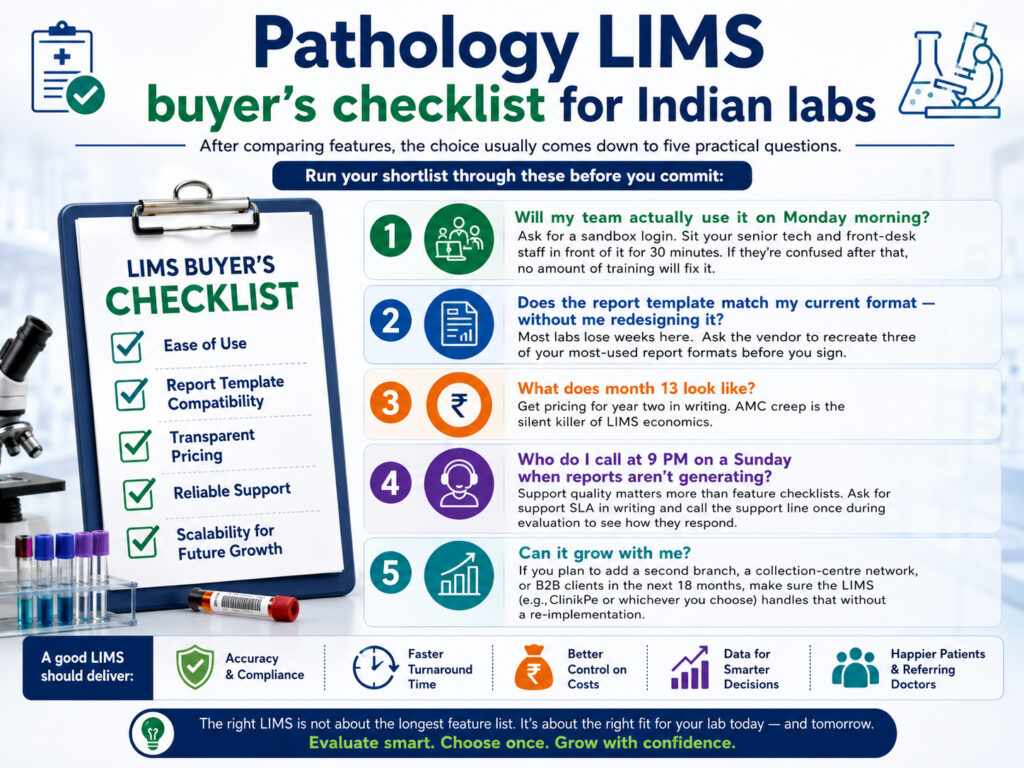
After comparing features, the choice usually comes down to five practical questions. Run your shortlist through these before you commit:
- Will my team actually use it on Monday morning? Ask for a sandbox login. Sit your senior tech and front-desk staff in front of it for 30 minutes. If they’re confused after that, no amount of training will fix it.
- Does the report template match my current format — without me redesigning it? Most labs lose weeks here. Ask the vendor to recreate three of your most-used report formats before you sign.
- What does month 13 look like? Get pricing for year two in writing. AMC creep is the silent killer of LIMS economics.
- Who do I call at 9 PM on a Sunday when reports aren’t generating? Support quality matters more than feature checklists. Ask for support SLA in writing and call the support line once during evaluation to see how they respond.
- Can it grow with me? If you plan to add a second branch, a collection-centre network, or B2B clients in the next 18 months, make sure the ClinikPe lab management (or whichever LIMS you choose) handles that without a re-implementation.
Lead-magnet CTA — Want this checklist as a printable PDF for your evaluation committee? Download the LIMS Buyer’s Checklist (free PDF) or book a ClinikPe walkthrough and we’ll run your lab through it live.
Common Mistakes Lab Owners Make When Buying a LIMS
A few patterns I see again and again — share them with anyone evaluating LIMS in your network:
- Buying on feature count, not workflow fit. A 400-feature LIMS is useless if 380 of those features don’t match how your team actually works.
- Skipping the analyzer integration test. Insist on a live demo of your specific analyzer model talking to the LIMS — not a slide claiming compatibility.
- Underestimating data migration. Five years of patient records, doctor lists, and pricing master files need to come over cleanly. Get the vendor to commit to a migration plan in writing.
- Letting one tech-savvy person own the decision. The LIMS will be used by phlebotomists, technicians, doctors, accounts, and front-desk staff. All of them should be in at least one demo.
- Ignoring the NABL angle until the audit. Buying a LIMS three months before your audit and expecting it to magically produce compliant documentation rarely ends well.
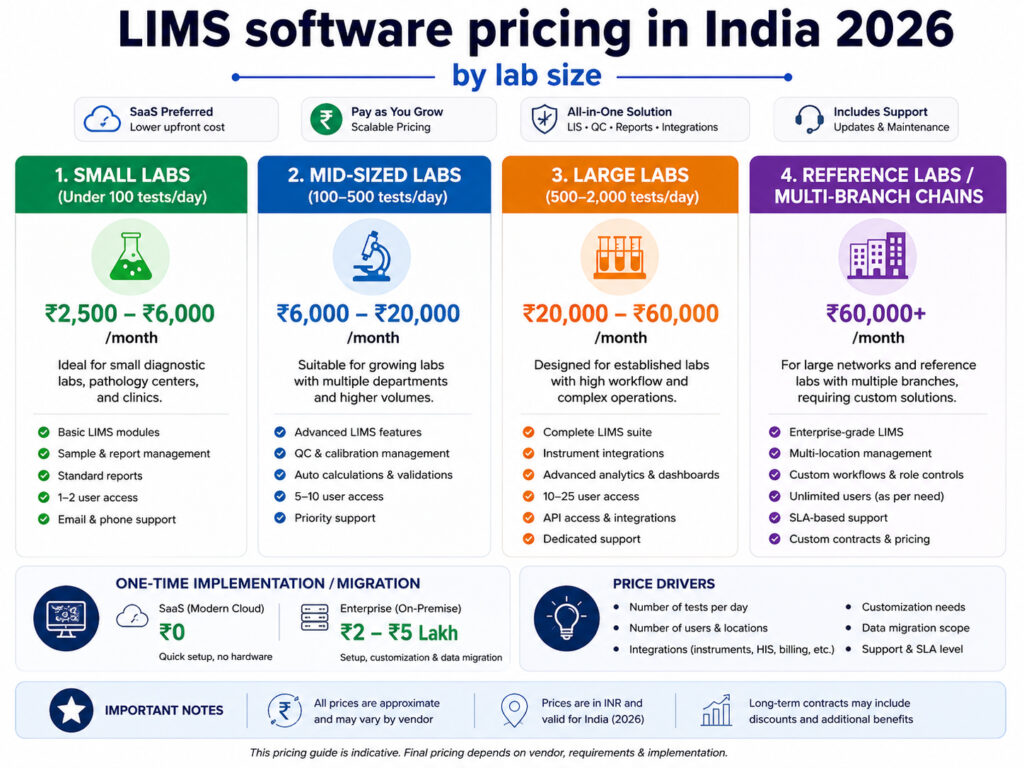
How Much Does a LIMS Cost in India in 2026?
Real-world pricing ranges most labs should expect:-
- Small labs (under 100 tests/day): ₹2,500–₹6,000/month
- Mid-sized labs (100–500 tests/day): ₹6,000–₹20,000/month
- Large labs (500–2,000 tests/day): ₹20,000–₹60,000/month
- Reference labs / multi-branch chains: ₹60,000+/month, often with custom contracts
- One-time implementation/migration: ₹0 (modern SaaS) up to ₹2–5 lakh (enterprise on-premise)
Hidden costs to ask about explicitly:
- Analyzer interface charges (per machine or flat?)
- WhatsApp / SMS credits
- Storage for old patient data
- Additional user licences
- Custom report design fees
- AMC after year one
External References
For deeper compliance reading, lab owners should bookmark:
- NABL India — ISO 15189 Medical Lab Accreditation — the source of truth for accreditation criteria.
- ICMR — Guidelines for diagnostic labs — particularly for emerging-pathogen and quality protocols.
- WHO — Laboratory Quality Management System handbook — foundational reading for QMS implementation.
FAQs: Best LIMS for Pathology Labs in India
For most growing pathology labs doing 100–2,000 tests/day, ClinikPe offers the strongest balance of NABL-readiness, analyzer integration, B2B features, and predictable flat pricing of ₹4,999/month. Mid-to-large reference labs with existing complex workflows often shortlist CrelioHealth alongside.
Entry-level LIMS subscriptions start around ₹2,500/month. Most mid-sized labs (100–500 tests/day) pay between ₹6,000 and ₹20,000 per month. Implementation is typically included with cloud-based LIMS providers in 2026.
Yes — provided the vendor offers encryption in transit and at rest, role-based access control, audit logs, and data residency in India. Most modern LIMS platforms including ClinikPe meet these criteria and are aligned with the DPDP Act 2023.
Yes. A NABL-ready LIMS provides version-controlled SOPs, internal QC charts, calibration logs, sample chain-of-custody records, and audit trails — all of which are required evidence during ISO 15189 audits.
Cloud LIMS platforms like ClinikPe typically go live in 5–14 days for single-centre labs. Enterprise on-premise systems can take 4–12 weeks.
Most modern LIMS support ASTM and HL7 protocols and connect with major analyzer brands like Sysmex, Mindray, Erba, Beckman, and Roche. Always ask for a live demo of integration with your specific analyzer model.
No. A good pathology LIMS includes billing, GST invoicing, doctor commissions, package pricing, and TDS handling. A separate billing tool usually creates more reconciliation work than it saves.
The terms are used interchangeably in India. Technically, LIS (Laboratory Information System) focuses on clinical lab workflows, while LIMS (Laboratory Information Management System) includes broader sample, inventory, and QMS workflows. Most Indian vendors today offer a unified product.
Final Word
Choosing the best LIMS for your pathology lab in India isn’t about finding the most expensive product — it’s about finding the one that disappears into your operations and lets your team focus on results, patients, and growth.
If you’re evaluating LIMS this quarter, do three things this week: shortlist two or three platforms from this guide, ask each for a workflow demo using your report formats, and call their support line once before signing.
Get started — book a 20-minute ClinikPe demo at clinikpe.com. We’ll show you exactly how your lab’s day-1 workflow will look, with your report formats and your analyzers. No slides, no jargon. Just the product.