Quick answer
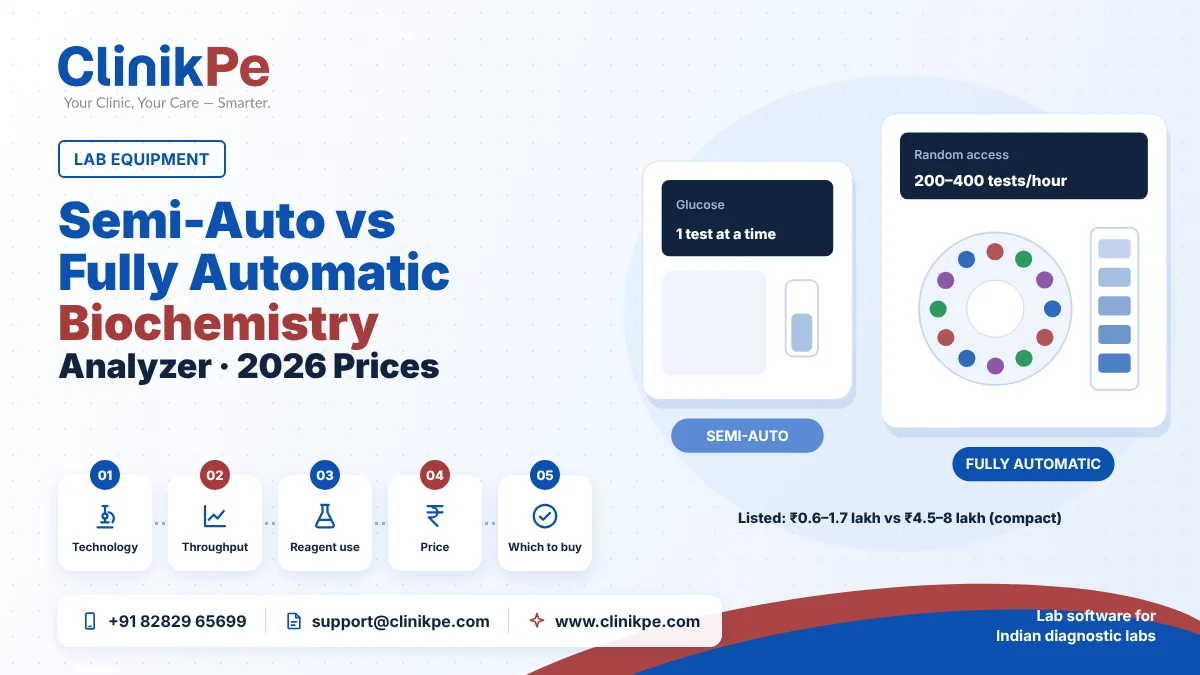
A semi-automatic biochemistry analyzer needs the technician to pipette each test by hand and costs about ₹0.6–1.7 lakh in India. A fully automatic analyzer pipettes from cooled onboard reagents and runs 200–400 tests an hour for compact models, at about ₹4.5–8 lakh. Choose semi-auto for low volume and a tight budget; fully automatic when volume, staff time or turnaround matters.
Key takeaways
- Semi-auto: manual pipetting, one test at a time; fully auto: random access, walk-away.
- Listed prices: about ₹0.6–1.7 lakh semi-auto, ₹4.5–8 lakh compact fully automatic.
- Accuracy can be comparable; speed, staff time and reagent use differ.
- Reagent cost per test and service matter more than purchase price.
- Analyzers now attract 5% GST (from 22 September 2025).
The difference in one paragraph
On a semi-automatic analyzer the technician pipettes sample and reagent by hand, incubates the mix and then the analyzer draws it into a flow cell and reads it, one test at a time. A fully automatic analyzer does all of that itself: it pipettes from cooled onboard reagents, runs many tests on many samples at once (random access) and flags results, while the technician does other work.
Both can give accurate results. A study at S.N. Medical College, Agra compared a semi-auto Erba Chem 7 with a fully automatic analyzer on 70 patients and found good agreement for creatinine and uric acid, with urea the exception. The real differences are speed, staff time, reagent use and price.
Side by side
| Semi-automatic | Fully automatic | |
|---|---|---|
| Pipetting | Manual, by the technician | Automatic, from cooled onboard reagents |
| How it runs | One test at a time through a flow cell | Random access: many samples and tests in parallel |
| Throughput | Depends on the technician | About 200 to 400 tests an hour for compact models (more with ISE) |
| Reagent volume | Larger aspiration volumes (e.g. 100 µL to several mL) | Small reaction volumes, often 100 to 180 µL minimum |
| Electrolytes | Separate electrolyte analyzer | Optional ISE module |
| Typical listed price | About ₹0.6 to 1.7 lakh | About ₹4.5 to 8 lakh for compact models; ₹10 lakh+ for larger |
| Best for | Low volume, tight budget | Growing labs, one-person benches, faster TAT |
Popular models and listed prices in India
| Model | Type | Listed price | Notes |
|---|---|---|---|
| Erba Chem 5X | Semi-auto | ≈ ₹62,000–80,000 | Peristaltic pump, 222 open programs |
| Agappe Mispa Viva | Semi-auto | ≈ ₹70,000 | IndiaMART dealer |
| Robonik Prietest Touch Plus | Semi-auto | ≈ ₹75,000 | IndiaMART |
| Mindray BA-88A | Semi-auto | ≈ ₹1.0–1.35 lakh | Several sellers |
| Erba Chem 7 | Semi-auto | ≈ ₹1.7 lakh | IndiaMART |
| Mindray BS-240 / BS-240 Pro | Fully automatic | ≈ ₹4.5–8 lakh | Up to 200 tests/hour (240 on Pro) |
| Erba EM 200 | Fully automatic | ≈ ₹5–6.3 lakh | 200 tests/hour, 400 with ISE |
| Erba XL 200 | Fully automatic | ≈ ₹5.8 lakh | Listed by Transasia |
| Agappe Mispa CXL Pro | Fully automatic | ≈ ₹6.5 lakh | Listed by Agappe |
| Mindray BS-430 / BS-480 | Fully automatic | ≈ ₹10–15 lakh | 400 tests/hour |
| Roche cobas c111 | Fully automatic | ≈ ₹13 lakh + GST | Dealer listing |
| Erba XL 640 | Fully automatic | ≈ ₹19 lakh | 400 tests/hour, 640 with ISE |
Get written quotes that include installation, training, warranty, AMC and, most important, the reagent cost per test for your top 20 tests.
Which should your lab buy?
Semi-auto or fully automatic? Three questions
Our suggestion
Compact fully automatic
With one technician and 40 to 150 tests a day, walk-away operation frees time for collection, reporting and patients.
Our rule of thumb, not a manufacturer recommendation. Check reagent cost per test and local service before buying.
The costs that matter more than the price tag
- Reagent cost per test. You pay it on every test for years. Ask each dealer for it in writing; see our guide to reagent consumption per test.
- Open or closed system. Closed systems tie you to one supplier’s reagent prices. Open systems let you buy reagents elsewhere, but you must verify each method.
- Service. How fast does an engineer reach you, and are spares stocked locally?
- Reagent rental. Some suppliers place a fully automatic analyzer in return for reagent purchases; compare it carefully in our guide to reagent rental vs buying.
- LIS interfacing. A fully automatic analyzer sending results straight into your software saves typing and transcription errors.
Frequently asked questions
In a semi-automatic analyzer the technician pipettes sample and reagent by hand and the analyzer reads one test at a time through a flow cell. A fully automatic analyzer pipettes from cooled onboard reagents and runs many tests on many samples at once, typically 200 to 400 tests an hour for compact models.
Online listings in October 2026 show most semi-auto analyzers between about ₹62,000 and ₹1.7 lakh, for example Erba Chem 5X around ₹62,000–80,000, Mindray BA-88A around ₹1.0–1.35 lakh and Erba Chem 7 around ₹1.7 lakh.
Compact fully automatic analyzers are listed at about ₹4.5–8 lakh (Mindray BS-240, Erba EM 200, Agappe Mispa CXL Pro). Larger 400 tests/hour systems such as Mindray BS-480 or Erba XL 640 are listed from about ₹10 lakh to ₹19 lakh.
Yes, when used correctly. A study at S.N. Medical College, Agra found good agreement between a semi-auto Erba Chem 7 and a fully automatic analyzer for creatinine and uric acid. Accuracy depends heavily on pipetting technique, timing and QC.
When biochemistry volume grows beyond what one technician can pipette comfortably, when turnaround time suffers, or when a single technician also handles collection and reporting. There’s no published volume cut-off; compare reagent cost per test and staff time.
Most fully automatic analyzers can send results to a LIS over serial or network connections using ASTM or HL7, and some semi-automatic models can too. Confirm interfacing for the exact model before buying.
Buying an analyzer? Connect it from day one
Tell us the analyzer you’re considering. We’ll confirm whether ClinikPe can interface it and show results flowing into a report.
No setup, migration or training fees · Free trial on cloud plans
Sources
- Mindray BA-88A brochure
- Mindray BS-200E brochure
- Mindray BS-240
- Transasia Erba Chem 5X
- Transasia Erba EM 200
- Transasia Erba XL-640
- IndiaMART: Mindray biochemistry analyzer listings
- IndiaMART: fully automated biochemistry analyzer listings
- Semi-auto vs fully auto comparison, S.N. Medical College Agra (GJRA 2024)
Written by the ClinikPe lab operations team in Kolkata. General information, not legal, tax or medical advice; check the sources and your state rules before acting.