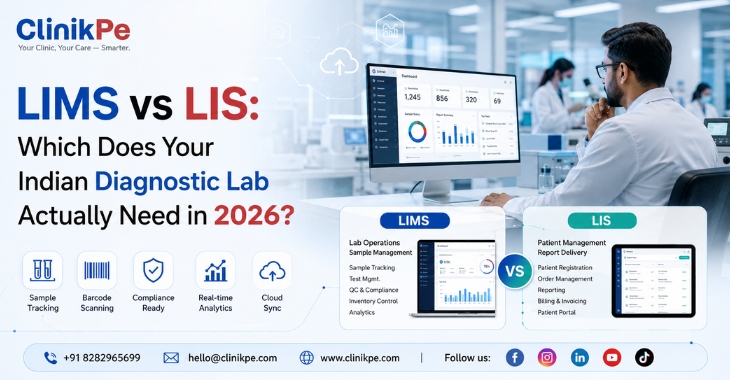
LIMS and LIS are used interchangeably in India’s diagnostic lab market. They shouldn’t be. Pick the wrong one, and you’re either overspending by 30–50% on features a single-location lab will never use — or under-buying for the scale you’ll hit in 18 months.
The difference isn’t technical jargon. It’s a business decision that affects your daily workflow, your NABL readiness, and your software costs for the next three to five years. A LIMS is not just a smarter LIS. It’s a separate category designed for specific operational needs.
Here’s the framework Indian lab owners actually use to decide.
LIMS vs LIS: The 2-Sentence Definition
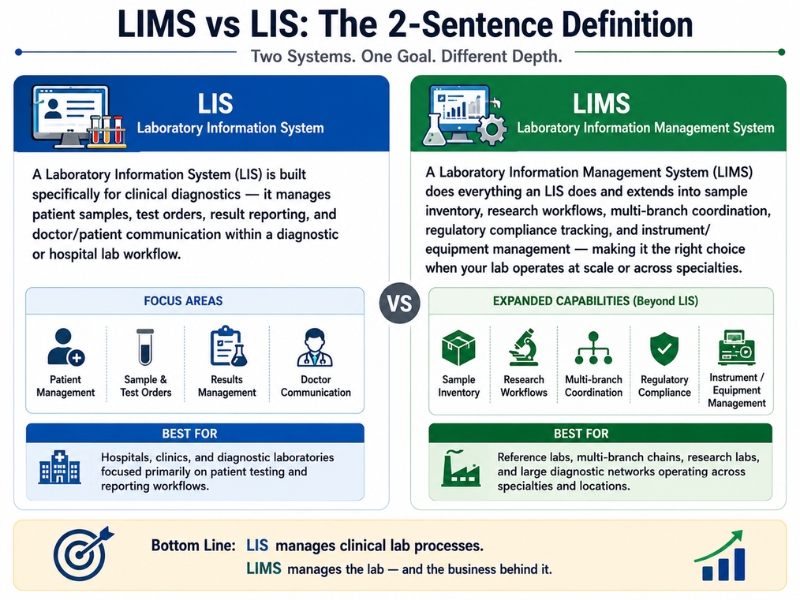
A Laboratory Information System (LIS) is built specifically for clinical diagnostics — it manages patient samples, test orders, result reporting, and doctor/patient communication within a diagnostic or hospital lab workflow.
A Laboratory Information Management System (LIMS) does everything an LIS does and extends into sample inventory, research workflows, multi-branch coordination, regulatory compliance tracking, and instrument/equipment management — making it the right choice when your lab operates at scale or across specialties.
What an LIS Does (and Where It Stops):
A lab LIS system is purpose-built for the clinical diagnostic journey. Here’s what it handles well:
- Patient registration and test ordering — connects patient demographics with requisition forms, digital prescriptions, and test requests for accurate workflow initiation.
- Sample tracking — monitors samples from collection to final reporting using barcode or RFID-based traceability systems.
- Result entry and validation — supports both manual data entry and automated analyzer interfacing for faster, more accurate reporting.
- Report generation and delivery — distributes reports through print, WhatsApp, email, SMS links, or secure patient portals.
- Doctor and hospital integration — automatically shares reports with referring physicians, clinics, or hospital departments.
- Billing integration — links completed tests directly with invoicing, payment tracking, and financial reporting workflows.
Where lab LIS systems stop: They are not designed for multi-branch inventory consolidation, research-grade chain-of-custody, regulatory audit trails (NABL, CAP), or the management of non-patient samples, such as quality control materials or environmental samples. Once your operational complexity crosses these lines, an LIS starts showing its limits — usually at the worst possible time.
What a LIMS Does Beyond an LIS:
A LIMS covers the full LIS feature set and then layers on capabilities that growing labs genuinely need:
- Multi-branch sample and inventory management — one dashboard across all collection centers
- Reagent and consumable tracking — with expiry alerts and automatic reorder triggers
- NABL/ISO audit trail — immutable logs for every sample touchpoint
- QC management — Westgard rules, Levey-Jennings charts, corrective action tracking
- Research and reference lab workflows — batched runs, study-linked samples, protocol versioning
- Equipment maintenance scheduling — calibration logs, service history, downtime alerts
- Role-based access and compliance reporting — critical for chains, hospital networks, and accreditation bodies
In short: LIMS is what happens when a diagnostic business grows beyond a single-location, single-specialty clinical lab.
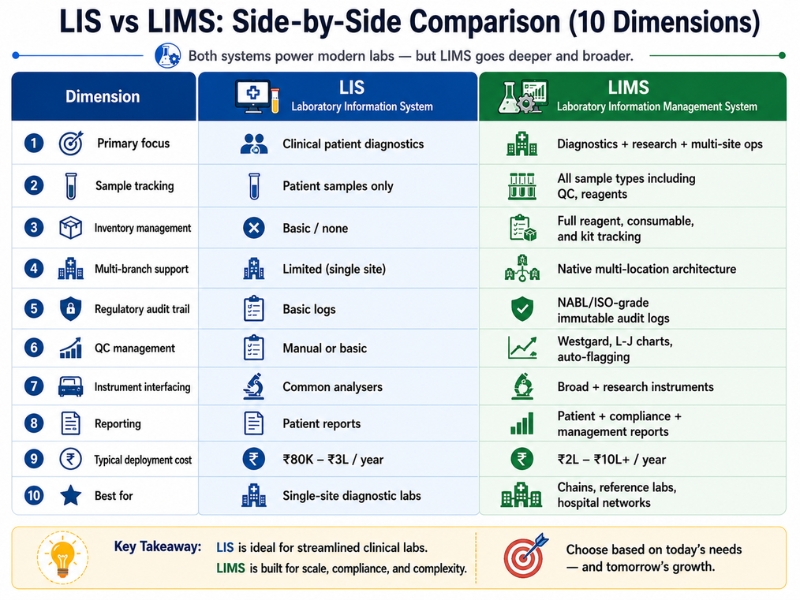
Side-by-Side Comparison Table (10 Dimensions):
| Dimension | LIS | LIMS |
| Primary focus | Clinical patient diagnostics | Diagnostics + research + multi-site ops |
| Sample tracking | Patient samples only | All sample types including QC, reagents |
| Inventory management | Basic / none | Full reagent, consumable, and kit tracking |
| Multi-branch support | Limited (single site) | Native multi-location architecture |
| Regulatory audit trail | Basic logs | NABL/ISO-grade immutable audit logs |
| QC management | Manual or basic | Westgard, L-J charts, auto-flagging |
| Instrument interfacing | Common analysers | Broad + research instruments |
| Reporting | Patient reports | Patient + compliance + management reports |
| Typical deployment cost | ₹80K–₹3L/year | ₹2L–₹10L+/year |
| Best for | Single-site diagnostic labs | Chains, reference labs, hospital networks |
When an LIS Is Enough — 4 Lab Profiles:
Profile 1 — The Standalone Pathology Lab
You operate a single-location diagnostic center processing approximately 100–500 routine tests daily, including CBC, LFT, KFT, lipid profiles, and urine analysis. Your primary operational priorities are fast report turnaround, accurate billing, and efficient patient registration. In this setup, a modern laboratory LIS system is usually more than sufficient for daily workflow management.
Profile 2 — The Clinic-Attached Lab
Your laboratory primarily supports one clinic, nursing home, or small healthcare facility. Test volumes remain stable, referral workflows are internal, and expansion is not currently part of the business plan. In this environment, LIS software offers a practical and cost-efficient solution without the added complexity of enterprise-grade workflow automation.
Profile 3 — The Urban Diagnostic Franchise (Single City, Single Owner)
You manage 2–3 collection centers connected to one central processing laboratory within the same city. As long as the lab LIS system supports centralized reporting, barcode routing, and collection-center coordination within a single processing hub, it can comfortably support operations for the next 12–18 months before advanced LIMS functionality becomes necessary.
Profile 4 — The Government/Public Sector Lab
Public health laboratories typically process high test volumes using standardized diagnostic protocols and fixed workflows. Because operations are structured and reagent variability is limited, LIS software aligns well with routine reporting, administrative control, and protocol-driven testing environments without introducing unnecessary operational overhead.
When You Need a LIMS — 4 Lab Profiles:
Profile 1 — The Diagnostic Chain (5+ Branches)
Multi-location diagnostic networks require centralized operations across branches, cities, and collection centers. Inventory standardization, branch-wise profitability tracking, unified quality control, referral analytics, and consolidated compliance reporting become difficult to manage manually. At this scale, a LIMS functions as core operational infrastructure rather than optional software.
Profile 2 — The NABL-Accredited or CAP-Seeking Lab
Accreditation frameworks such as NABL and CAP demand strict documentation, audit trails, calibration records, QC tracking, user accountability, and corrective action logs. Traditional LIS software usually handles reporting workflows but lacks a deep compliance architecture. A LIMS is specifically designed to support structured accreditation and audit readiness.
Profile 3 — The Reference or Specialty Lab
Advanced diagnostic environments handling genomics, oncology, molecular diagnostics, environmental testing, toxicology, or clinical research require far more than routine reporting. These laboratories often need protocol version control, study-linked sample management, advanced analyzer integrations, and complex workflow automation — capabilities typically built into modern LIMS platforms.
Profile 4 — The Hospital Network Lab
Hospital-integrated labs support multiple departments, including ICU, OPD, Emergency, OT, and inpatient services, each with different turnaround expectations, billing structures, and sample priorities. Managing this level of coordination across departments and entities requires workflow automation and scalability that only a robust LIMS can realistically support long-term.
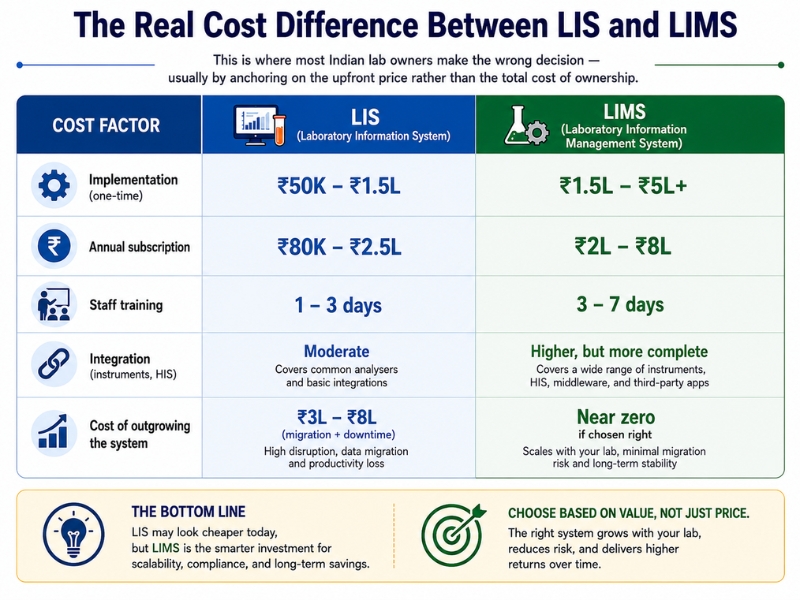
The Real Cost Difference Between LIS and LIMS:
This is where most Indian lab owners make the wrong decision — usually by anchoring on the upfront price rather than the total cost of ownership.
| Cost Factor | LIS | LIMS |
| Implementation (one-time) | ₹50K–₹1.5L | ₹1.5L–₹5L+ |
| Annual subscription | ₹80K–₹2.5L | ₹2L–₹8L |
| Staff training | 1–3 days | 3–7 days |
| Integration (instruments, HIS) | Moderate | Higher, but more complete |
| Cost of outgrowing the system | ₹3L–₹8L (migration + downtime) | Near zero if chosen right |
The last row is the one that matters. Labs that buy an LIS and outgrow it within 18 months typically spend 30–50% more total, factoring in migration costs, data conversion, re-training, and the operational disruption of switching mid-growth. Conversely, a 100-test/day standalone lab that buys a full LIMS is paying for 60% of functionality it will never use.
Hybrid Platforms (and Why ClinikPe Is Both):
The smartest buying decision in 2026 is a platform that starts as a lab LIS system and grows into a LIMS as your operations scale — without forcing you to migrate, retrain, or re-negotiate contracts.
ClinikPe is designed exactly for this. For a single-location diagnostic lab, it behaves like LIS software — fast setup, clean patient workflows, instant digital reports, and billing integration. As your lab grows, you activate LIMS-grade capabilities: multi-branch dashboards, reagent inventory, QC management, NABL audit trails, and role-based compliance controls.
This hybrid architecture means:-
- No forced migration at scale
- No overspending at launch
- One vendor relationship through your entire growth curve
- Indian regulatory compliance built in (ABDM, HL7, NABL-ready)
For most Indian diagnostic labs in 2026, a hybrid platform like ClinikPe eliminates the LIMS vs LIS dilemma entirely.
The Switching Cost — Can You Upgrade from LIS to LIMS?
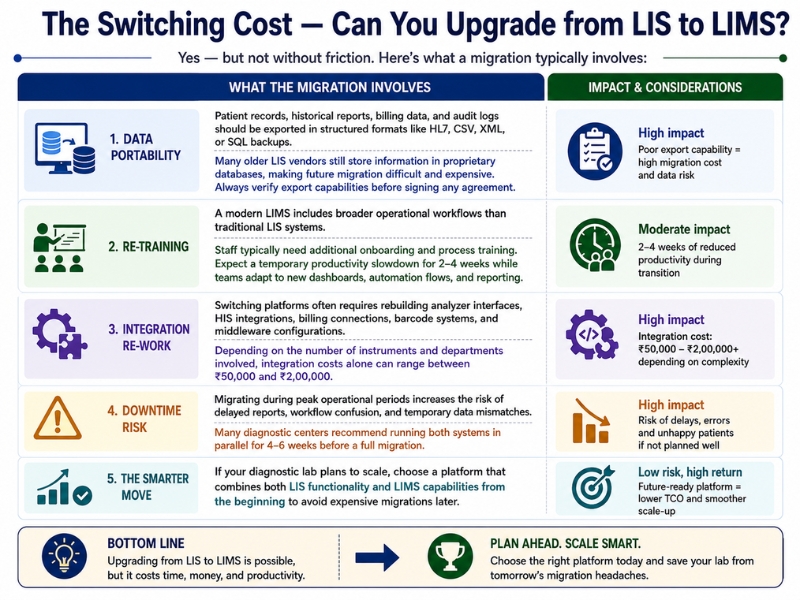
Yes — but not without friction. Here’s what a migration typically involves:
Data portability:
Patient records, historical reports, billing data, and audit logs should be exported in structured formats like HL7, CSV, XML, or SQL backups. Many older LIS vendors still store information in proprietary databases, making future migration difficult and expensive. Always verify export capabilities before signing any agreement.
Re-training:
A modern LIMS includes broader operational workflows than traditional laboratory LIS systems. Staff members typically require additional onboarding and process training. Most labs experience a temporary productivity slowdown for 2–4 weeks while teams adapt to new dashboards, automation flows, and reporting systems.
Integration re-work:
Switching platforms often requires rebuilding analyzer interfaces, HIS integrations, billing connections, barcode systems, and middleware configurations. Depending on the number of instruments and departments involved, integration costs alone can range between ₹50,000 and ₹2,00,000.
Downtime risk:
Migrating during peak operational periods increases the risk of delayed reports, workflow confusion, and temporary data mismatches. Many diagnostic centers recommend running both systems in parallel for 4–6 weeks before a full migration.
The smarter move:
If your diagnostic lab plans to scale, choose a platform that combines both LIS functionality and LIMS capabilities from the beginning to avoid expensive migrations later.
Frequently Asked Questions:-
No. An LIS (Laboratory Information System) focuses on clinical patient diagnostics. A LIMS (Laboratory Information Management System) includes all LIS capabilities plus inventory, QC, compliance, multi-site, and research workflows.
For a standalone lab under 300 tests/day with no immediate expansion plans, lab LIS systems are sufficient and more cost-effective. Choose LIMS only if you have 3+ locations, NABL ambitions, or research workflows.
Good LIS software in India ranges from ₹80,000 to ₹2.5 lakh per year, depending on features, number of users, and instrument interfaces. Cloud-based options are usually more affordable for small labs.
Technically, yes, but practically costly. Migration involves data export, reintegration, and staff retraining. A better approach is choosing a hybrid platform that scales from LIS to LIMS without migration.
NABL accreditation requires documented audit trails, equipment calibration records, and QC management — all native LIMS features. Most NABL labs either use a LIMS or spend significant manual effort compensating for what their LIS lacks.
Hospital labs serving multiple departments need multi-entity coordination, varied SLAs, and department-wise billing — requirements that laboratory LIS systems handle only partially. Hospital networks consistently outgrow LIS within 12–24 months of scaling.
LIS implementation typically takes 1–3 weeks. LIMS implementation ranges from 3–8 weeks, depending on branch count, instrument interfaces, and workflow complexity.
ClinikPe is a hybrid platform — it functions as LIS software for single-location labs and activates LIMS capabilities (multi-branch, inventory, QC, compliance) as your operation grows. You pay for what you need today without limiting what you can do tomorrow.
The Bottom Line
The LIMS vs LIS decision comes down to one question: Where will your lab be in 18 months? If the honest answer is “same size, same location, same test menu” — a well-implemented lab LIS system is everything you need. If the answer involves expansion, accreditation, or diversification, you are buying a LIMS — or you are buying an LIS today and a migration headache tomorrow.
The Indian diagnostic market in 2026 is moving fast. Labs that choose infrastructure designed to scale aren’t just saving money — they’re buying optionality.
Ready to see how ClinikPe works as both LIS software and a full LIMS? Book a free 20-minute demo. Our team will map your current lab profile to the right feature tier — no sales pressure, just a clear recommendation.