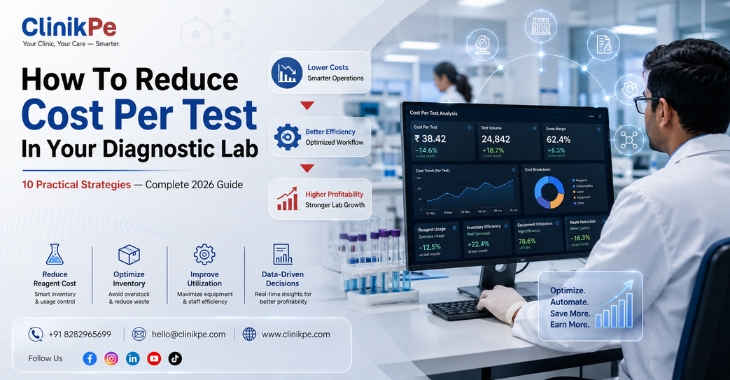
Reducing cost per test directly improves margin without raising prices. Every rupee saved in cost is a rupee added to profit. These 10 strategies address the highest-impact cost drivers in a diagnostic lab.
How to Calculate Your Cost Per Test
Before reducing costs, measure them accurately. Cost per test has two components:
| Cost Type | Components | Typical % |
| Direct variable cost | Reagent + consumable (tube, lancet, swab) per test | 20–28% |
| Overhead allocation | Rent + salary + utilities + software ÷ total tests | 40–55% |
| Total cost per test | Variable + Overhead | 62–83% |
10 Strategies to Reduce Cost Per Test
1. Negotiate Volume-Based Reagent Contracts
Commit to annual purchase volumes with your reagent suppliers in exchange for lower per-unit prices. A 20% volume increase can negotiate 10–15% price reduction. Consolidate to 2–3 suppliers rather than buying from many — concentration gives negotiating leverage.
2. Reduce Reagent Wastage
Track reagent usage vs. test count monthly. If 500 CBC tests consumed 600 runs worth of reagent, 16% is wasted — from calibration waste, QC failures, repeat runs, or improper storage. Systematic QC management and analyser maintenance can cut reagent wastage by 8–12%.
3. Batch Testing Strategically
Biochemistry analysers have dead volume — reagent used for calibration and warming. Running 5 LFT tests costs almost the same in calibration overhead as running 20. Schedule batch runs for common panels such as LFT, KFT, and lipid profiles at fixed times to maximise tests per calibration cycle.
4. Outsource Esoteric Tests
Tests with fewer than 5–10 requests per week are rarely cost-effective to run in-house. Outsource hormone panels, genetic tests, rare markers, and culture panels to reference labs. Negotiate a margin above the reference lab rate. Your lab can offer a broader test menu without carrying the overhead of low-volume esoteric reagents.
5. Invest in Automation — It Pays Back
A fully automated biochemistry analyser costs 30–40% more than a semi-auto but processes 4–5x more tests per staff hour. At 100+ tests per day, the staff time saving alone can often justify the investment within 12–18 months.
Automation also reduces transcription errors — and every error that requires a repeat test has a direct reagent cost.
6. Optimise Staff-to-Test Ratio
Track tests processed per staff hour in each department. If your biochemistry technician is processing 40 tests per day when capacity is 120, you may be overstaffed for your current volume — or the technician may be spending time on manual reporting that automation could eliminate.
7. Prevent Repeat Tests from Errors
Every repeat test caused by a haemolysed sample, mislabelled tube, or instrument error costs reagent without generating revenue. Track your repeat rate monthly. A repeat rate above 3% can be a warning sign. Investigate collection technique, tube quality, analyser performance, or maintenance procedures.
8. Control Inventory — Prevent Expiry Waste
Reagents that expire unused are pure loss. Use FEFO (First Expired, First Out) storage and set minimum reorder levels based on actual consumption rates. Lab management system with inventory tracking can alert you when stock is approaching expiry, helping prevent expensive last-minute disposals.
9. Reduce Energy Costs
Energy represents around 3–5% of costs but is often overlooked. Practical ways to reduce energy expenses include:
- Use LED lighting throughout the lab
- Service AC units regularly, as dirty filters can increase power consumption
- Turn off analysers that are not in use after the evening batch
- Use a power stabiliser to help protect equipment from voltage fluctuations
10. Increase Volume — The Best Cost Reducer
Fixed overheads such as rent, salaries, and software remain relatively constant regardless of test count. Adding 30 more tests per day without increasing fixed costs directly reduces your cost per test. Every new doctor referral that adds volume can lower your overhead allocation per test. Growing volume is therefore both a revenue strategy and a cost strategy.
See Your Cost Per Test — Revenue Intelligence in ClinikPe
Track revenue by test type, by day, and by doctor. Know which tests drive margin and which may be underpriced relative to your actual cost.
See Revenue Feature →
Frequently Asked Questions
Staff salaries, typically 25–30% of revenue, and reagents, typically 20–28%, together represent 45–58% of total costs. Reducing reagent wastage and improving staff productivity through automation can help target the two largest cost buckets simultaneously. Rent can also be a significant expense but is generally less controllable once a lease has been signed.
A reagent rental model, where an analyser is provided with a commitment to purchase a minimum reagent volume, can reduce upfront capital costs but may lock you into one supplier at potentially higher per-unit reagent rates. It can be suitable for new labs with limited capital.
As test volume grows, outright equipment ownership and competitive reagent purchasing may become more cost-effective. Evaluate the total cost over three years before committing.
Reduce Costs. Protect Your Margin. Grow Smarter with ClinikPe.
Track revenue, test performance, and operational data to identify where your lab can improve efficiency and control costs.